The United States is stitched together by a vast network of infrastructure, but few structures capture the American imagination quite like its bridges. These are not merely transit points; they are triumphs of engineering, symbols of regional identity, and enduring testaments to human ambition. From the fog-shrouded gates of the Pacific to the historic spans of the East Coast, the bridges on this list represent the pinnacle of design and utility.
In compiling this ranking, we looked beyond simple statistics like length or height. We analyzed cultural resonance, architectural innovation, and the sheer “awe factor” that draws millions of visitors annually. The data in this article is compiled and analyzed based on information updated as of December 2025, ensuring that recent developments—such as the completion of safety enhancements on the Golden Gate and major preservation projects on the Brooklyn Bridge—are reflected in our narrative.
While the American landscape is ever-changing—evidenced by the tragic loss of Baltimore’s Francis Scott Key Bridge in 2024—the following ten structures stand firm as the nation’s most definitive engineering icons. This list prioritizes active, standing bridges that you can visit, cross, and marvel at today.
Table of the Top 10 Most Iconic Bridges in the United States
| Rank | Bridge Name | Location | Opening Year | Type | Key Feature |
|---|---|---|---|---|---|
| 1 | Golden Gate Bridge | San Francisco, CA | 1937 | Suspension | International Orange Color |
| 2 | Brooklyn Bridge | New York City, NY | 1883 | Suspension/Cable-stay | Gothic Stone Towers |
| 3 | Mackinac Bridge | Mackinaw City, MI | 1957 | Suspension | 5-Mile Total Length |
| 4 | Seven Mile Bridge | Florida Keys, FL | 1982 (New) | Box Girder | Overseas Highway Jewel |
| 5 | Royal Gorge Bridge | Cañon City, CO | 1929 | Suspension | America’s Highest Bridge |
| 6 | Bixby Creek Bridge | Big Sur, CA | 1932 | Open-spandrel Arch | Pacific Coast Highway Icon |
| 7 | Chesapeake Bay Bridge-Tunnel | Virginia Beach, VA | 1964 | Bridge-Tunnel | Man-made Islands |
| 8 | Sunshine Skyway Bridge | Tampa Bay, FL | 1987 | Cable-stayed | Golden Sails Design |
| 9 | Mike O’Callaghan-Pat Tillman Memorial | NV/AZ Border | 2010 | Concrete Arch | Hoover Dam Bypass |
| 10 | New River Gorge Bridge | Fayetteville, WV | 1977 | Steel Arch | Home of “Bridge Day” |
Top 10. New River Gorge Bridge
Spanning the rugged, ancient landscape of West Virginia, the New River Gorge Bridge is a masterpiece of steel that turned a treacherous 40-minute drive down narrow mountain roads into a breezy less-than-a-minute crossing. When it opened in 1977, it instantly became the world’s longest single-span arch bridge, a title it held for decades. Its massive Corten steel structure blends naturally with the surrounding Appalachian forest, as the unpainted metal weathers into a rust-colored patina that practically camouflages it against the autumn leaves.
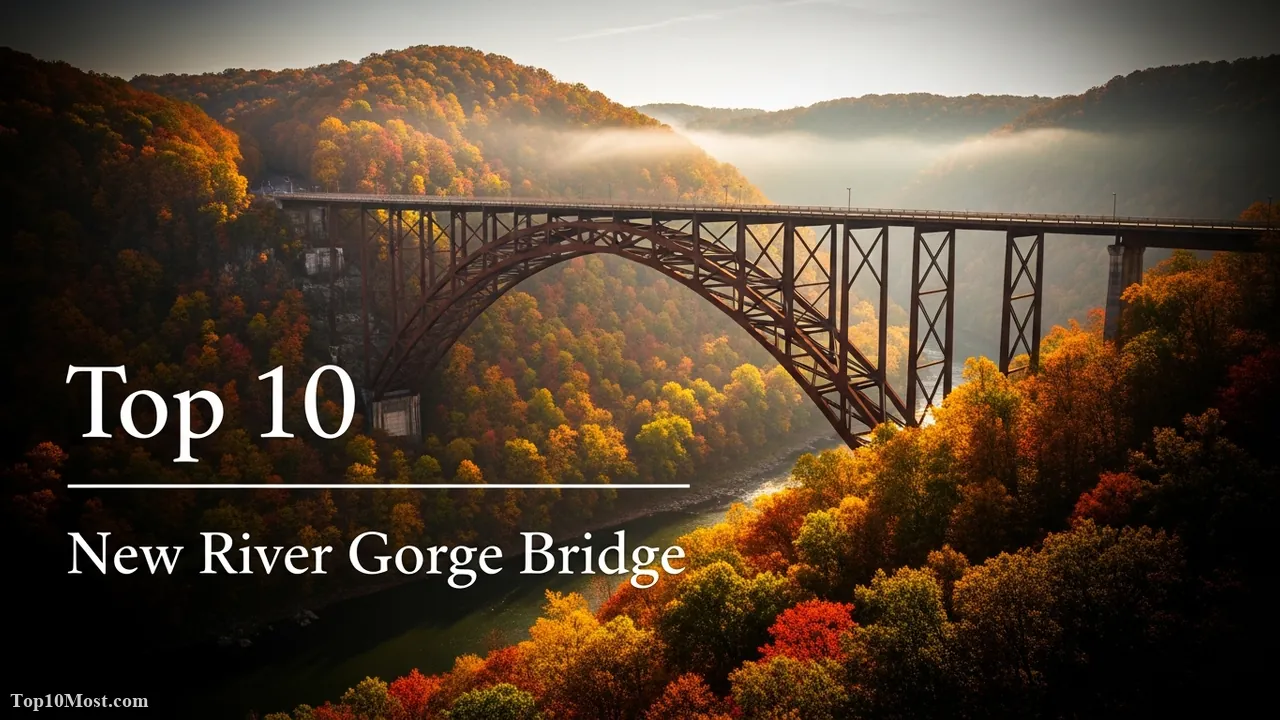
The ranking of this bridge is secured by its unique cultural footprint, specifically the annual “Bridge Day” festival. It is the only day of the year when the bridge is closed to traffic and opened to pedestrians, and famously, to thrill-seekers. It remains one of the few places in the world where BASE jumping is legal for a few distinct hours, turning the quiet gorge into an amphitheater of adrenaline. This rare interaction between the public and the infrastructure elevates it from a simple roadway to a destination event.
Walking the catwalk beneath the bridge—a tour available year-round—offers a perspective that feels both terrifying and serene. You are suspended over 800 feet above the New River, one of the oldest rivers on the continent. It’s a visceral reminder of the scale of American engineering; standing there, hearing the wind whip through the steel lattice, you realize this isn’t just a bridge, it’s a portal through the sky.
Key Highlights
- Height: The deck sits 876 feet above the river, making it one of the highest vehicular bridges in the Americas.
- Material: Constructed from COR-TEN steel, which never needs painting.
- Event: “Bridge Day” (3rd Saturday in October) attracts nearly 100,000 spectators annually.
Top 9. Mike O’Callaghan-Pat Tillman Memorial Bridge
For decades, the only way to cross the Colorado River near Las Vegas was to drive directly over the Hoover Dam, a route plagued by hairpin turns and security bottlenecks. The solution was this breathtaking concrete arch bridge, opened in 2010, which soars 900 feet above the river. Named after a former governor and an NFL player-turned-soldier, the bridge is the highest concrete arch bridge in the Western Hemisphere and arguably offers the most spectacular view of the Hoover Dam itself.
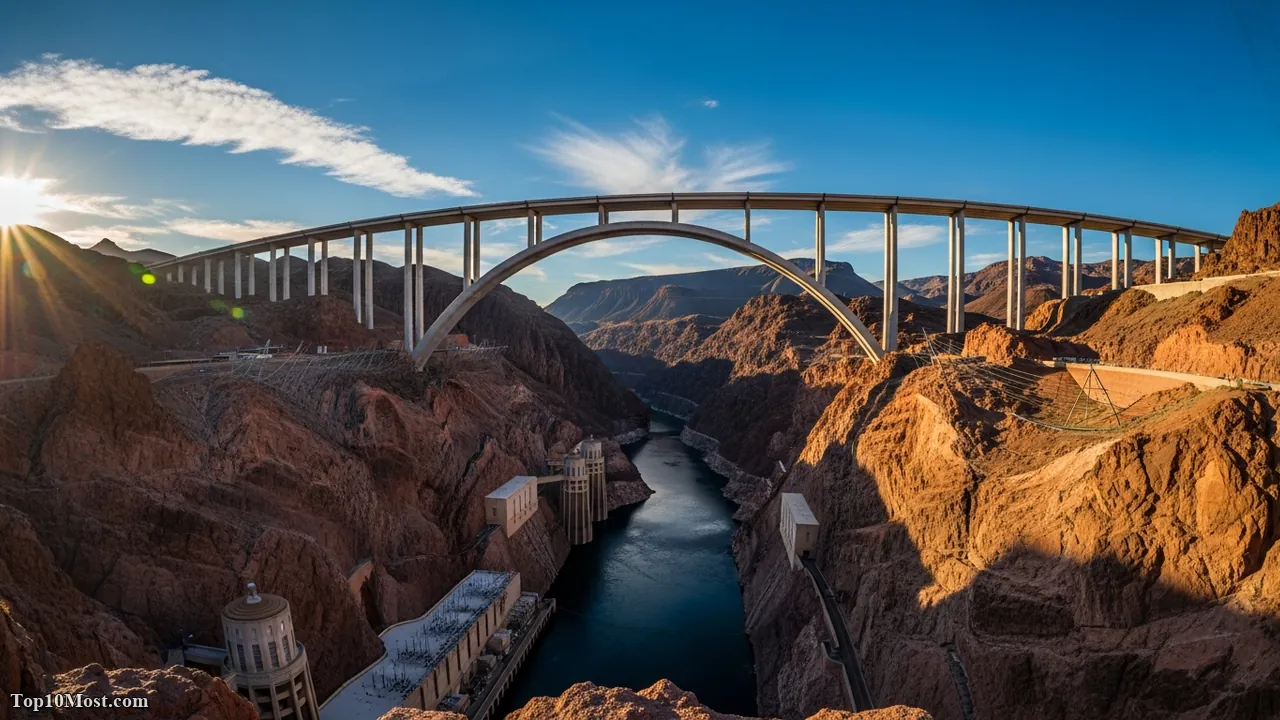
We rank this bridge highly because it is a modern triumph of function and form. It solved a critical logistical problem while respecting the historic weight of its neighbor, the Hoover Dam. The engineering required to suspend the massive concrete arch segments over the deep Black Canyon gorge was a feat comparable to the dam’s construction in the 1930s. It stands as a dialogue between two eras of American “super-building”—the Art Deco concrete of the dam and the sleek, high-strength composite of the 21st century.
Walking the pedestrian path here is an otherworldly experience. You are separated from the highway traffic by a concrete barrier, leaving you alone with the wind and the view. Looking down at the dam, which looks like a white wedge pressed between the canyon walls, you feel the immense verticality of the landscape. It is one of the few places where you can look down on a major dam and feel small.
Key Highlights
- Elevation: The roadway sits 890 feet above the Colorado River.
- Structure: It is the first concrete-steel composite arch bridge built in the United States.
- Viewpoint: Provides the only comprehensive aerial view of the Hoover Dam face accessible to pedestrians.
Top 8. Sunshine Skyway Bridge
Rising like a pair of golden sails from the waters of Tampa Bay, the Bob Graham Sunshine Skyway Bridge is the premier example of cable-stayed elegance in the United States. Completed in 1987 to replace a tragic predecessor, this bridge was designed to be safer, higher, and more beautiful. Its yellow cables fan out from two central pylons, creating a distinct silhouette that has become the visual logo for the entire Tampa Bay region.
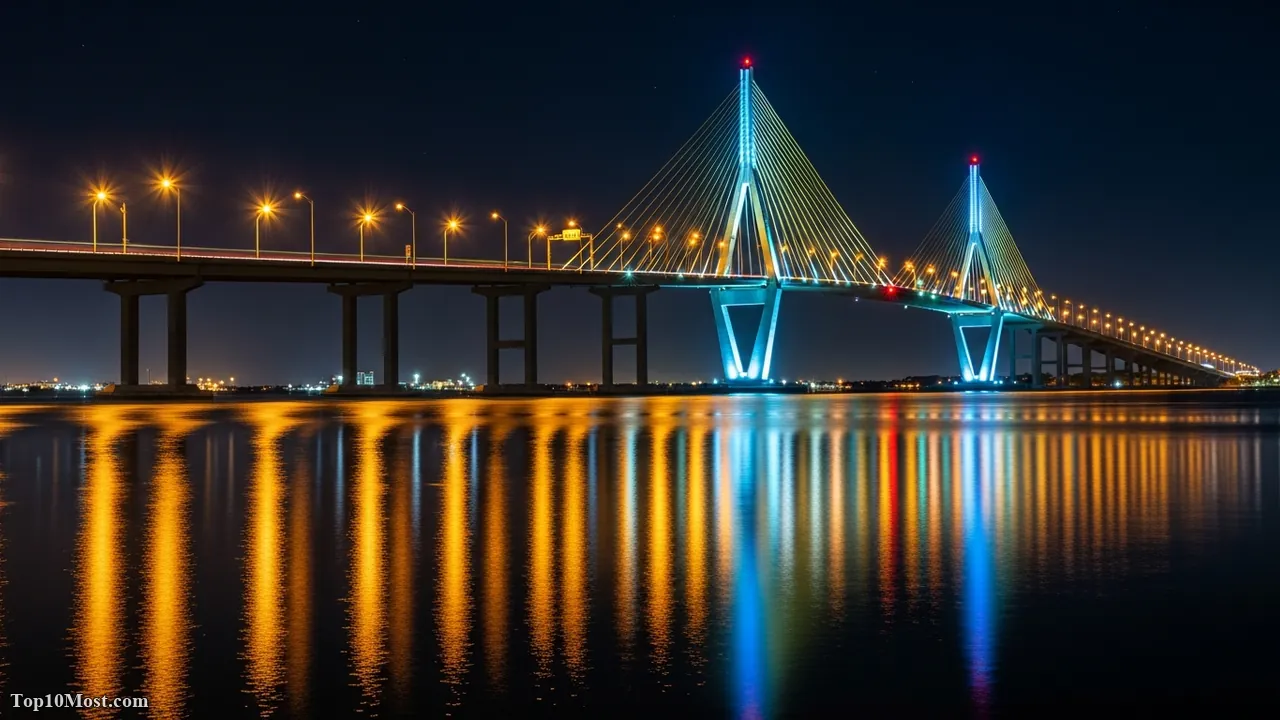
Its placement on this list is due to its aesthetic revolution; it proved that highway bridges could be sculptural art. The experience of driving across it is akin to flying; the road curves gently, and at the summit, you are surrounded only by the yellow cables and the open Gulf sky. Recently, the installation of a $15 million LED lighting system has transformed the bridge into a nightly light show, cementing its status as a 24-hour icon.
There is a profound sense of redemption in this structure. Built after a freighter collapse destroyed the old span in 1980, the new Skyway represents resilience. When you drive over the apex, looking out toward the Gulf of Mexico, the memory of the tragedy is replaced by the sheer optimism of the design—bright, strong, and unmissable.
Key Highlights
- Design: The first major concrete cable-stayed bridge in the U.S., featuring 21 steel cables.
- Length: The total bridge length is 4.1 miles, with a main span of 1,200 feet.
- Recent Upgrade: A programmable LED lighting system now illuminates the columns and cables nightly.
Top 7. Chesapeake Bay Bridge-Tunnel
The Chesapeake Bay Bridge-Tunnel (CBBT) is not just a bridge; it is a logic-defying infrastructure complex. Spanning nearly 18 miles across the mouth of the Chesapeake Bay, it connects mainland Virginia to the Eastern Shore. It was named one of the “Seven Engineering Wonders of the Modern World” when it opened in 1964 because it does the impossible: it dips underwater into mile-long tunnels to allow Navy ships to pass, then re-emerges onto man-made islands to continue as a bridge.
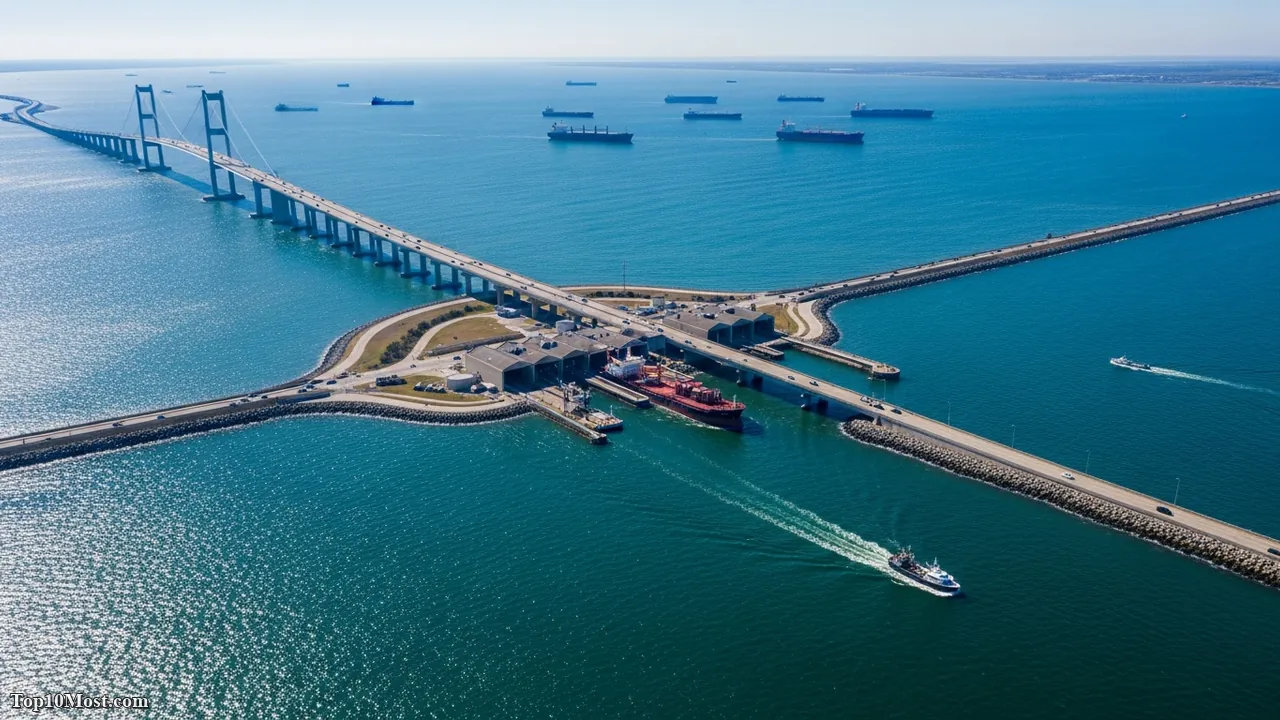
This structure earns its rank for sheer audacity and engineering endurance. It effectively turned a remote ferry crossing into a major oceanic highway. The transition from driving 30 feet above the Atlantic Ocean to 90 feet below it is a surreal experience that few other roadways on Earth can offer. It is a lifeline that battles nor’easters and hurricanes, standing as a gritty testament to survival against the elements.
Driving the CBBT feels like a voyage at sea. There are moments when you cannot see land in either direction, just the endless rhythm of concrete trestles and the gray-blue water. Stopping at the scenic overlook on one of the artificial islands lets you watch massive container ships glide directly over the tunnel you just drove through—a humbling reminder of the complex layers of modern logistics.
Key Highlights
- Structure: Consists of 12 miles of trestle, two 1-mile tunnels, four artificial islands, and two high-level bridges.
- Traffic: It has saved motorists over 95 miles of driving compared to the inland route.
- Status: A parallel tunnel project is currently underway to expand capacity, expected to complete by 2027.
Top 6. Bixby Creek Bridge
Perched on the jagged cliffs of California’s Big Sur coast, Bixby Creek Bridge is one of the most photographed bridges in the world, despite being a relatively short span on a two-lane rural highway. Completed in 1932, its concrete open-spandrel arch design was chosen for its ability to withstand the harsh marine environment and its aesthetic harmony with the canyon walls. It is the gateway to the sublime, marking the transition into the wildest stretches of the Pacific Coast Highway.
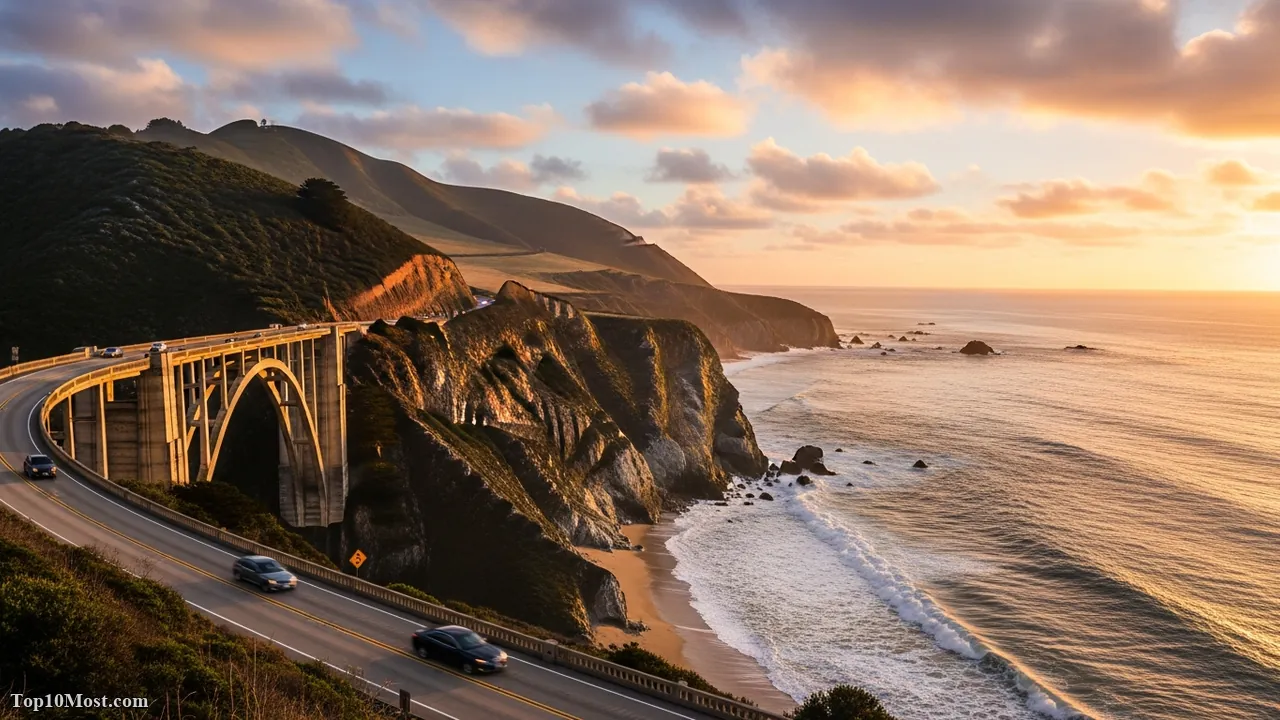
The bridge ranks here because it perfectly illustrates the concept of “architecture in nature.” It doesn’t dominate the landscape; it complements it. The bridge allows travelers to float over a canyon that was once impassable, opening up one of America’s most scenic drives. Its appearances in countless car commercials and TV shows (like Big Little Lies) have made it a pop-culture shorthand for “freedom” and “luxury.”
Standing at the north turnout at sunset is a spiritual experience for many travelers. The fog rolls in from the Pacific, hitting the concrete arch while the ocean crashes hundreds of feet below. It feels ancient, as if the bridge grew out of the rock itself. It serves as a reminder that the best infrastructure respects the ground it stands on.
Key Highlights
- Height: Soars 260 feet above the canyon floor.
- Construction: Built for just over $200,000 in 1932 using a massive timber falsework.
- Fame: The “Insta-famous” icon of the Pacific Coast Highway (Highway 1).
Top 5. Royal Gorge Bridge
For nearly 75 years, the Royal Gorge Bridge in Colorado held the title of the highest bridge in the world. Suspended 956 feet above the Arkansas River, it is a structure built not for transportation, but for the sheer thrill of existence. Constructed in 1929 as a tourist attraction, its wooden deck creates a distinct rumble under tires and feet, adding a visceral auditory layer to the vertigo-inducing visual.
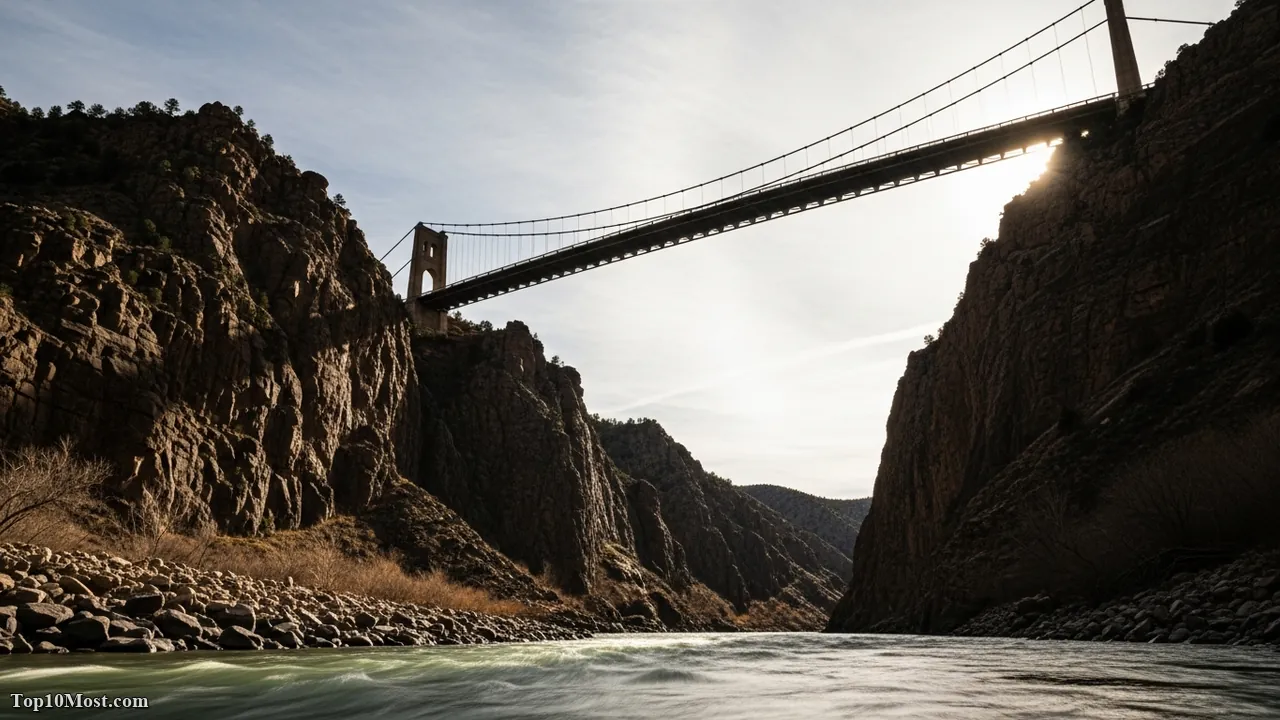
We rank it in the top 5 because it represents the American era of “roadside attraction” grandeur. It is a destination in itself, requiring a detour to experience. Unlike highway bridges designed for efficiency, this bridge was designed to terrify and delight. It survived a devastating wildfire in 2013 that destroyed most of the surrounding park, a testament to its steel resilience.
Walking across the Royal Gorge is a test of nerve. The wind through the gorge can be fierce, and through the cracks in the wooden planks, you can catch glimpses of the river nearly a thousand feet down. It is a place that forces you to be present; you cannot cross this bridge absent-mindedly. It captures the adventurous spirit of the American West perfectly.
Key Highlights
- Record: Was the world’s highest bridge from 1929 until 2001; still the highest in the U.S.
- Deck: Features 1,292 wooden planks that are regularly replaced.
- Context: Located within a park that features a gondola and zip line across the gorge.
Top 4. Seven Mile Bridge
The Seven Mile Bridge is the crown jewel of the Overseas Highway, a ribbon of concrete connecting the Florida Keys. The modern bridge, completed in 1982, runs parallel to the historic “Old Seven,” a relic of Henry Flagler’s railroad that was destroyed by the Labor Day Hurricane of 1935. This duality—the sleek new highway next to the crumbling historic ruins—creates a unique visual narrative of man versus nature.
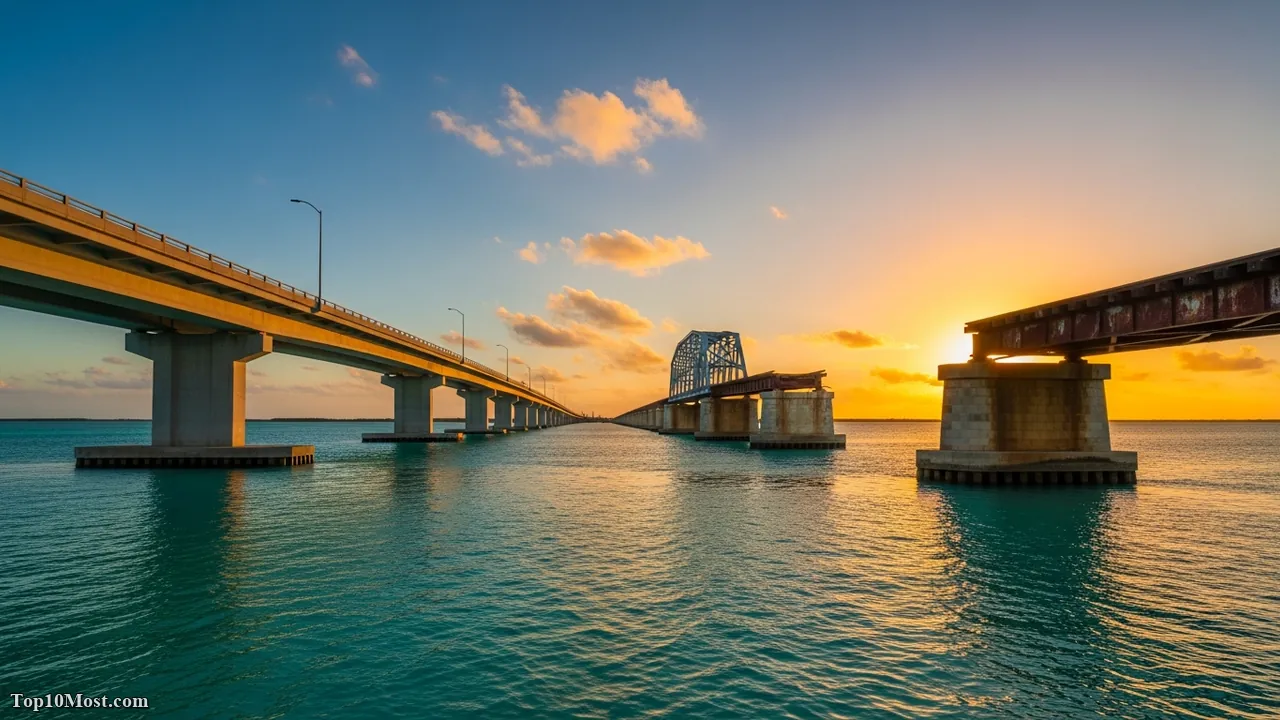
This bridge is iconic because it fundamentally changed the geography of Florida, turning a chain of isolated islands into a cohesive community. The experience of driving it is aquatic; for minutes at a time, you are surrounded entirely by turquoise water, with no land in sight. It is less of a bridge crossing and more of a low-altitude flight over the ocean.
The “Old Seven” bridge, now partially a pedestrian recreation trail, offers a poignant reflection. Walking on the old span, you see the rusted rails and the gaps where the ocean has reclaimed the structure. It contrasts sharply with the smooth efficiency of the modern box-girder bridge beside it. It’s a beautiful, sun-drenched reminder that while we can bridge the ocean, the ocean always watches and waits.
Key Highlights
- Location: Connects Knight’s Key (Middle Keys) to Little Duck Key (Lower Keys).
- Cinema: Famous for the explosion scene in the movie True Lies.
- Structure: A precast concrete box-girder design built to withstand hurricane forces.
Top 3. Mackinac Bridge
Known affectionately as “Big Mac,” the Mackinac Bridge is the colossal suspension bridge connecting Michigan’s Upper and Lower Peninsulas. With a total length of five miles, it is a monster of engineering that defies the brutal winter ice and winds of the Great Lakes. Since opening in 1957, it has served as the vital link that unified the state of Michigan, replacing slow and unreliable ferries.
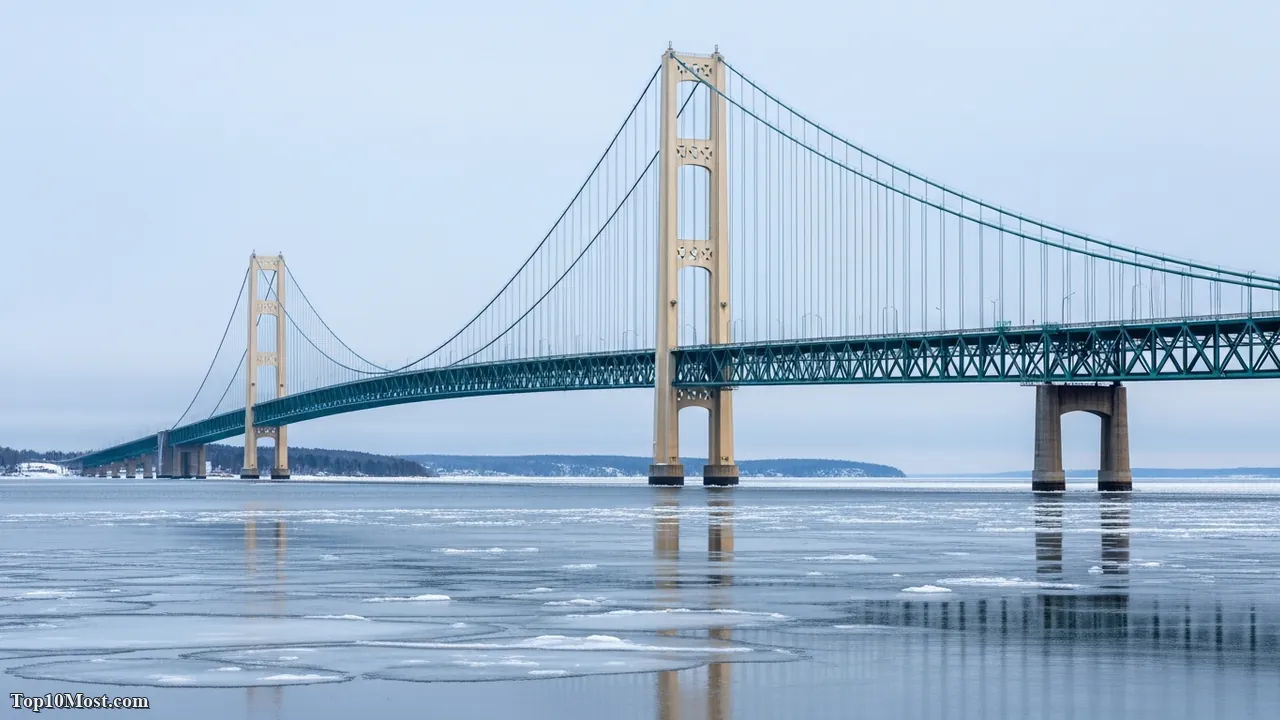
It earns the #3 spot for its sheer scale and engineering dominance. While the Golden Gate gets the movie roles, the Mackinac is actually longer (anchorage to anchorage). It is a working-class hero of a bridge—stoic, massive, and essential. The bridge is so long that it has its own microclimate; it can be sunny on one end and snowing on the other.
Every Labor Day, the bridge closes to cars for the “Mackinac Bridge Walk,” where tens of thousands of people cross on foot. It’s a tradition that highlights the bridge’s role as a community connector. Driving over the open steel grating in the center lanes is a memorable sensory experience; the hum of the tires and the view of the churning water 200 feet straight down through the road surface is enough to make any driver grip the wheel a little tighter.
Key Highlights
- Ranking: The longest suspension bridge between anchorages in the Western Hemisphere.
- Engineering: Designed to withstand wind speeds of up to 150 mph.
- Maintenance: Ongoing 2024-2025 projects include major paving and joint replacements to ensure longevity.
Top 2. Brooklyn Bridge
The Brooklyn Bridge is the grandmother of modern suspension bridges. When it opened in 1883, it was the longest suspension bridge in the world and the first to use steel wire cables. Its neo-Gothic granite towers and intricate web of diagonal stay cables make it one of the most recognizable structures on the planet. It connected the then-independent cities of New York and Brooklyn, spurring the consolidation that created modern New York City.
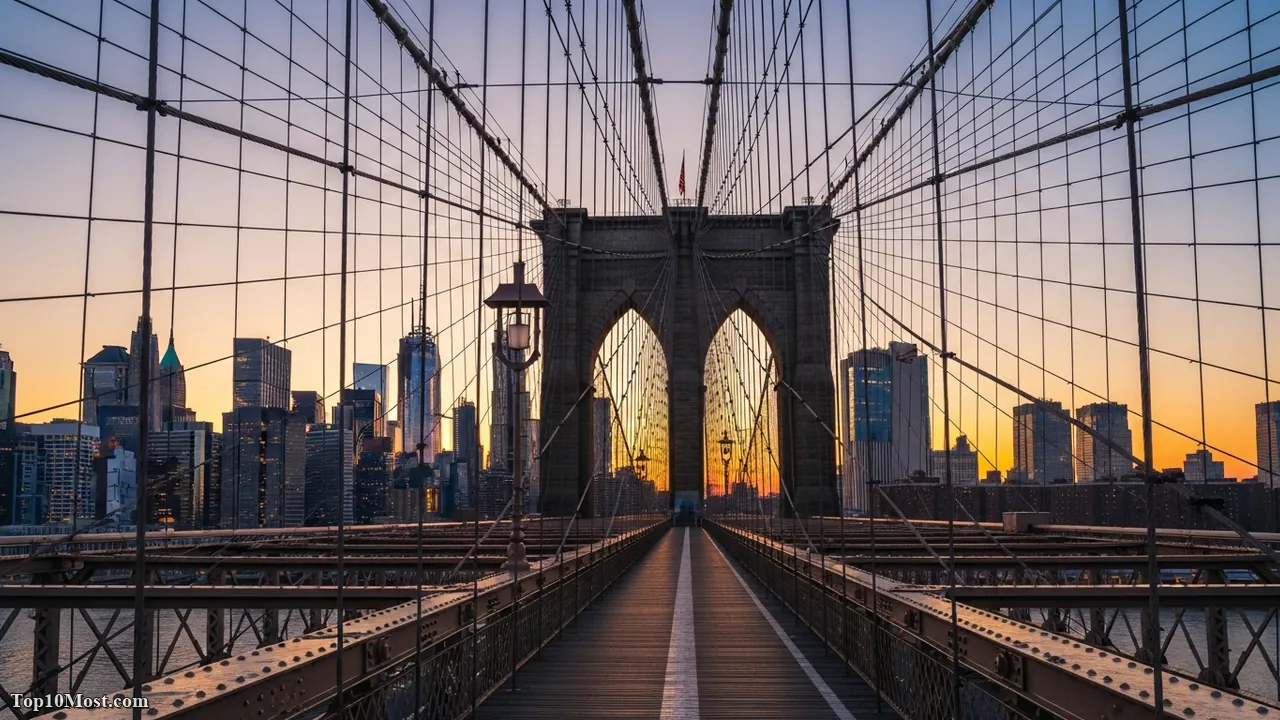
We place it at #2 because it is more than a bridge; it is a historic monument that is still a vital artery of a global metropolis. It has evolved with the times—most recently in 2021, when a car lane was converted into a protected two-way bike path, and in late 2024, with new safety improvements for pedestrian access. It refuses to become a museum piece; it remains a living, breathing part of the city.
Walking the wooden promenade of the Brooklyn Bridge is a rite of passage. Above you, the stone arches frame the Manhattan skyline; below you, the East River ferries cut through the water. It is a chaotic, crowded, beautiful mess of tourists, commuters, and cyclists. Touching the cold limestone of the towers connects you to the 19th-century laborers who built it by hand, creating a tangible link to the past in a city that is always rushing toward the future.
Key Highlights
- History: Designated a National Historic Landmark; completed in 1883.
- Recent Update: Features a dedicated, protected bike lane (installed 2021) separate from pedestrians.
- Traffic: Carries over 100,000 vehicles and 30,000 pedestrians daily.
Top 1. Golden Gate Bridge
The Golden Gate Bridge is not just the most iconic bridge in the United States; it is arguably the most beautiful span of steel in the world. Opening in 1937, its “International Orange” color was originally a primer, but the architect Irving Morrow successfully argued that it complemented the natural hills and contrasted visibly with the fog. It spans the strait where the San Francisco Bay meets the Pacific Ocean, serving as a welcoming gate to the West.
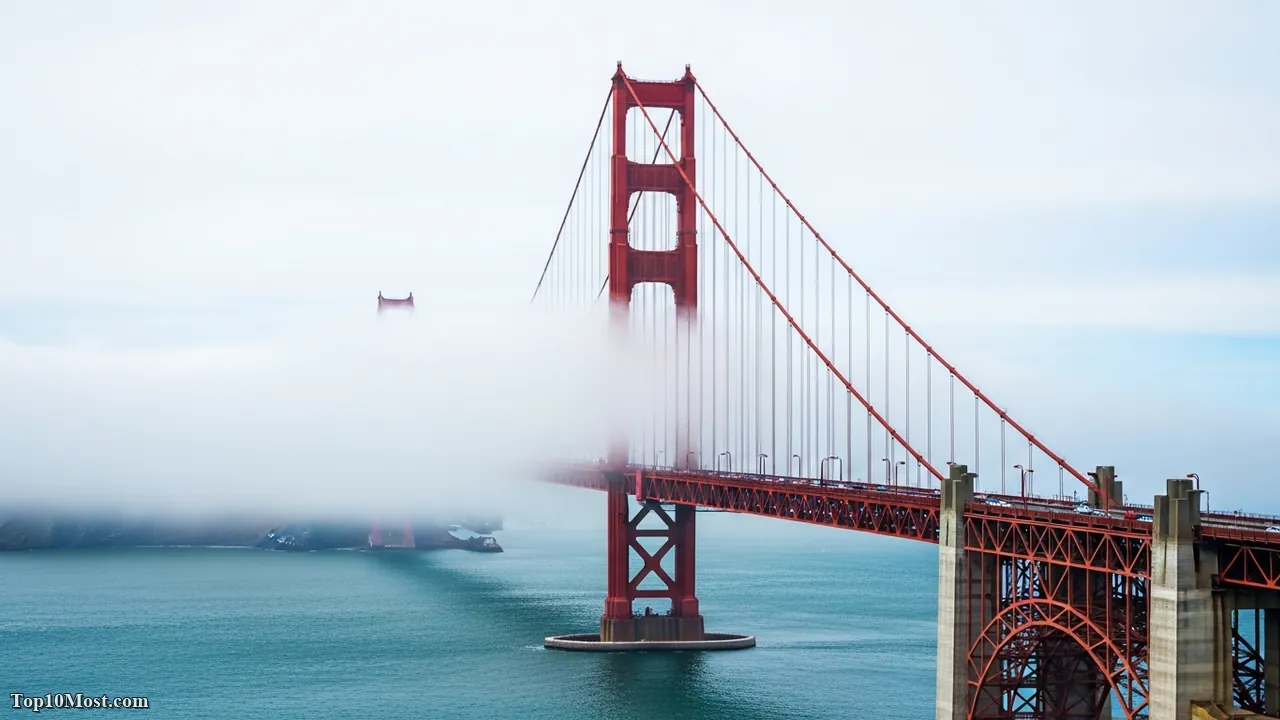
It holds the #1 spot because it is the perfect synthesis of engineering daring and artistic beauty. It has withstood earthquakes, relentless salt spray, and the shifting tides of history. In January 2024, the bridge completed a massive, years-long project to install a suicide deterrent net system, a profound update that adds a layer of humanity and care to its majestic structure, ensuring it remains a symbol of hope rather than tragedy.
Seeing the Golden Gate for the first time is one of those rare moments where reality exceeds the hype. Whether the towers are piercing through the famous fog (“Karl the Fog”) or glowing against a clear blue sky, the scale is humbling. Walking the span, you feel the bridge live—it vibrates and sways with the wind and traffic. It is the enduring face of American infrastructure, a bold declaration that we can build things that are both useful and transcendent.
Key Highlights
- Color: Painted “International Orange” to enhance visibility in fog and harmonize with the landscape.
- Safety 2024: A physical suicide deterrent net was fully completed in Jan 2024, reducing tragedy significantly.
- Status: Declared one of the Wonders of the Modern World by the American Society of Civil Engineers.
Conclusion
These ten bridges are more than just steel and concrete connections; they are the architectural heartbeat of the United States. From the historic masonry of the Brooklyn Bridge to the modern safety innovations of the Golden Gate, each structure tells a story of its time, its challenges, and its people. As we move through the mid-2020s, these icons continue to evolve—through new lighting, preservation efforts, and changing uses—proving that great infrastructure is never truly “finished,” but is always adapting to serve the future. Visiting them offers a chance to stand suspended between earth and sky, witnessing the raw power of human ingenuity.