The Earth breathes, and nowhere is this more evident than in the towering presence of its volcanoes. These geological giants are not merely mountains; they are the planet’s pressure valves, creators of land, and destroyers of civilizations. At Top 10 Most, we have analyzed these formations not just by their height or eruption frequency, but by their total “impressiveness”—a metric that combines raw power, beauty, cultural reverence, and scientific significance.
The data in this article is compiled and analyzed based on information updated as of late 2025. We have taken into account recent eruptive cycles, such as the reawakening of Mauna Loa and the ceaseless activity of Mount Etna, to ensure this ranking reflects the current geological reality. Our perspective is that a volcano’s true impact lies in its ability to command respect, fear, and awe in equal measure.
From the icy summits of the Andes to the fire-spitting vents of the Pacific Ring of Fire, this list represents the pinnacle of volcanic grandeur. We have verified elevation data, recent activity logs, and historical records to present a definitive guide to the world’s most spectacular natural furnaces.
Table of the Top 10 Most Impressive Volcanoes
| Rank | Volcano Name | Location | Elevation (m / ft) | Primary Characteristic |
|---|---|---|---|---|
| 1 | Mauna Loa | Hawaii, USA | 4,169 m / 13,679 ft | World’s largest active volcano |
| 2 | Mount Fuji | Honshu, Japan | 3,776 m / 12,388 ft | Perfect symmetry & cultural icon |
| 3 | Mount Etna | Sicily, Italy | 3,357 m / 11,014 ft | Europe’s most active volcano |
| 4 | Kilauea | Hawaii, USA | 1,247 m / 4,091 ft | Most active & accessible lava flows |
| 5 | Mount Vesuvius | Campania, Italy | 1,281 m / 4,203 ft | Historical destroyer of Pompeii |
| 6 | Krakatoa (Anak Krakatau) | Sunda Strait, Indonesia | 157 m / 515 ft | Violent history & growing island |
| 7 | Mount Kilimanjaro | Kilimanjaro Region, Tanzania | 5,895 m / 19,341 ft | World’s highest free-standing mountain |
| 8 | Mount Bromo | East Java, Indonesia | 2,329 m / 7,641 ft | Otherworldly “Sea of Sand” landscape |
| 9 | Mount Rainier | Washington, USA | 4,392 m / 14,411 ft | Most glaciated peak in contiguous US |
| 10 | Cotopaxi | Latacunga, Ecuador | 5,897 m / 19,347 ft | Ideally conical active stratovolcano |
Top 10. Cotopaxi
Rising from the Ecuadorian highlands, Cotopaxi is often cited as one of the most beautiful volcanoes in the world due to its nearly perfectly symmetrical cone. As part of the Pacific Ring of Fire, it dominates the skyline south of Quito. Despite being capped by glaciers, it remains a fiercely active stratovolcano. Its most recent major stirrings in 2022 and 2023 reminded the world that the fire within the ice never truly sleeps, maintaining a delicate balance between a mountaineer’s paradise and a geological threat.
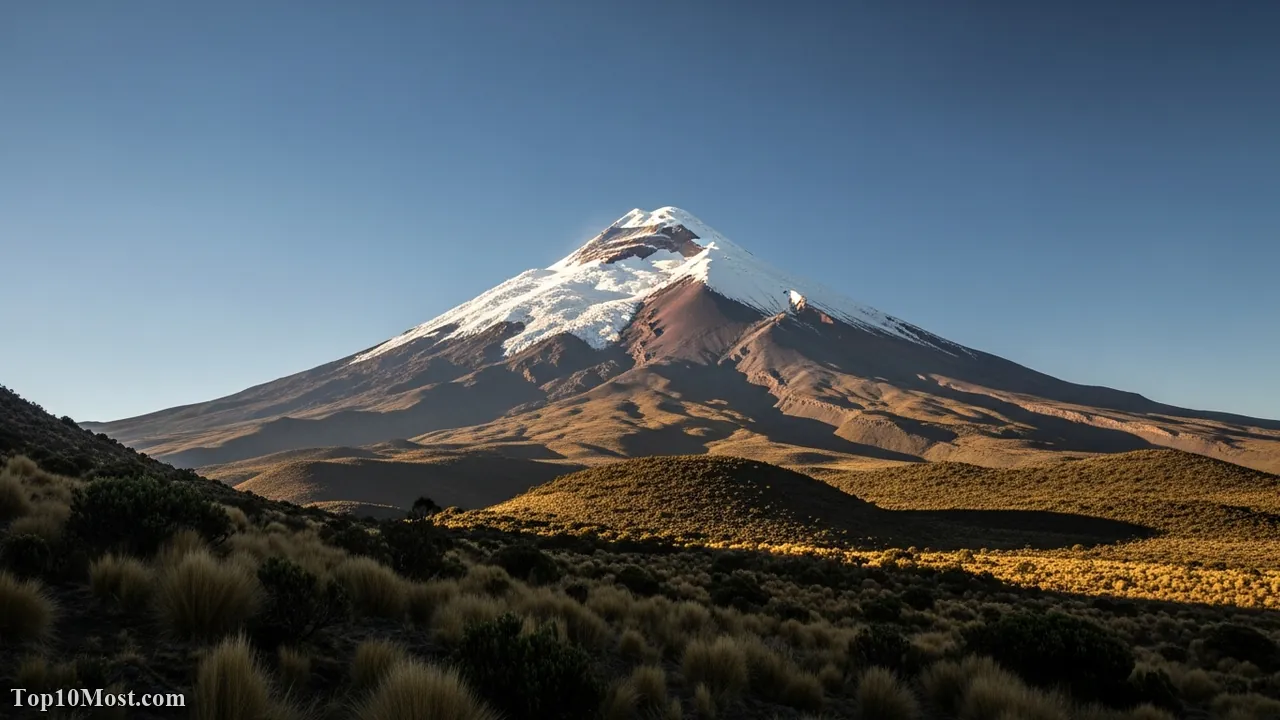
We rank Cotopaxi here because it perfectly embodies the “classic” volcano aesthetic while posing significant technical challenges and hazards. It is one of the highest active volcanoes globally, and its eruptions are particularly dangerous due to the immediate melting of its glacial cap, which can trigger devastating lahars (mudflows) that threaten the valleys below. The juxtaposition of tropical latitude and permanent ice makes it a unique geological marvel.
There is something profoundly humbling about standing at the base of Cotopaxi. The whiteness of its summit against the deep blue Andean sky feels almost artificial, like a painting. It serves as a stark reminder of nature’s indifference to human borders; a sleeping giant that commands reverence not just for its beauty, but for the potential devastation it holds in its frozen grip.
Key Highlights:
- Elevation: 5,897 meters (19,347 ft).
- Location: Approximately 50 km south of Quito, Ecuador.
- Hazard: Known for producing massive lahars that can travel over 100 km.
- Status: Active; significant ash emissions reported as recently as 2023.
Top 9. Mount Rainier
Mount Rainier is not just a mountain; it is the most glaciated peak in the contiguous United States and the menacing backdrop to the Seattle metropolitan area. This massive stratovolcano is an icon of the Pacific Northwest, visible for hundreds of miles on a clear day. However, its beauty masks a volatile reality: Rainier is considered one of the most dangerous volcanoes in the world, not necessarily due to explosive power, but because of the immense volume of ice that sits atop weak, hydrothermally altered rock.
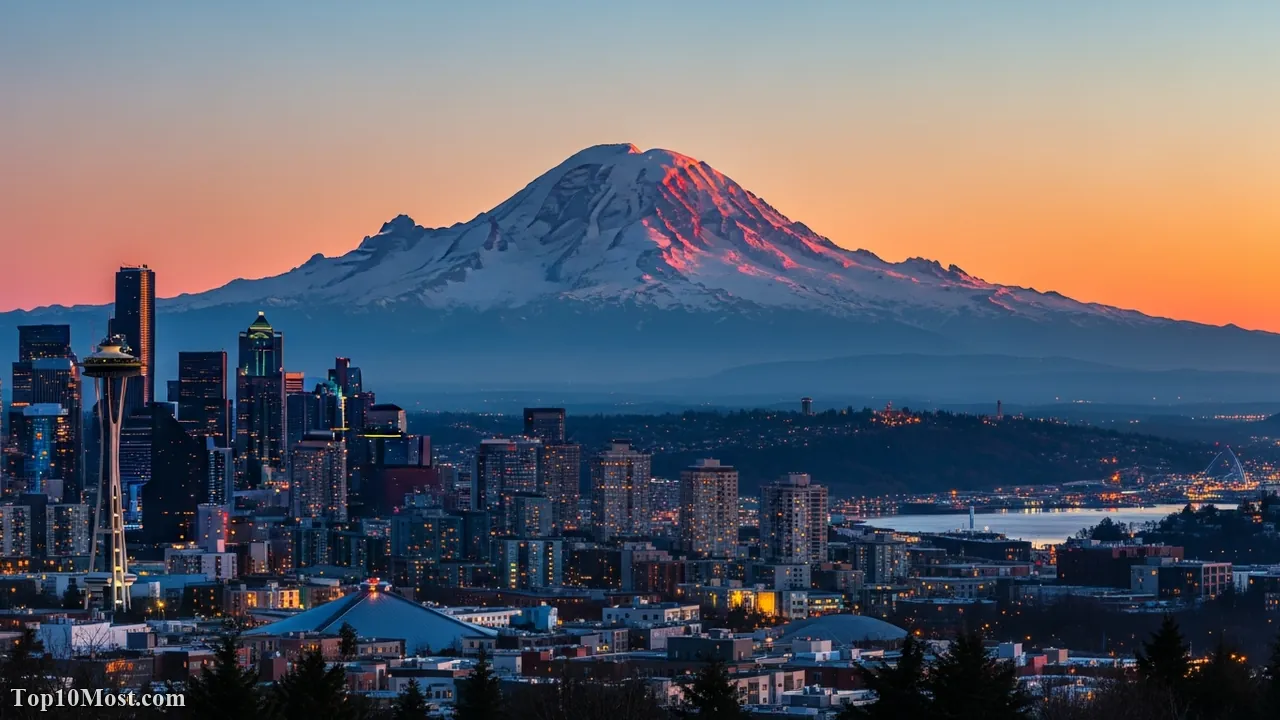
Our analysis places Rainier in the top 10 because of its sheer hydrological dominance. It spawns five major rivers and supports a complex ecosystem of old-growth forests and subalpine meadows. The danger here is the “lahar scenario”—a volcanic mudflow that could bury nearby communities with little warning. This tension between being a beloved recreational playground and a ticking geological time bomb makes it deeply impressive.
Locals simply call it “The Mountain,” a moniker that speaks to its overwhelming psychological presence. When the clouds part and Rainier reveals its full bulk, it doesn’t look like it belongs on Earth. It looks like a fortress in the sky, a silent sentinel that watches over millions of people who live in its shadow, blissfully unaware of the fire in its belly.
Key Highlights:
- Glaciation: Supports 25 major glaciers, the largest concentration in the lower 48 states.
- Risk Factor: Designated a “Decade Volcano” due to its proximity to large populations.
- Age: The current cone is approximately 500,000 years old.
Top 8. Mount Bromo
Located in East Java, Indonesia, Mount Bromo offers a landscape that feels more Martian than terrestrial. It sits inside the massive Tengger Caldera, surrounded by a vast plain of fine volcanic sand known as the “Sea of Sand.” unlike the solitary peaks on this list, Bromo is part of a complex of volcanoes, constantly belching white sulfurous smoke. It is accessible, photogenic, and culturally vital to the Tenggerese people, who celebrate the Yadnya Kasada festival by throwing offerings into its crater.
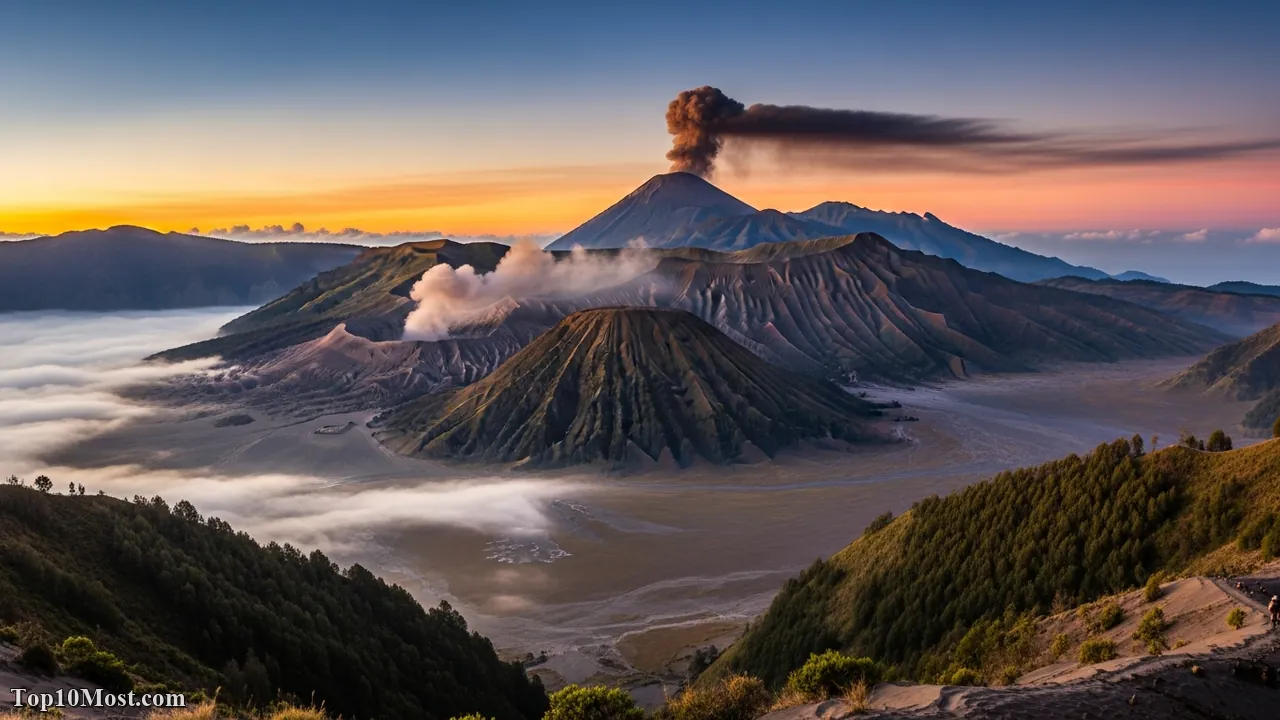
We selected Bromo for its unique atmospheric quality. It isn’t the highest volcano in Indonesia, but the visual impact of its jagged, blown-off top surrounded by mist and sand is unmatched. The experience of watching the sunrise over the caldera, with the towering Mount Semeru smoking in the background, is widely considered one of the most spectacular sights in Southeast Asia. It represents the spiritual connection between humanity and volcanic forces.
Walking across the Sea of Sand to reach the crater stairs feels like a pilgrimage to the end of the world. The roar of the crater as you approach the rim is a visceral sound—a low-frequency rumble that vibrates in your chest. Bromo isn’t just a mountain to look at; it’s a sensory experience that envelopes you in the smell of sulfur and the sound of the earth breathing.
Key Highlights:
- Setting: Located inside the ancient Tengger Sand Sea caldera.
- Culture: Site of the annual Yadnya Kasada festival where offerings are thrown into the crater.
- Accessibility: One of the most accessible active volcano craters in the world.
Top 7. Mount Kilimanjaro
Mount Kilimanjaro is the “Roof of Africa,” a dormant volcano in Tanzania that holds the title of the highest free-standing mountain in the world. Composed of three distinct volcanic cones—Kibo, Mawenzi, and Shira—it is a sky-island of biodiversity. Climbers pass through five distinct ecological zones, from rainforest to alpine desert, before reaching the glacial summit. While currently dormant, its fumaroles still emit gas, hinting that the giant is merely sleeping.
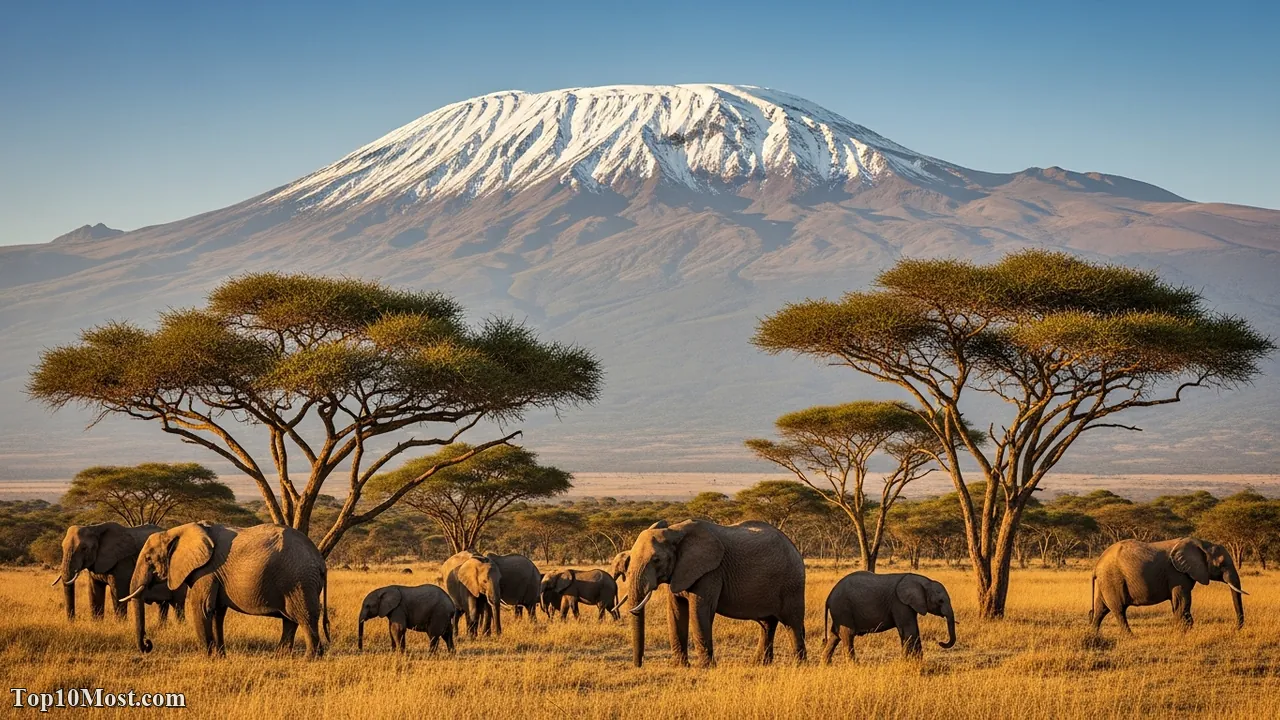
Kilimanjaro earns its place on our list for its singular prominence. Rising 4,900 meters from its base on the plains, it creates its own weather systems. The tragedy and beauty of Kilimanjaro lie in its famous glaciers, which scientists project may disappear entirely within decades due to climate change. This ephemeral nature adds a layer of poignancy to its grandeur; to see Kilimanjaro today is to witness a vanishing world wonder.
There is a unique cognitive dissonance in standing on the equator while crunching through snow. Kilimanjaro represents the ultimate endurance challenge for non-technical climbers. It is a symbol of the continent itself—vast, ancient, and enduring. The view from Uhuru Peak isn’t just a view of Tanzania; it feels like a view of the curvature of the Earth itself.
Key Highlights:
- Structure: A stratovolcano with three cones; Kibo is the highest and dormant.
- Status: Dormant, though gas is emitted from the crater; the last major eruption was 360,000 years ago.
- Ecology: Hosts shrinking ice fields that are scientifically critical climate indicators.
Top 6. Krakatoa (Anak Krakatau)
The name “Krakatoa” is synonymous with catastrophe. The 1883 eruption was one of the deadliest and loudest events in recorded history, shattering eardrums 40 miles away and altering global climate. Today, the “Child of Krakatoa,” or Anak Krakatau, grows in the place of its destroyed parent. Located in the Sunda Strait between Java and Sumatra, this highly active volcano is a living laboratory of geology, constantly building itself up and collapsing, as seen in the deadly 2018 tsunami-triggering collapse.
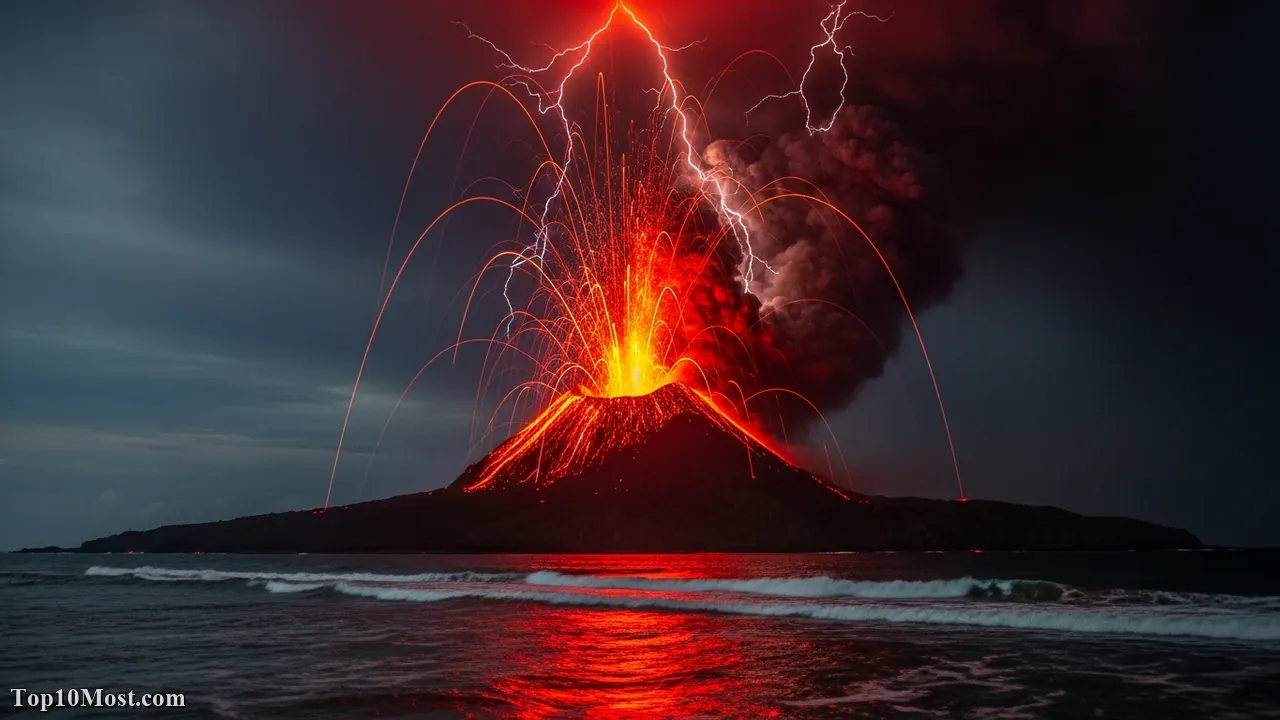
We include Krakatoa for its historical weight and its ferocious regenerative power. It is one of the few places on Earth where you can watch an island being born and destroyed in real-time. Its existence is a testament to the Earth’s violent renewal processes. The volcano is volatile, frequently banned for tourism due to explosive Strombolian activity, making it a forbidden, dangerous beauty.
Krakatoa is the villain of the volcano world—unpredictable and historically devastating. Yet, watching it erupt from a safe distance at night, spewing glowing rocks into the dark ocean, is mesmerically beautiful. It serves as a stark memento mori: nature can hit the reset button whenever it chooses, erasing islands and civilizations in a single afternoon.
Key Highlights:
- History: The 1883 eruption produced the loudest sound ever recorded in modern history.
- Current State: Anak Krakatau emerged from the sea in 1927 and grows roughly 5 meters per year.
- Recent Impact: A major flank collapse in 2018 triggered a deadly tsunami, reshaping the volcano’s profile.
Top 5. Mount Vesuvius
Mount Vesuvius is perhaps the most famous volcano in history, forever linked to the destruction of Pompeii and Herculaneum in 79 AD. Situated on the Gulf of Naples in Italy, it is the only active volcano on the European mainland. It is a “humpbacked” mountain, consisting of a large cone (Gran Cono) partially encircled by the steep rim of a summit caldera caused by the collapse of an earlier structure.
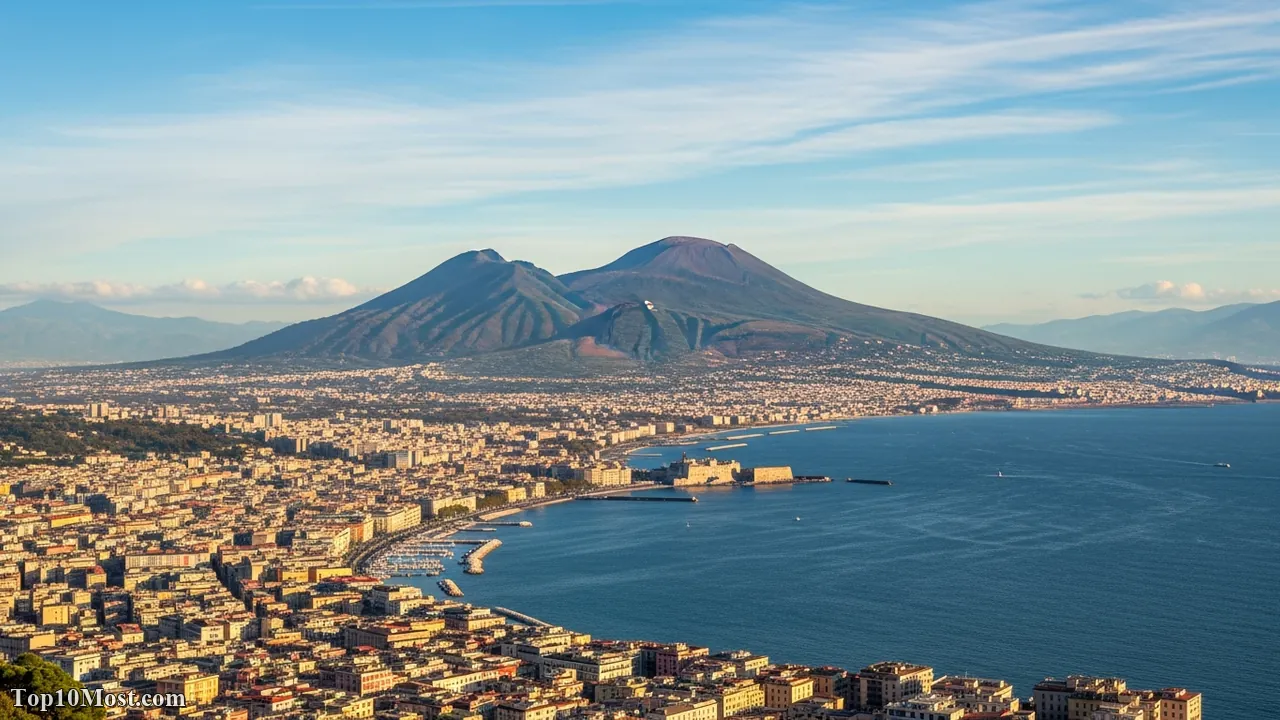
Vesuvius ranks high because of the unparalleled human stakes involved. It sits in the middle of a metropolitan area of three million people, making it arguably the most dangerous volcano on Earth in terms of potential life loss. Its history is written in the archaeology of the Roman cities it buried, providing us with the most detailed snapshot of ancient life we possess. It is a cultural monument as much as a geological one.
Looking into the crater of Vesuvius, one is struck by the silence. It is a deceiving tranquility. Below the Bay of Naples, the magma chamber remains, refilling over centuries. Vesuvius is a “sleeping monster” in the truest sense. It forces us to confront our own complacency—we build cities on the slopes of giants, hoping they won’t wake up during our lifetime.
Key Highlights:
- History: Buried Pompeii in 79 AD; last erupted in 1944.
- Population Risk: Over 600,000 people live in the immediate “Red Zone” danger area.
- Type: Complex stratovolcano characterized by explosive, Plinian eruptions.
Top 4. Kilauea
Kilauea, on the Big Island of Hawaii, is the world’s most reliable showman. Unlike the explosive stratovolcanoes on this list, Kilauea is a shield volcano known for its effusive, fluid lava flows. It has been erupting nearly continuously since 1983, with a brief pause in 2018 before resuming activity. It is the home of Pele, the Hawaiian volcano goddess, and occupies a central place in indigenous culture and modern volcanology.
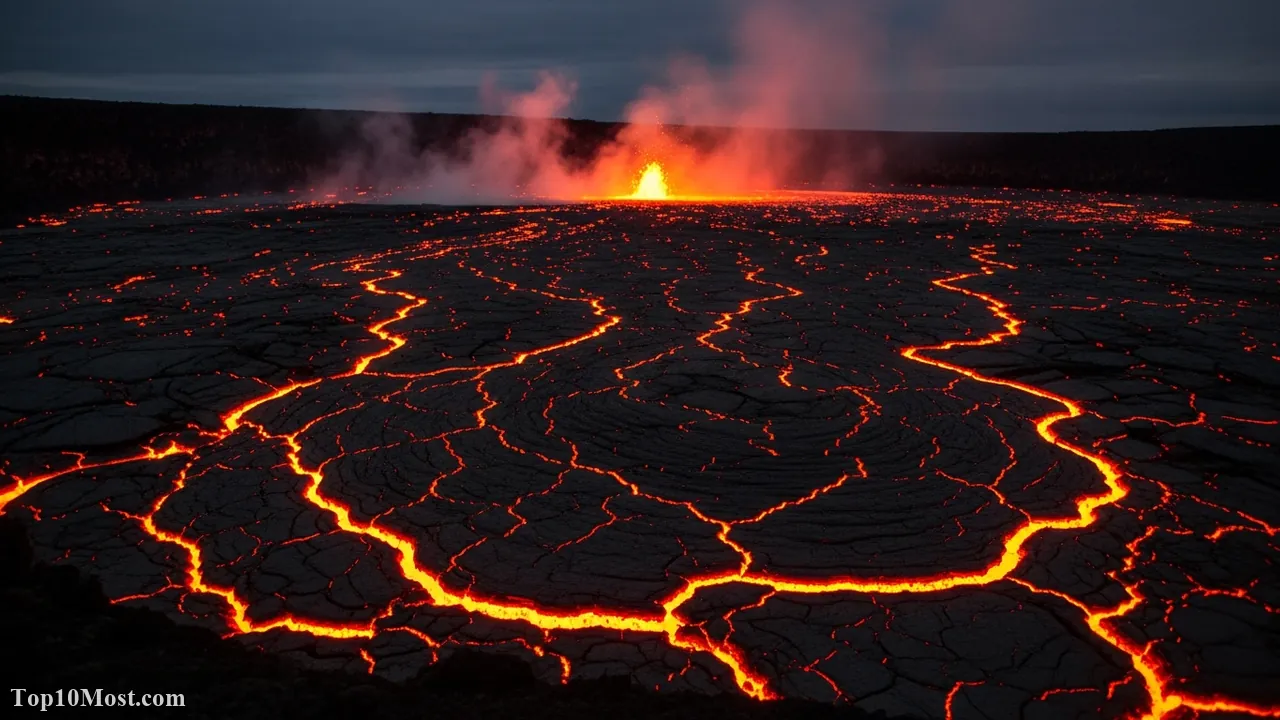
We rank Kilauea fourth because it offers the most intimate encounter with volcanic activity possible. It is one of the few places where you can often stand safe distances away and watch new land being created as lava meets the ocean. The 2018 eruption reshaped the island’s coastline and destroyed hundreds of homes, while recent activity in 2023 and 2024 has been confined to the Halemaʻumaʻu crater, creating a mesmerizing lava lake.
Kilauea changes your perception of time. Here, geology isn’t something that happened millions of years ago; it is happening now. The ground is warm, the air smells of vog (volcanic smog), and the landscape is a stark black canvas of fresh rock. It is the Earth’s construction site, a place of creation that is raw, messy, and relentlessly active.
Key Highlights:
- Activity: Regarded as one of the most active volcanoes on Earth.
- Mythology: Traditionally considered the sacred home of the goddess Pele.
- Type: Shield volcano with fluid, basaltic lava flows.
Top 3. Mount Etna
Dominating the island of Sicily, Mount Etna is Europe’s tallest and most active volcano. It is a UNESCO World Heritage site and a true geological oddity, boasting multiple craters and a history of eruptions dating back 500,000 years. Etna is constantly active, offering a spectacular variety of phenomena: lava fountains, ash plumes, and slow-moving flows. It is deeply integrated into Sicilian life, with vineyards and orchards thriving in its fertile volcanic soil.
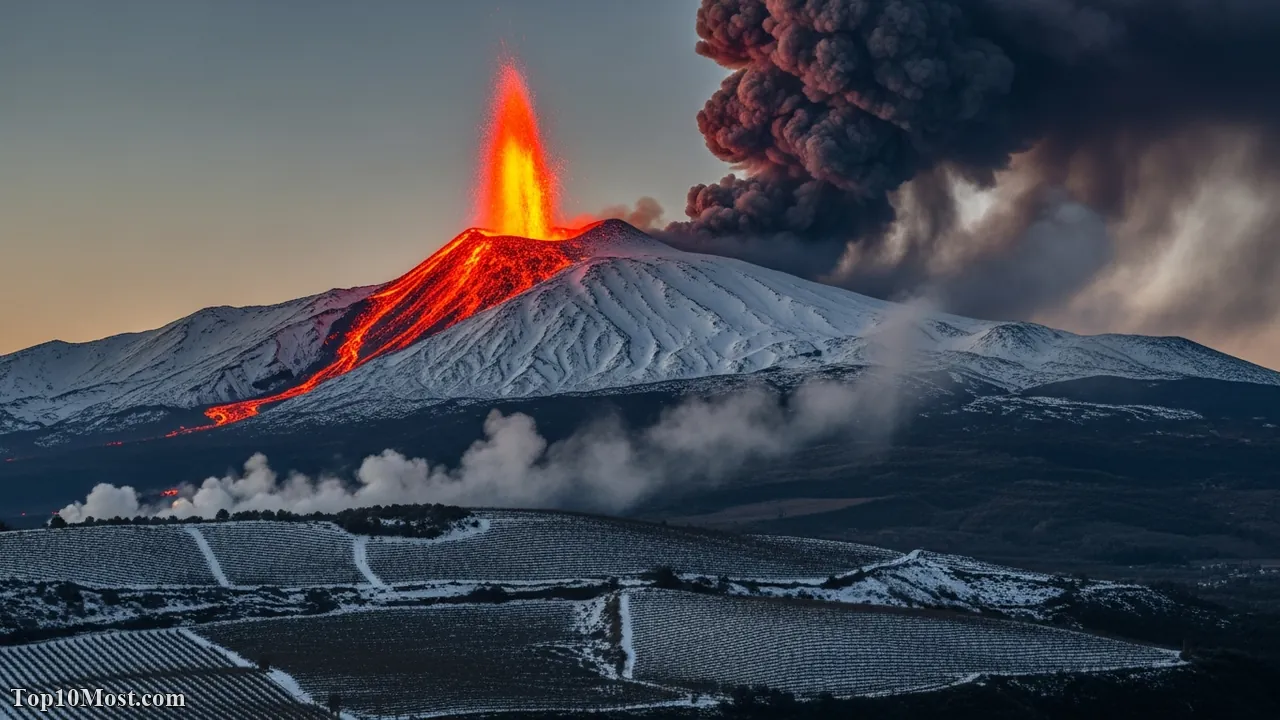
Etna takes the bronze medal for its relentless energy and complexity. It doesn’t just erupt from the top; it has hundreds of flank vents that can open up anywhere on its sides. This unpredictability makes it a constant subject of study. Its “paroxysms”—short, violent bursts of lava fountaining—are among the most visually stunning volcanic displays on the planet.
The locals call her “Mamma Etna.” She is nurturing, providing fertile soil for the region’s famous pistachios and wine, but she is also temperamental. To visit Etna is to see a landscape of contrasts: fire and snow, black rock and green vineyards, destruction and creation existing side-by-side in a chaotic harmony.
Key Highlights:
- Frequency: In a state of near-constant activity; frequent Strombolian eruptions.
- Size: Covers over 1,190 km², with a basal circumference of 140 km.
- History: Has the longest documented record of eruption history of any volcano, dating back to 1500 BC.
Top 2. Mount Fuji
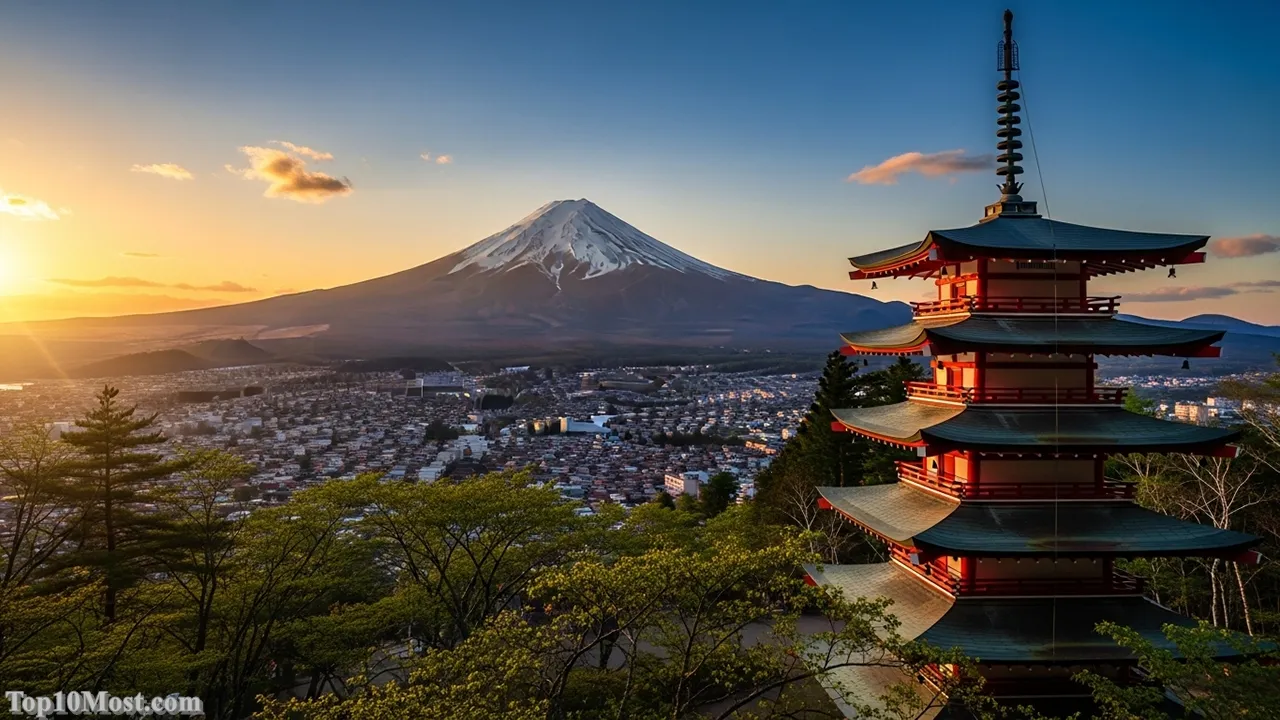
Mount Fuji is the soul of Japan. Rising 3,776 meters, this solitary stratovolcano is celebrated for its exceptional symmetry and cultural sanctity. It has inspired art (like Hokusai’s 36 Views of Mount Fuji) and poetry for centuries. While it has been dormant since 1707, it is still classified as active. Its cone is snow-capped for several months a year, creating a stark, beautiful silhouette that is instantly examining recognizable worldwide.
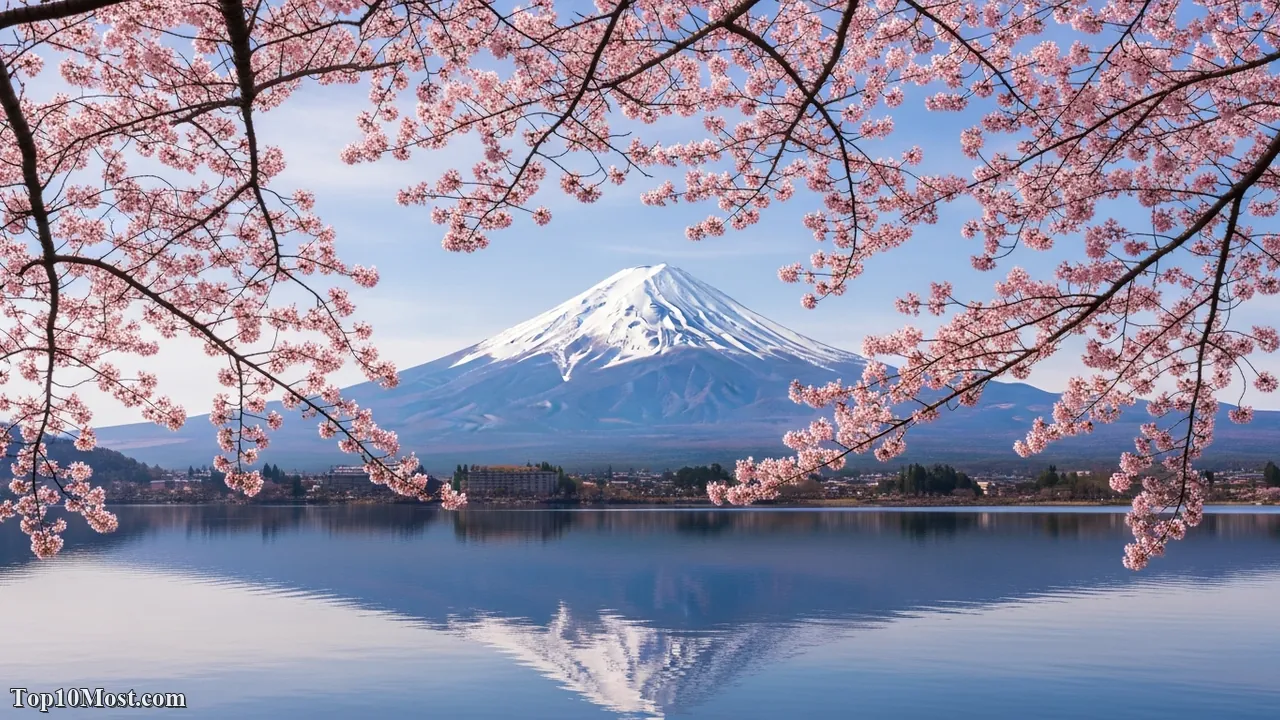
Fuji is number two because it transcends geology to become art. It is the gold standard for what a volcano “should” look like. The climb is a rite of passage for hundreds of thousands annually, but the view of the mountain is even more prized than the view from it. Its potential for eruption is a subject of intense national preparation, yet its image remains one of peace and eternity.
There is a spiritual gravity to Fuji. It commands the landscape without violence. In a world of chaotic, jagged peaks, Fuji’s lines are clean and perfect. It feels like a monument built by the gods. The Japanese proverb, “He who climbs Mt. Fuji once is a wise man; he who climbs it twice is a fool,” captures the physical grueling reality of the mountain versus its romanticized visual perfection.
Key Highlights:
- Symbolism: One of Japan’s “Three Holy Mountains” (Sanreizan).
- Status: Active but dormant; last eruption was the Hōei eruption in 1707.
- Tourism: Most climbed mountain in the world, with over 300,000 visitors annually.
Top 1. Mauna Loa
The undisputed king. Mauna Loa is the largest active volcano on Earth, covering half of the Big Island of Hawaii. Its name means “Long Mountain,” a fitting title for a shield volcano that rises gradually to over 4,000 meters above sea level—but extends another 5,000 meters to the sea floor. In terms of sheer volume and mass, it is a planetary behemoth. After slumbering for 38 years, it roared back to life in late 2022, reminding the world of its staggering scale.
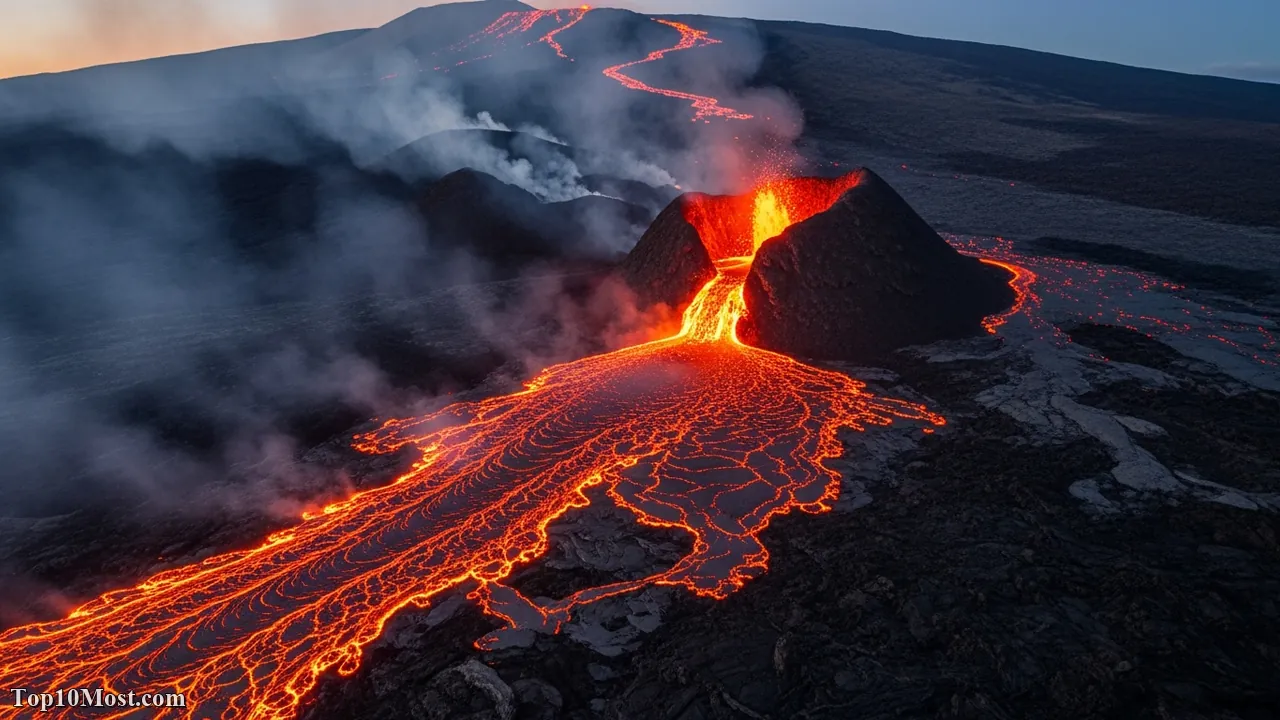
Mauna Loa is our #1 choice because it is the superlative of volcanoes. It is not just a mountain; it is a geological force that depresses the Earth’s crust under its weight. Its eruptions are not explosive pops but massive outpourings of lava that can generate rivers of fire miles wide. The 2022 eruption provided a spectacular dual-show alongside its neighbor Kilauea, a rare event that underscored the volcanic vitality of the Hawaiian hotspot.
Standing on Mauna Loa feels like standing on the surface of another planet. The scale is impossible to comprehend from the ground; the slope is so gentle you often don’t realize how high you are until you look down at the clouds. It is a silent, brooding giant that creates the land we stand on. It doesn’t need a steep cone to be impressive; its impressiveness lies in its sheer, overwhelming existence. It is the true master of the volcanic world.
Key Highlights:
- Size: Largest active volcano on Earth by volume (approx. 75,000 km³).
- Recent Activity: Erupted in Nov-Dec 2022 after a 38-year hiatus.
- Structure: A massive shield volcano so heavy it bends the oceanic crust.
Conclusion
From the symmetrical perfection of Mount Fuji to the raw, land-building power of Mauna Loa, these ten volcanoes represent the most awe-inspiring geological features on our planet. They are reminders that the Earth is dynamic, dangerous, and incredibly beautiful. While they pose risks to those who live in their shadows, they also provide fertile soil, breathtaking vistas, and a direct connection to the inner workings of our world.
At Top 10 Most, we believe that understanding these giants helps us appreciate the fragility of our existence. Whether you are a climber, a geologist, or simply an admirer of nature’s power, these volcanoes offer a glimpse into the forces that shaped the Earth—and continue to shape it today.