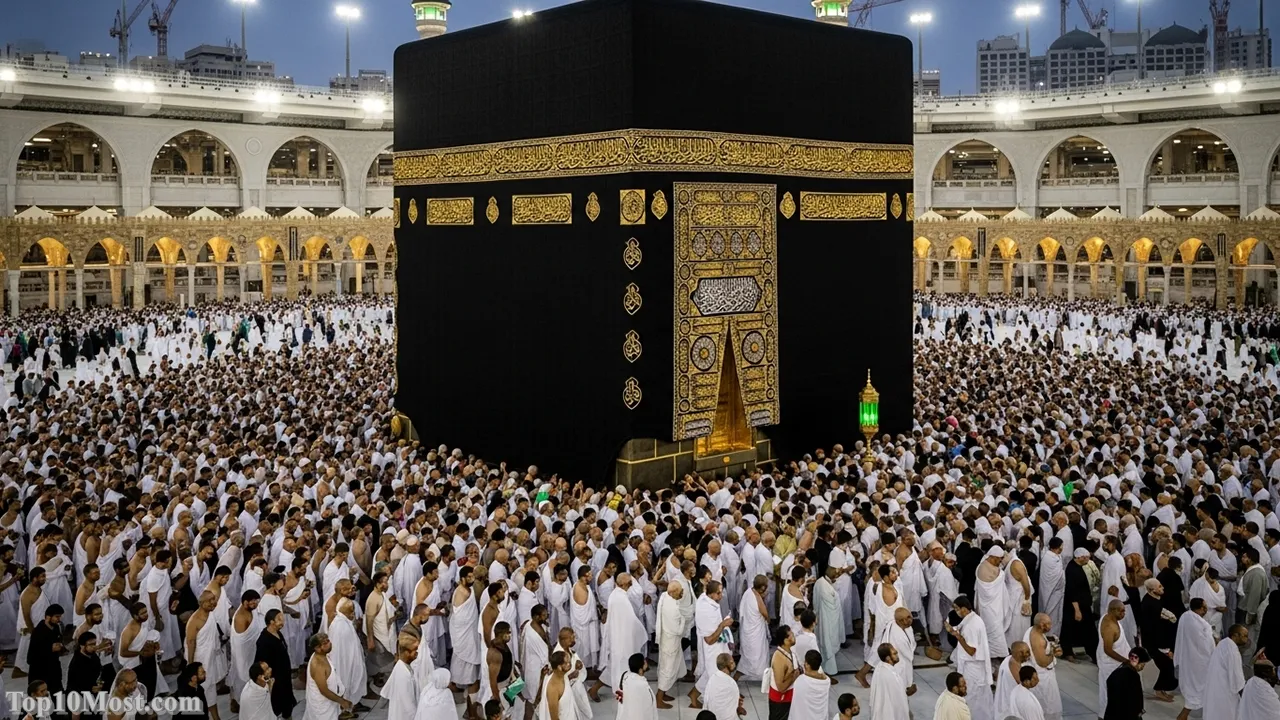
The world is a canvas, and humanity’s oldest traditions are the paint. While many cultural events are somber or strictly ceremonial, others explode with a visual intensity that transcends language. From the neon-lit ice cities of northern China to the organic red chaos of Spanish streets, these festivals are not just events; they are sensory overloads that define the human spirit’s capacity for joy and expression.
The data and rankings in this article are compiled and analyzed based on information updated as of December 2025. We have evaluated these festivals not just on their popularity, but on the sheer saturation and variety of color they introduce to the physical landscape. Whether it is the specific symbolism of a purple and green bead in New Orleans or the spiritual guidance of an orange marigold in Mexico, every hue tells a story.
This list represents a reasoned analytical perspective on the most visually arresting cultural phenomena on Earth. We invite you to explore the meaning behind the kaleidoscope.
Table of the Top 10 Most Colorful Cultural Festivals
| Rank | Festival Name | Location | Primary Colors | Key Month |
|---|---|---|---|---|
| 1 | Holi (Festival of Colors) | India & Nepal | Multi-colored (Gulal Powders) | March |
| 2 | Rio Carnival | Rio de Janeiro, Brazil | Gold, Sequins, Neon Feathers | February/March |
| 3 | Harbin Ice & Snow Festival | Harbin, China | Neon (LEDs), White Ice | January |
| 4 | Día de los Muertos | Mexico | Marigold Orange, Black, Purple | November |
| 5 | Yi Peng Lantern Festival | Chiang Mai, Thailand | Warm Gold, Midnight Blue | November |
| 6 | Venice Carnival | Venice, Italy | Gold, Velvet Red, Black | February |
| 7 | Mardi Gras | New Orleans, USA | Purple, Green, Gold | February/March |
| 8 | La Tomatina | Buñol, Spain | Crimson Red | August |
| 9 | Chinese New Year | Global (China centered) | Red, Gold | January/February |
| 10 | Songkran Water Festival | Thailand | Clear Blue, Floral Prints | April |
Top 10. Songkran Water Festival
Songkran marks the Thai New Year, transforming the entire nation of Thailand into a playful, water-soaked street party. While it is rooted in the gentle tradition of pouring water over Buddha statues and the hands of elders for purification, the modern iteration is a nationwide water fight. The visual landscape is dominated by the splash of clear water against the bright, chaotic “Songkran shirts”—floral, Hawaiian-style button-downs worn by millions—and the beige paste (din sor pong) smeared on cheeks as a blessing.
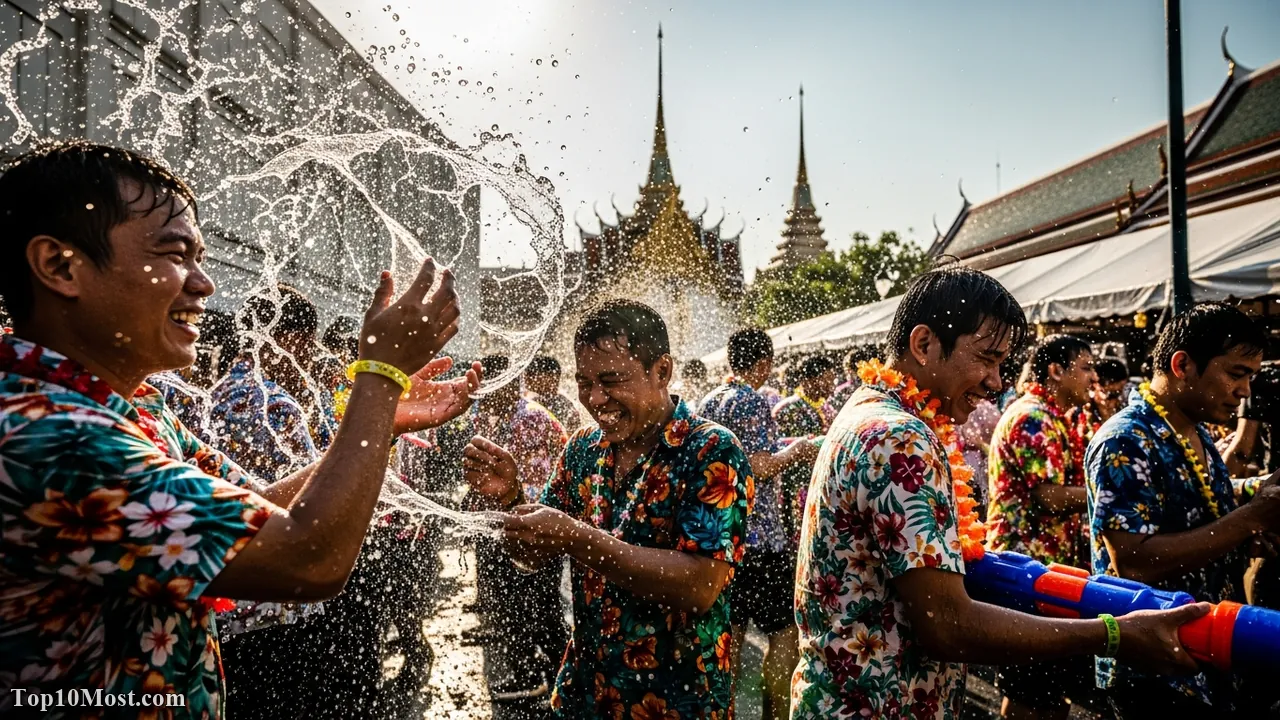
The ranking of Songkran at number 10 highlights its unique medium: water. Unlike festivals that use paint or fabric, Songkran utilizes light and liquid. The air shimmers with water droplets capturing the sun, creating transient rainbows in the streets of Bangkok and Chiang Mai. It is a festival of kinetic energy where the “color” comes from the sheer vibrancy of the wet, laughing crowds and the brightly colored water guns that have become iconic symbols of the holiday.
Participating in Songkran changes your perspective on personal space and community. There is something profoundly leveling about being drenched by a stranger; social barriers dissolve instantly. It is a reminder that renewal doesn’t have to be solemn—it can be raucous, messy, and incredibly bright. The wet floral shirts clinging to revelers create a moving mosaic of tropical colors that defines the Thai scorching summer.
Key Highlights:
- Symbolism: Water represents the washing away of misfortunes from the previous year.
- Key Visual: Bright floral shirts and the shimmer of water in the sun.
- Timing: Annually from April 13–15.
Top 9. Chinese New Year
Chinese New Year, or the Spring Festival, is the single largest annual human migration and a masterclass in the psychological power of the color red. In Chinese culture, red is not just a color; it is a weapon against evil spirits and a magnet for good fortune. For 15 days, cities across the globe—from Beijing to London’s Chinatown—are draped in scarlet lanterns, red couplets, and gold calligraphy. The visual uniformity is striking; it is a sea of crimson that commands attention and commands luck.
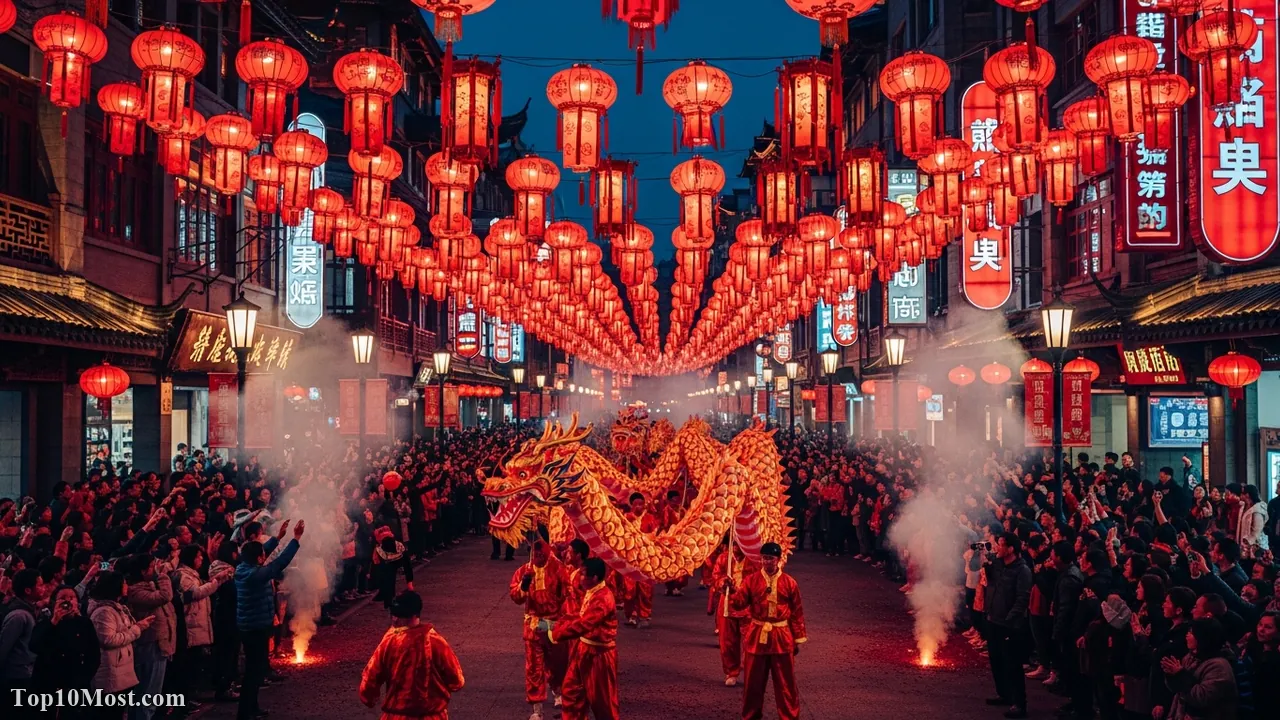
We place this festival at number 9 because of its sheer scale and the intensity of its bichromatic palette. While other festivals offer a rainbow, Chinese New Year proves the power of limitation. The interplay of Red and Gold creates a feeling of warmth, opulence, and vitality. The firecrackers that litter the streets with red paper casings and the intricate dragon dances add dynamic movement to this monochromatic dominance.
Walking through a decorated market during the Lunar New Year feels like stepping into a beating heart. The saturation of red is physically warming. It is a festival that honors the cyclical nature of time, reminding us that with every end comes a prosperous beginning, provided you welcome it with enough noise and enough light.
Key Highlights:
- Color Meaning: Red symbolizes luck, joy, and warding off the beast “Nian.”
- Global Reach: Celebrated by approximately 20% of the world’s population.
- Finale: The celebration concludes with the visually stunning Lantern Festival.
Top 8. La Tomatina
La Tomatina is perhaps the most bizarre entry on this list, turning the small town of Buñol, Spain, into a literal river of red. Originating from a spontaneous street brawl in 1945, this event has no deep religious or ancient significance—it is purely about the joy of the absurd. For one hour on the last Wednesday of August, thousands of participants pelt each other with overripe, inedible tomatoes, coating the whitewashed town walls and cobblestone streets in a thick, crimson pulp.
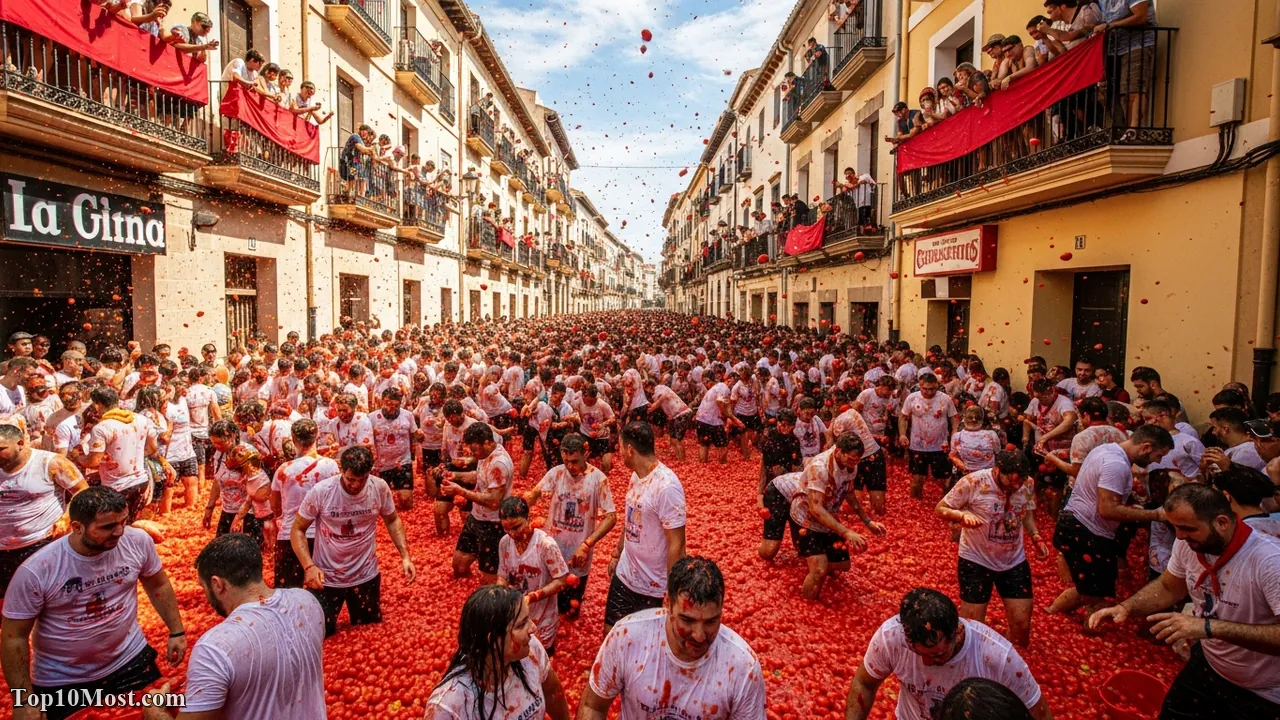
The visual impact of La Tomatina is visceral. It isn’t the carefully curated red of Chinese New Year; it is raw, organic, and messy. We rank it here because it offers a visual texture found nowhere else on earth. The contrast between the blue summer sky, the white clothes participants wear (before the fight), and the sudden, overwhelming deluge of red tomato puree creates a surreal, painterly aesthetic that photographers adore.
There is a primal release in La Tomatina. In a world that demands cleanliness and order, standing knee-deep in tomato juice allows adults to return to a state of childish, chaotic glee. It is a brief, intense explosion of color that leaves the town cleaner than before (thanks to the citric acid) and the participants exhausted but bonded by the sheer ridiculousness of the experience.
Key Highlights:
- The Numbers: Approximately 150,000 kg of tomatoes are thrown in one hour.
- Visual Contrast: White clothing turning pink and then deep crimson.
- Status: Declared a Fiesta of International Tourist Interest by Spain.
Top 7. Mardi Gras
New Orleans’ Mardi Gras is a carnival of excess, defined by its rigid adherence to a specific tricolor palette: Purple, Green, and Gold. Established in 1872 by the “Rex” organization, these colors represent Justice, Faith, and Power, respectively. The festival turns the French Quarter into a flowing tapestry of velvet floats, beaded necklaces, and elaborate masks, all adhering to this royal color scheme.
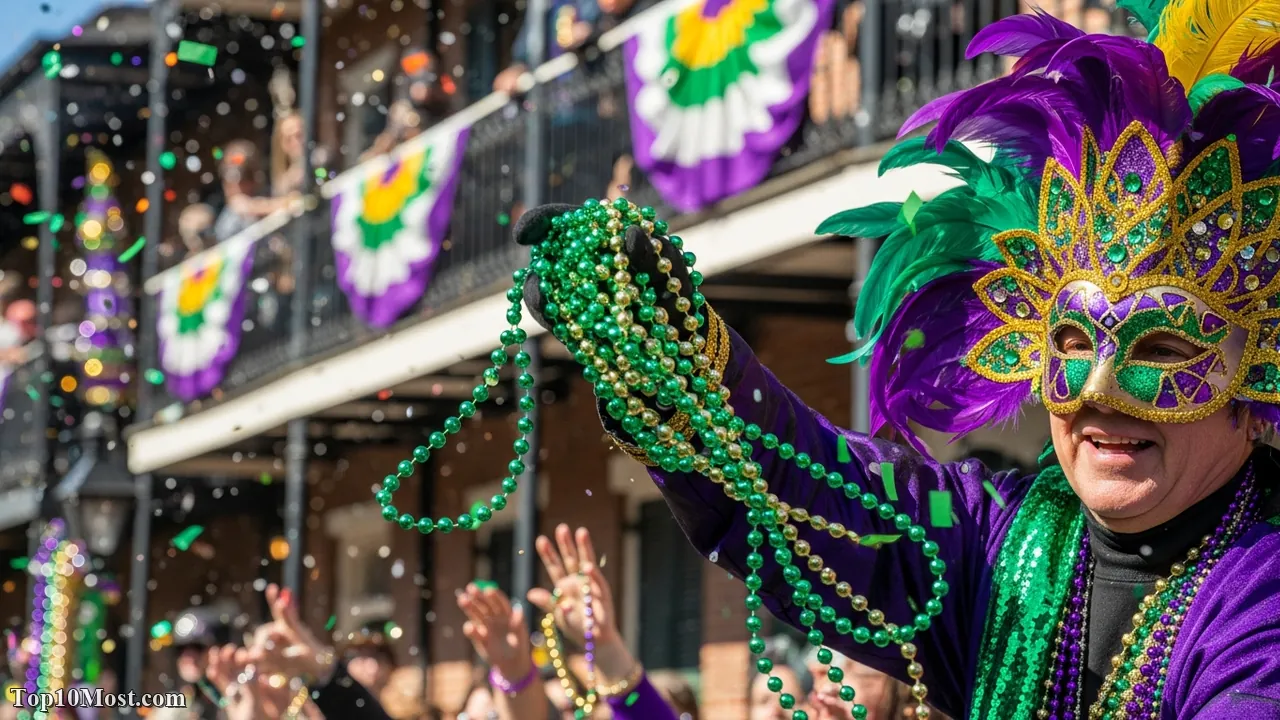
Mardi Gras earns its spot due to the complexity of its costuming and the “throws”—millions of plastic beads that hang from the live oaks and balconies of St. Charles Avenue long after the parades end. The visual density is high; you aren’t just looking at color, you are catching it, wearing it, and stepping on it. The distinct color trio makes Mardi Gras instantly recognizable, branding the city of New Orleans for the entire season of Carnival.
Beyond the debauchery often portrayed in media, there is a profound artistry to Mardi Gras. The “Krewe” floats are moving sculptures that take year-round preparation. To witness the flambeaux carriers lighting the night parades with flickering torches against the purple and green darkness is to see a tradition that links the modern American South with medieval European pageantry.
Key Highlights:
- The Trinity: Purple (Justice), Green (Faith), Gold (Power).
- Artifacts: “Throws” (beads, doubloons, coconuts) create a layer of color on the streets.
- Timing: Culminates on “Fat Tuesday,” the day before Ash Wednesday.
Top 6. Venice Carnival
If La Tomatina is chaotic, the Carnival of Venice is elegant, mysterious, and steeped in history. Set against the backdrop of the grey lagoon and ancient stone, the festival is an explosion of gold leaf, deep velvet reds, and the stark white of the Volto masks. It is a festival of concealment, where the color serves to hide the identity, allowing social classes to mix without judgment in a tradition dating back to the 12th century.
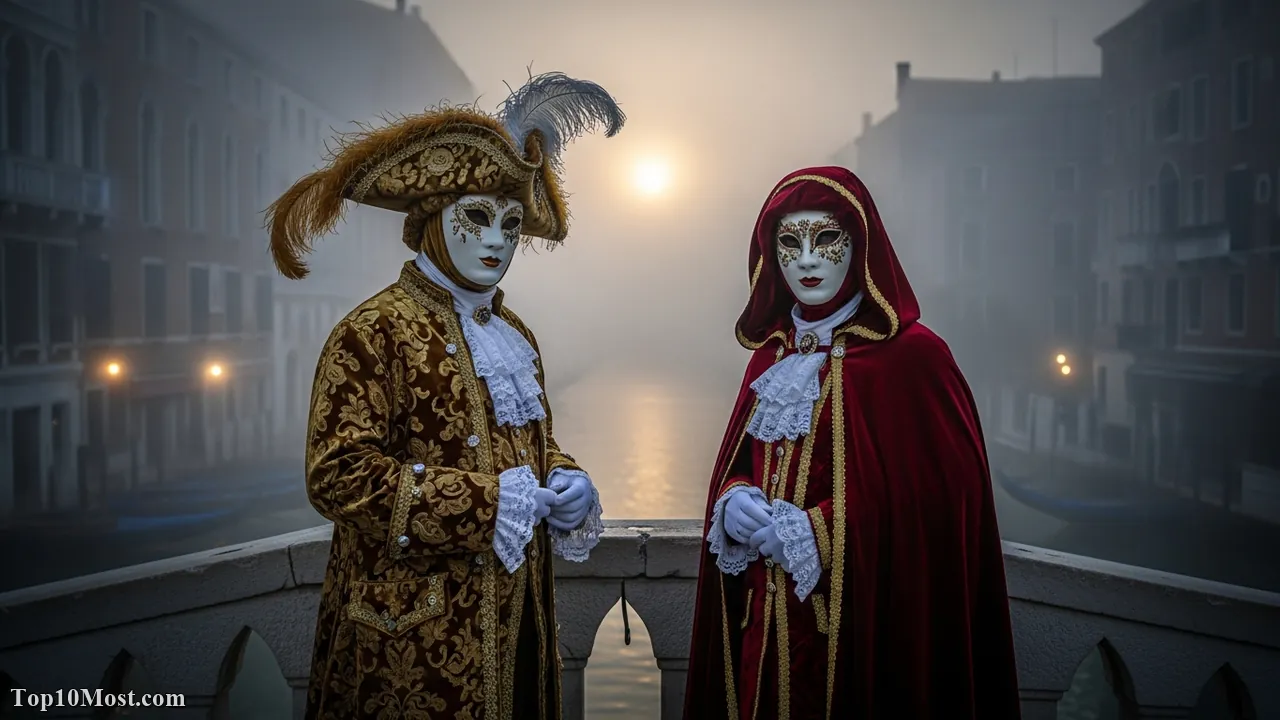
We analyze this festival as a triumph of craftsmanship. The costumes here are not mass-produced; they are historical recreations of 18th-century finery. The visual spectacle is slower and more posed than the frenetic energy of Rio or Holi. The reflection of elaborate, gilded costumes in the canals of Venice creates a double image of luxury that is unique to this sinking city.
There is a haunting beauty to Venice Carnival. The contrast between the lifeless, expressionless masks and the vibrant, living colors of the fabrics creates a surreal atmosphere. It feels like walking through a living painting, a final glorious shout of color and decadence before the somber period of Lent begins.
Key Highlights:
- Iconic Item: The Venetian Mask (Bauta, Colombina, Medico della Peste).
- Aesthetic: Baroque and Rococo elegance.
- Atmosphere: Silent, mysterious pageantry rather than loud parades.
Top 5. Yi Peng Lantern Festival
While most festivals on this list rely on daylight to showcase their colors, Thailand’s Yi Peng utilizes the darkness. Held during the full moon of the 12th lunar month in Chiang Mai, this festival sees thousands of khom loi (sky lanterns) released simultaneously into the night. The result is a sky filled with drifting, warm-orange stars, creating a mirror image of the candlelight reflected in the rivers below (part of the associated Loy Krathong festival).
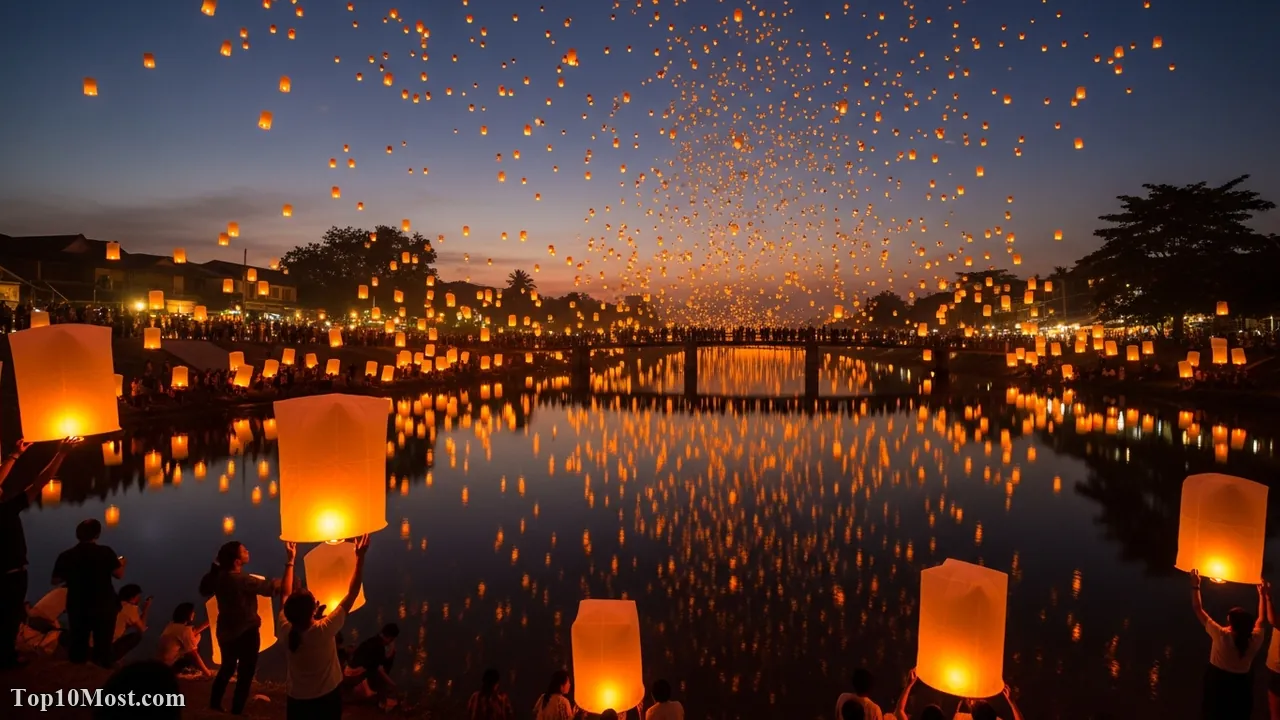
Yi Peng is ranked in the top 5 for its emotional and spiritual visual impact. The color palette is simple—warm gold against midnight blue—but the sheer quantity of lanterns creates a mesmerizing, moving galaxy. It represents the release of misfortunes and the making of merits. The sight of thousands of lights drifting silently upward is widely considered one of the most breathtaking experiences a traveler can witness.
The silence of Yi Peng is what makes the color so loud. Unlike the booming fireworks of other celebrations, the lanterns rise with a hush. Watching your own lantern join the stream of thousands of others evokes a sense of unity and smallness in the face of the universe. It is a visual prayer, glowing softly against the vast dark.
Key Highlights:
- Key Visual: Thousands of paper lanterns illuminating the night sky.
- Location: Best viewed in Northern Thailand (Lanna culture).
- Meaning: Releasing bad luck and paying respect to the Buddha.
Top 4. Día de los Muertos
Mexico’s Day of the Dead is a masterclass in using color to reframe the narrative of death. Far from a mournful grey, this holiday is a vibrant celebration of life, anchored by the bright orange Cempasúchil (marigold) flowers. These petals are believed to guide the spirits of the departed back to the land of the living. Combined with the intricate black and white of the Calavera (skull) makeup and the bright papel picado (cut paper), the festival is a visual feast.
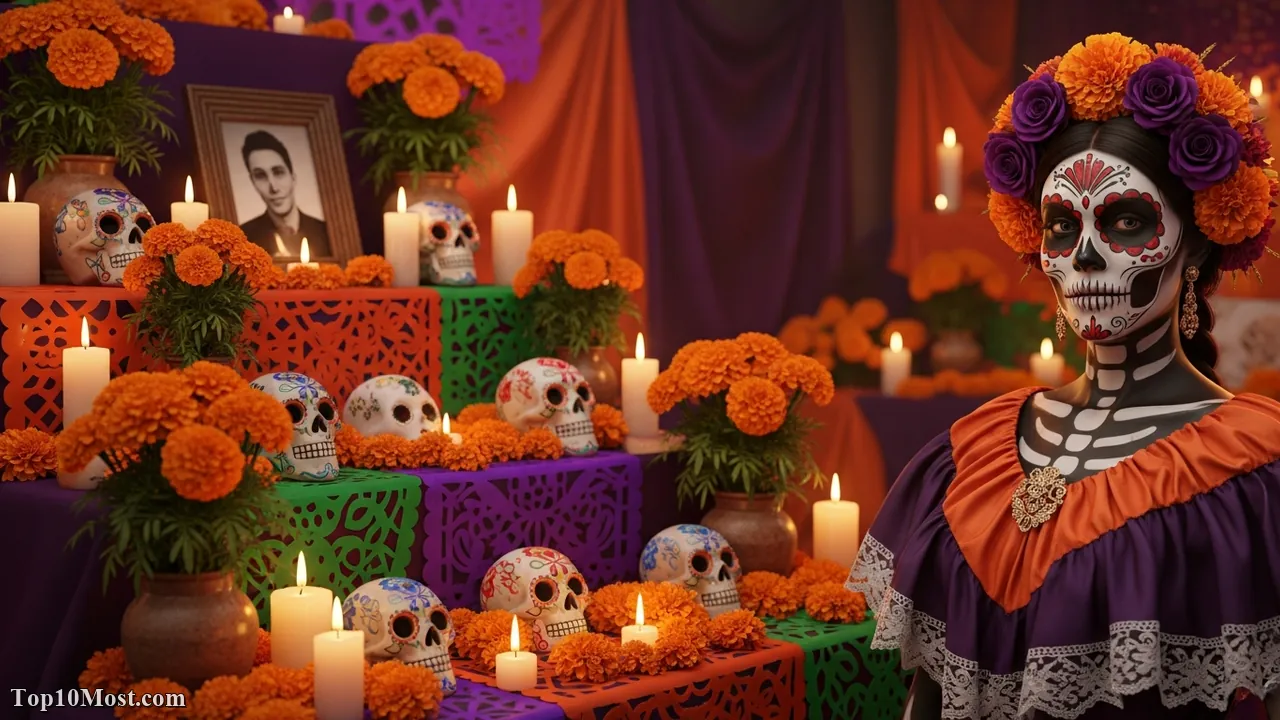
The specific color theory here is profound. The orange represents the sun and light, guiding spirits; purple signifies mourning and grief; white represents purity and hope. The ofrendas (altars) built in homes are tiered explosions of these colors, laden with sugar skulls and food. It stands high on our list because it fundamentally changes how we visualize the end of life—turning it from a void into a spectrum.
To witness Día de los Muertos is to feel a bittersweet joy. The cemeteries are not scary places of silence, but social hubs glowing with candlelight and covered in orange petals. It teaches us that memory is colorful, and as long as we tell the stories of those who left, their colors remain bright in our world.
Key Highlights:
- Primary Flower: Mexican Marigold (Cempasúchil).
- Key Icon: La Catrina (the elegant skeleton).
- Dates: November 1st and 2nd.
Top 3. Harbin Ice & Snow Festival
In the freezing winds of Heilongjiang, China, humanity builds a city that defies nature. The Harbin Ice and Snow Festival is the world’s largest winter festival, but it is the nighttime illumination that secures its place in the top 3. Massive blocks of ice, harvested from the Songhua River, are constructed into life-sized castles, pagodas, and coliseums, all lit from within by high-tech neon LEDs. The result is a translucent, glowing neon metropolis that looks like a digital rendering come to life.
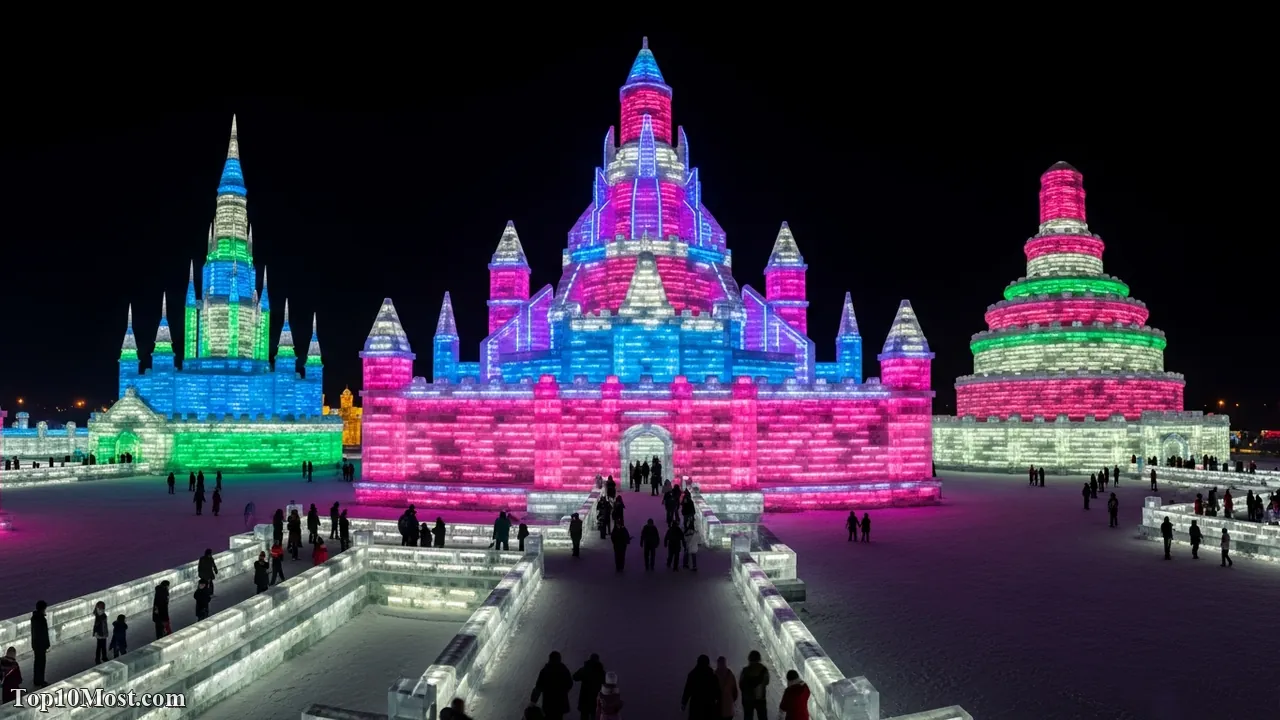
The colors here are electric: acidic greens, hot pinks, and deep cyans trapped inside crystal-clear ice. This is “structural color”—light passing through frozen water. The scale is impossible to overstate, with some towers reaching 40 meters in height. It provides a stark, futuristic contrast to the traditional, organic colors of festivals like Holi or La Tomatina.
Walking through Harbin’s Ice and Snow World is physically punishing due to the cold (often -30°C), but visually hallucinogenic. It feels like exploring an alien planet. The festival proves that even in the harshest, whitest, and coldest environments, human creativity can generate a warmth of light and color that is absolutely blinding.
Key Highlights:
- Material: Ice blocks taken from the Songhua River.
- Visual Tech: Computer-controlled LED lighting embedded in ice.
- Duration: Officially opens Jan 5th, lasting through February.
Top 2. Rio Carnival
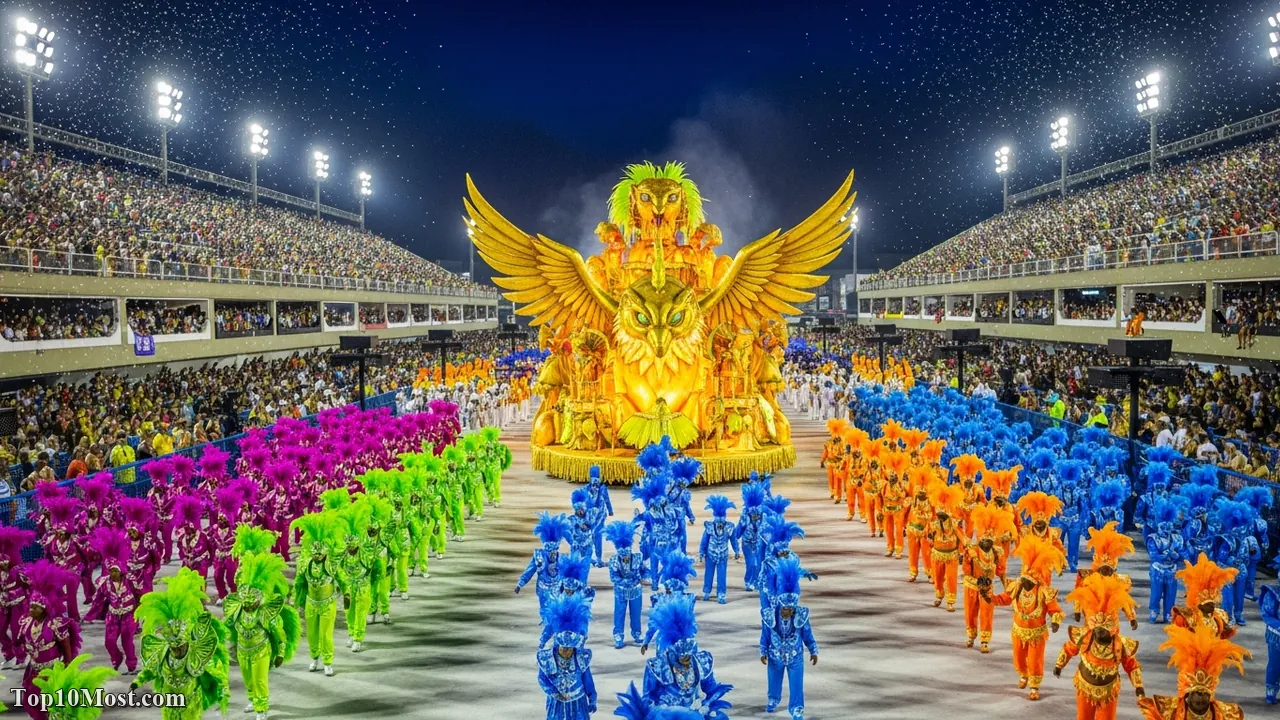
Rio Carnival is the undisputed king of pageantry. It is the largest carnival in the world, with two million people per day on the streets of Rio de Janeiro. But the heart of the color explosion is the Sambadrome, where the top Samba schools compete. The costumes are feats of engineering, towering creations of sequins, feathers, gold plating, and vibrant fabrics that tell complex stories of Brazilian history and mythology.
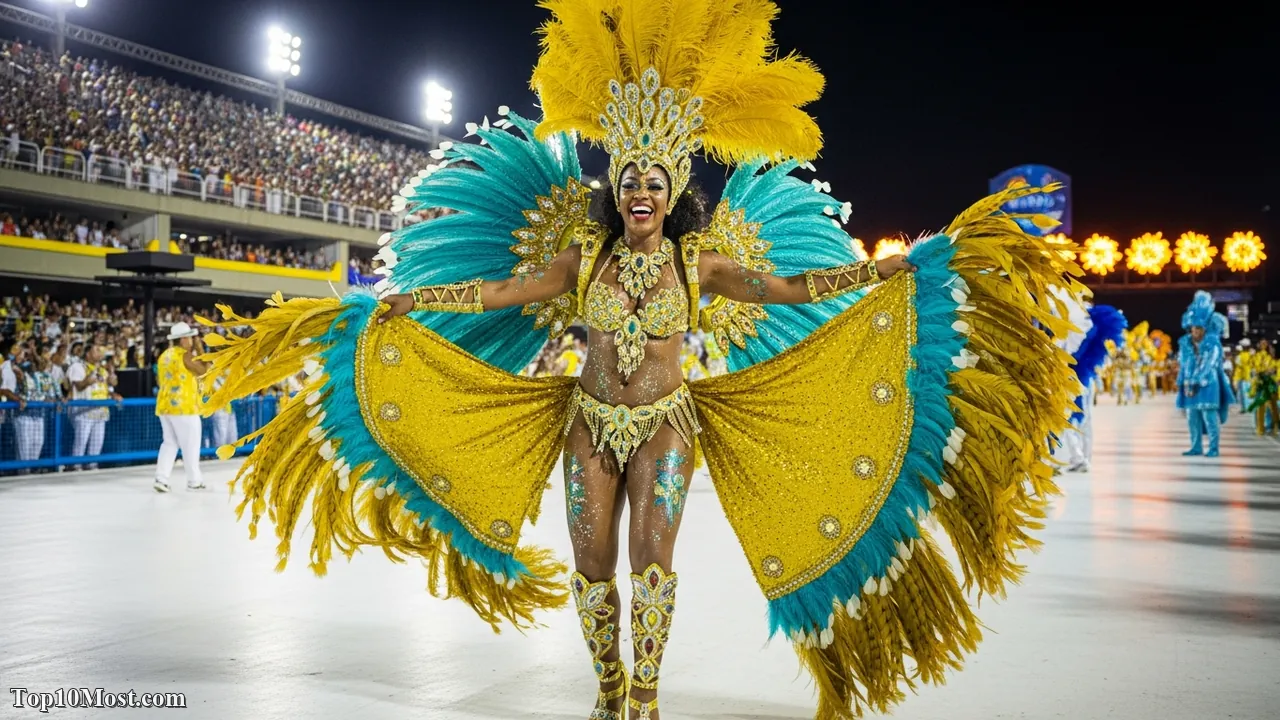
We rank Rio at number 2 because of the “shimmer factor.” The colors here are metallic and moving. The sheer expense and detail put into the costumes mean that every dancer is a walking refraction of light. The floats are multi-story moving buildings covered in flowers and glitter. The palette changes with every school, offering a comprehensive spectrum of every color visible to the human eye in a single night.
The energy of Rio is infectious. It is a celebration of the body, of rhythm, and of life itself. The colors are designed to be seen from the back of the grandstands, meaning they are bold, saturated, and unapologetic. It is a sensory overload where the drumming enters your chest and the colors burn into your retinas.
Key Highlights:
- The Venue: The Sambadrome (Marquês de Sapucaí).
- Key Components: Samba Schools, floats, and Baterias (drum sections).
- Scale: The world’s largest carnival celebration.
Top 1. Holi (Festival of Colors)
There could be no other number one. Holi is not just a colorful festival; it is the Festival of Colors. Celebrated primarily in India and Nepal to mark the arrival of spring and the victory of good over evil (the burning of Holika), this festival involves throwing handfuls of gulal (colored powder) at friends, family, and strangers. The air itself turns into a cloud of pink, yellow, green, and blue.
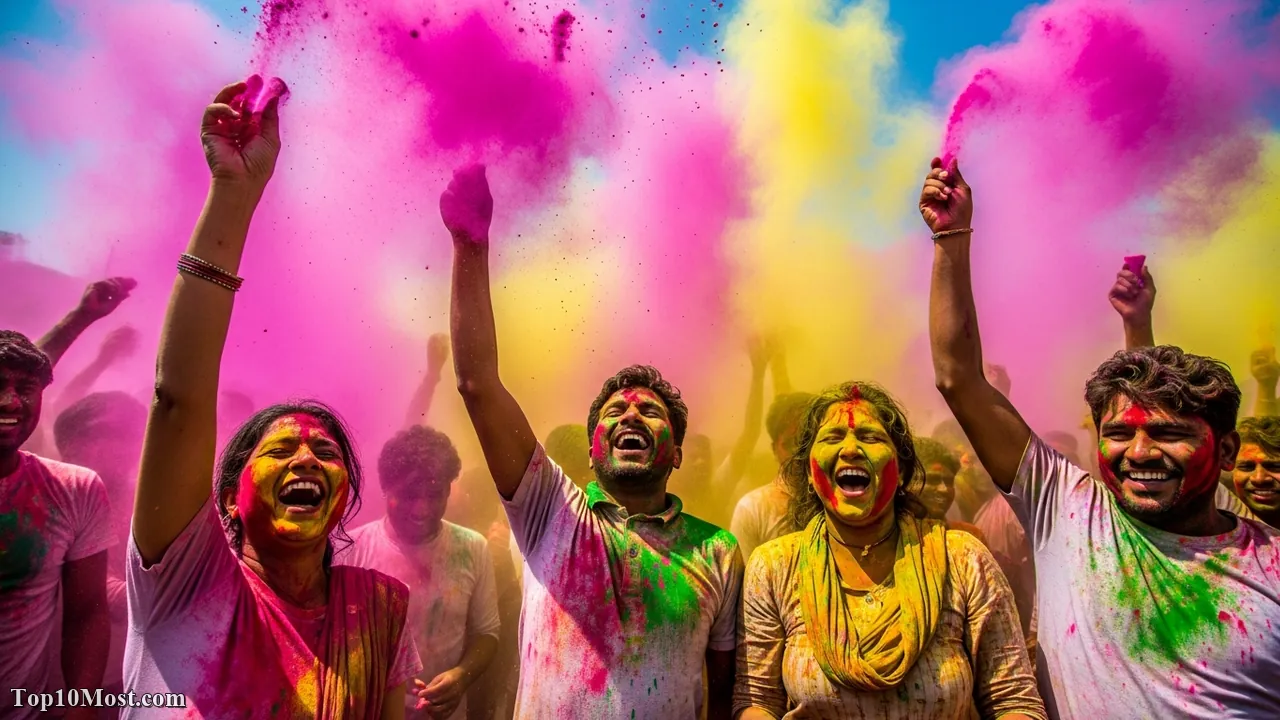
Holi takes the top spot because the participants become the canvas. In Rio or Venice, you watch the color; in Holi, you are the color. The distinct meaning of the colors—green for new beginnings, saffron for piety, red for love and fertility—merges into a unified, joyful mess. It creates a visual equality; covered in paint, caste, class, and age become indistinguishable. Everyone is just a human rainbow.
The experience of Holi is euphoric. It is a suspension of social norms where the streets pulse with energy and the sky is obscured by clouds of magenta and indigo. It is the ultimate celebration of life’s vibrancy, a chaotic, happy reminder that we are all made of the same colorful spirit underneath. For its total immersion and symbolic depth, Holi reigns supreme.
Key Highlights:
- The Substance: Gulal (fine colored powder) and colored water.
- Social Impact: Dissolves social hierarchies for one day.
- Global Icon: The inspiration for “Color Runs” worldwide.
Conclusion
Our journey through the Top 10 Most Colorful Cultural Festivals reveals a fundamental truth: humans have an innate need to break the monotony of daily life. Whether we are throwing tomatoes in Spain, lighting lanterns in Thailand, or painting each other in India, these festivals serve as release valves for society. They allow us to step out of our grey routines and into a world that is brighter, louder, and more connected.
As we move through late 2025 and into the future, these celebrations are more important than ever. They remind us that despite our geographical and cultural differences, we all share a love for spectacle, a reverence for tradition, and a deep joy in seeing the world in full color. We hope this list inspires you to pack your bags and experience the kaleidoscope for yourself.