The act of gathering to give thanks for a bountiful yield is one of humanity’s oldest and most universal traditions. From the rice paddies of Asia to the vineyards of South America, harvest festivals serve as a vital reminder of our connection to the land and to each other. At Top 10 Most, we have analyzed global celebrations to identify those that best exemplify the spirit of communal joy, cultural richness, and historical significance. The data in this article is compiled and analyzed based on information updated as of late 2025 and early 2026.
These festivals are not merely about food; they are profound cultural expressions that blend spirituality, hard work, and festivity. Whether it is the lantern-lit skies of the Mid-Autumn Festival or the exuberant parades of Mendoza, each entry on our list represents a unique interpretation of gratitude. We selected these specific festivals based on their scale of participation, the vibrancy of their traditions, and their enduring capacity to bring people together in a shared state of happiness.
Our ranking looks beyond simple popularity. We examine the “Joy Factor”—the tangible atmosphere of celebration, the inclusiveness of the events, and the depth of the culinary traditions involved. As we move into another agricultural cycle, these festivals remind us that despite our differences, the joy of a good harvest is a language everyone speaks.
Table of the Top 10 Most Joyful Harvest Festivals
| Rank | Festival | Primary Location | Typical Month | Key Joy Factor |
|---|---|---|---|---|
| 1 | Thanksgiving | USA / Canada | November / October | Family Reunion & Feasting |
| 2 | Mid-Autumn Festival | China / Vietnam | September / October | Lanterns & Mooncakes |
| 3 | Oktoberfest | Germany (Munich) | Sept. to early Oct. | Communal Cheer & Beer |
| 4 | Pongal | India (Tamil Nadu) | January | Colorful Art & Gratitude |
| 5 | Chuseok | South Korea | September / October | Ancestral Honor & Gifts |
| 6 | Fiesta Nacional de la Vendimia | Argentina (Mendoza) | February / March | Spectacular Performance |
| 7 | Sukkot | Israel / Global Jewish Communities | September / October | Outdoor Living & Unity |
| 8 | New Yam Festival | Nigeria / Ghana | August / September | Cultural Drumming & Dance |
| 9 | Rice Harvest Festival (Seren Taun) | Indonesia (Bali/Java) | May / June | Spiritual Harmony & Nature |
| 10 | Madeira Flower & Wine Festival | Portugal (Madeira) | August / September | Grape Treading & Folklore |
Top 10. Madeira Flower & Wine Festival (Portugal)
The island of Madeira, floating in the Atlantic, transforms into a vibrant stage of color and aroma during its harvest season. While the island is famous for its spring Flower Festival, the Wine Festival in late summer is equally joyous, celebrating the harvest of the famous Madeira grapes. The streets of Funchal are filled with folklore groups, traditional music, and tables laden with local gastronomy, creating an atmosphere that feels both intimate and grand.
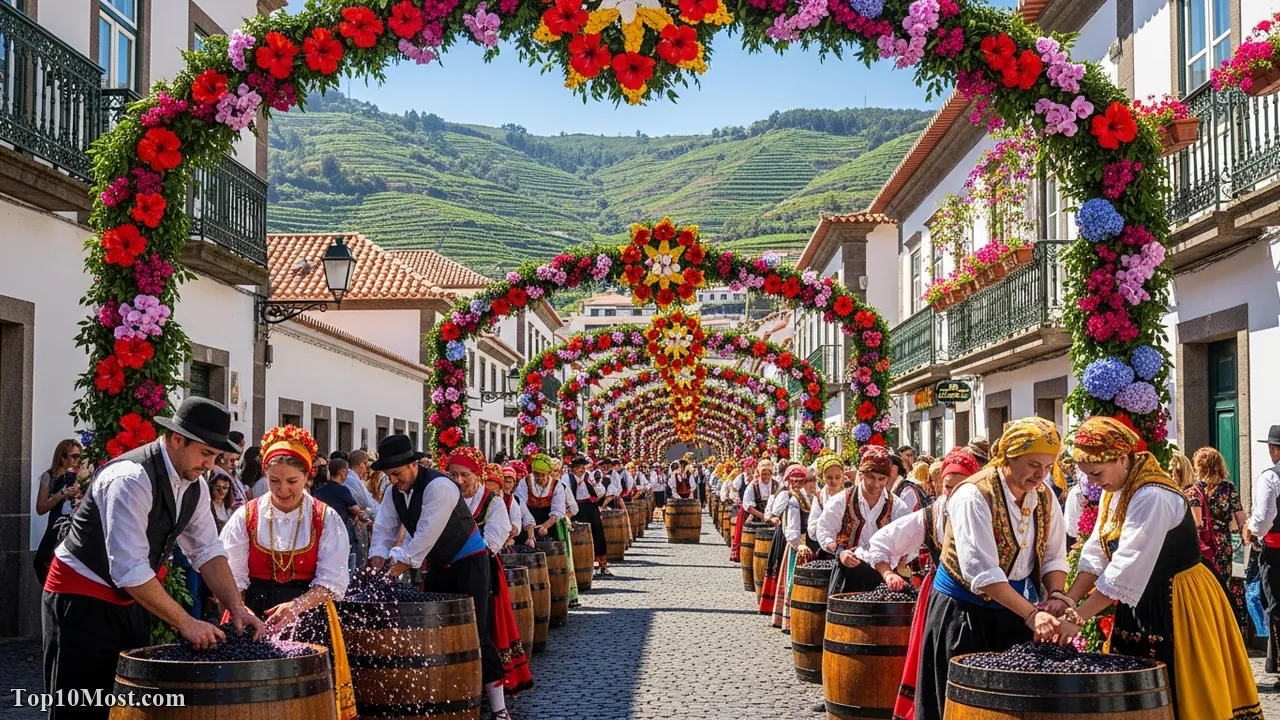
We rank this festival here because it offers a uniquely tactile experience of the harvest. Unlike many modern festivals where the connection to the crop is abstract, visitors here are often invited to participate in the live treading of grapes in Estreito de Câmara de Lobos. It is a visceral reminder of the labor that goes into the wine, turned into a party where tourists and locals stomp grapes together to the rhythm of folk music.
There is something incredibly charming about the way Madeira preserves its “old world” soul during this time. Watching the harvest parade, with its floats dedicated to the history of winemaking, you feel a deep sense of island pride. It is a celebration not just of the wine, but of the resilience of the people who cultivate these steep volcanic slopes.
Key Highlights:
- Location: Funchal and Estreito de Câmara de Lobos, Madeira.
- Interactive Element: Public grape-treading events where visitors can join in.
- Significance: Honors the centuries-old tradition of Madeira wine production.
Top 9. Rice Harvest Festival (Indonesia)
In the lush landscapes of Indonesia, particularly in Bali and West Java, the Rice Harvest Festival (often known as Seren Taun in Sundanese culture) is a deeply spiritual and serene celebration. It marks the end of the agricultural cycle and is dedicated to Dewi Sri, the Rice Goddess, who is believed to oversee the success of the crops. Villages are adorned with colorful flags, and small straw dolls representing the goddess are placed in granaries as offerings of protection and thanks.
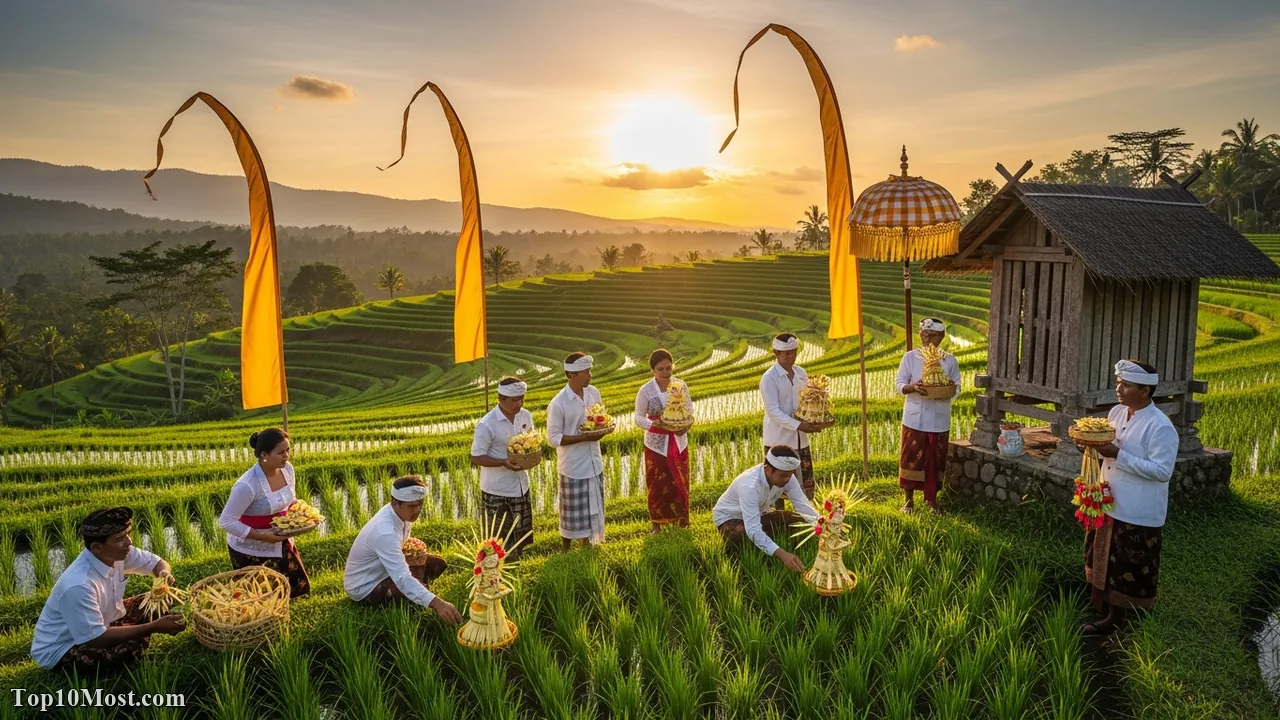
This festival earns its place for its profound spiritual harmony and connection to nature. It is less about raucous partying and more about community cohesion and reverence for the earth. The “Joy Factor” here is derived from a sense of peace and balance (Tri Hita Karana in Bali)—the harmony between people, nature, and the divine. The sight of golden rice fields contrasting with vibrant ceremonial attire creates a visual feast that matches the spiritual one.
Witnessing the traditional Angklung music performances or the pounding of the rice mortar during Seren Taun offers a window into a culture that views farming as a sacred duty. The joy here is quiet, rhythmic, and deeply sustained, reflecting a gratitude that goes beyond the harvest itself to the very essence of life and sustenance.
Key Highlights:
- Deity: Dedicated to Dewi Sri, the Goddess of Rice and fertility.
- Cultural Feature: Use of the angklung, a traditional bamboo musical instrument.
- Timing: Varies by region, typically May or June based on the rice cycle.
Top 8. New Yam Festival (Nigeria & Ghana)
Across West Africa, particularly among the Igbo people of Nigeria and the Ga people of Ghana (where it intersects with Homowo), the New Yam Festival is a massive cultural event. Known as Iri Ji in Igbo, it marks the beginning of the harvest season and the time when yams—the staple crop of the region—are ready to be eaten. The festival is a colorful explosion of masquerades, royal dances, and the symbolic offering of the first yams to the gods and ancestors.
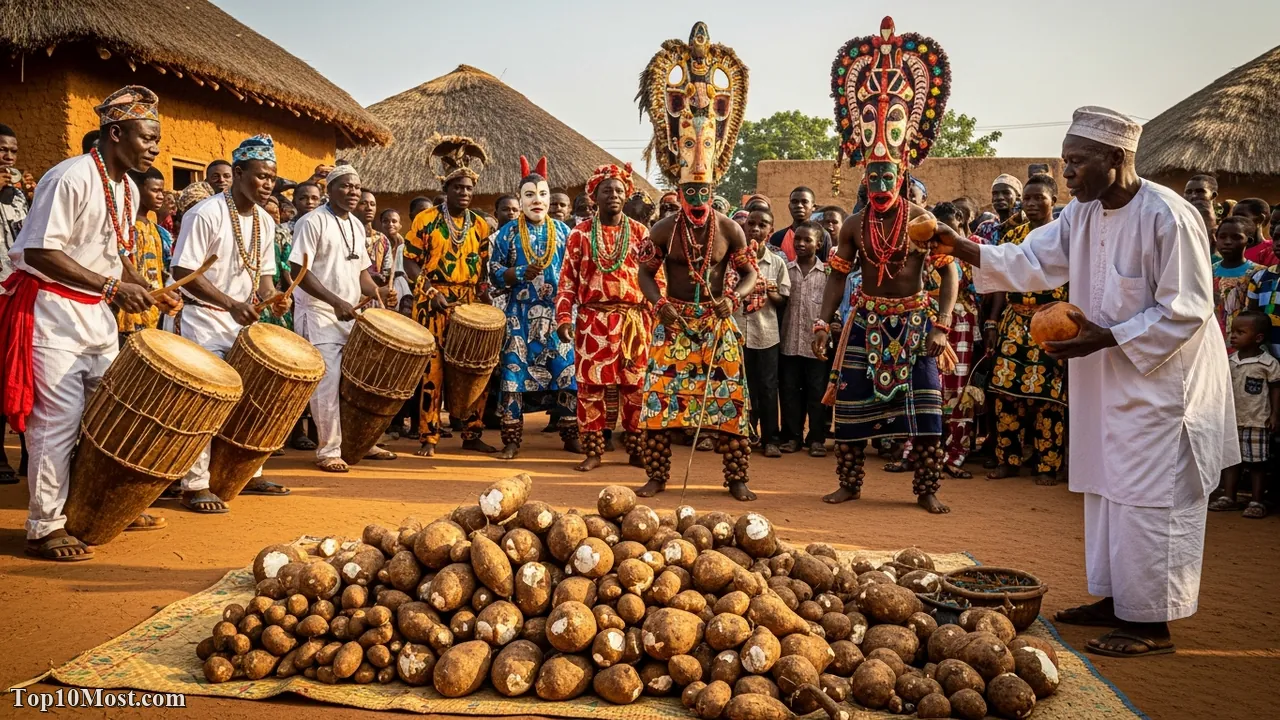
We selected this festival for its raw energy and deep community integration. It is a powerful affirmation of survival and prosperity; the new yam symbolizes the conclusion of the “season of scarcity.” The joy is palpable in the drumming and the high-energy dances that fill the village squares. It is a time when communities reaffirm their unity, and the sheer vibrancy of the traditional attire makes it one of the most photogenic harvest celebrations on Earth.
Participating in or observing the roasting of the fresh yam is a memorable experience. The smell of the charred yam skin, the spicy sauces, and the communal sharing of the tuber creates a bond between everyone present. It is a celebration that loudly and proudly declares, “We have survived, and we have plenty.”
Key Highlights:
- Cultural Name: Known as Iri Ji (Igbo) or associated with Homowo (Ga).
- Significance: Yams are considered the “king of crops” in these regions.
- Ritual: Old yams must be consumed or discarded before the new ones are eaten.
Top 7. Sukkot (Israel & Global)
Sukkot, often called the “Feast of Tabernacles,” is a biblical harvest festival celebrated by Jewish communities worldwide. For seven days, families build and dwell in temporary outdoor huts called sukkahs, which are topped with branches and decorated with hanging fruits and harvest symbols. It recalls the 40 years the Israelites spent wandering in the desert, but it is explicitly commanded to be a “season of our rejoicing.”

The ranking of Sukkot is driven by its unique “Joy Factor”: the adventure of moving one’s life outdoors. In a modern world of concrete and screens, the act of eating, sleeping, and hosting guests in a fragile wooden booth creates an immediate, intimate connection with nature and neighbors. It is a festival of hospitality (hachnasat orchim), where the joy comes from inviting others into your temporary home to share meals.
There is a special magic to sitting in a sukkah at night, seeing the stars through the roof of palm fronds or pine branches. It levels the playing field; whether rich or poor, everyone sits in the same simple structure, vulnerable to the wind but secure in their community. It transforms the solitary act of harvesting into a shared experience of faith and friendship.
Key Highlights:
- Structure: The Sukkah (booth) must have a roof made of organic material (sekhakh).
- Symbols: The “Four Species” (lulav and etrog) are waved in all directions.
- Atmosphere: Explicitly designated in tradition as Z’man Simchateinu (The Time of Our Joy).
Top 6. Fiesta Nacional de la Vendimia (Argentina)
In Mendoza, the heart of Argentina’s wine country, the grape harvest is not just a farming milestone; it is a theatrical spectacular. The Fiesta Nacional de la Vendimia is one of the largest harvest festivals on the planet, attracting hundreds of thousands of visitors. The main event is a dazzling show in a Greek-style amphitheater featuring over a thousand dancers, actors, and musicians, culminating in the coronation of the “Queen of the Vendimia.”
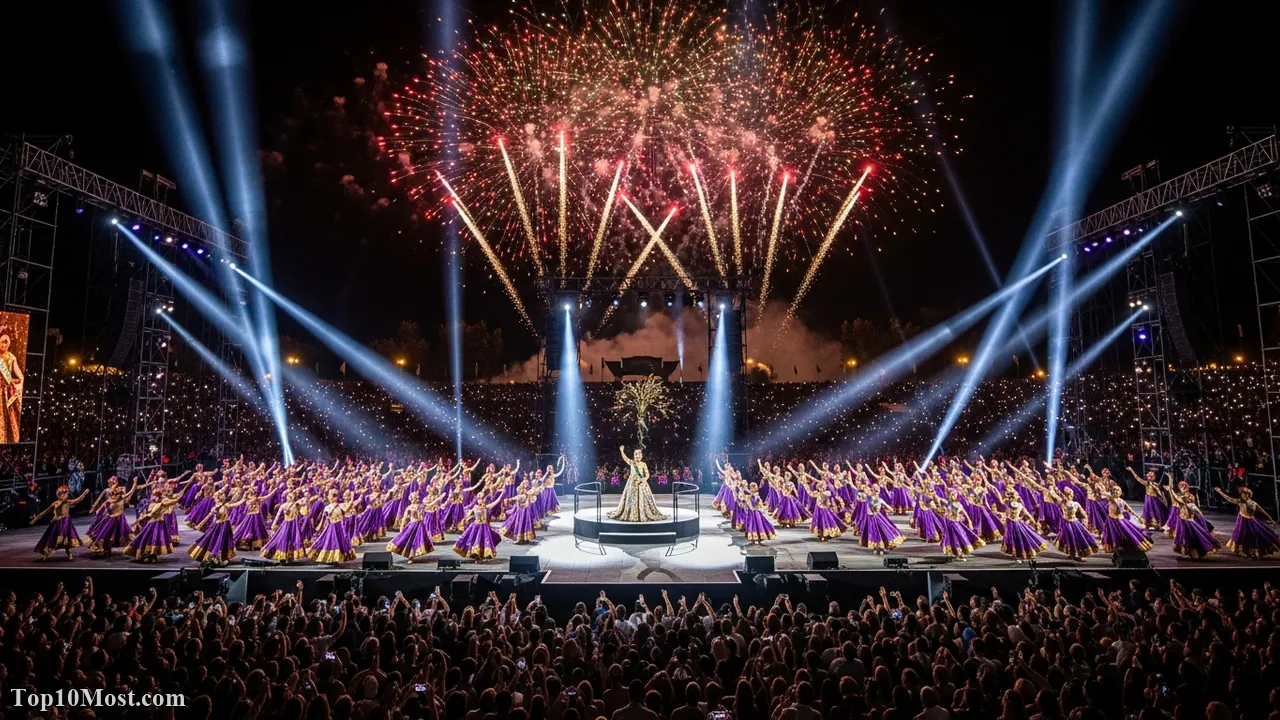
We place this festival at number six because of its sheer artistic scale. While other festivals focus on the family dinner, Mendoza turns the harvest into a Broadway-caliber production. The “Joy Factor” here is awe—the collective gasp of the crowd as fireworks illuminate the vineyards and the mountains. It elevates the humble act of picking grapes into a national myth, celebrated with passion and flair.
Beyond the main stage, the streets of Mendoza are alive with “Via Blanca” parades of floats during the day and night. The wine flows freely, and the pride the locals feel for their Malbec and other varietals is infectious. It is a sophisticated, high-energy celebration that proves agriculture can be the stuff of high art.
Key Highlights:
- Location: Mendoza, Argentina.
- Scale: The main act involves up to 1,000 performers on a massive stage.
- Tradition: The election of the “National Harvest Queen” is a major cultural event.
Top 5. Chuseok (South Korea)
Chuseok, often referred to as “Korean Thanksgiving,” is a three-day holiday that triggers one of the largest mass migrations of people in Asia. Families travel from major cities back to their ancestral hometowns to pay respect to their spirits, clear the weeds from family graves, and share a massive feast. The centerpiece of the food is songpyeon, half-moon-shaped rice cakes steamed over pine needles.
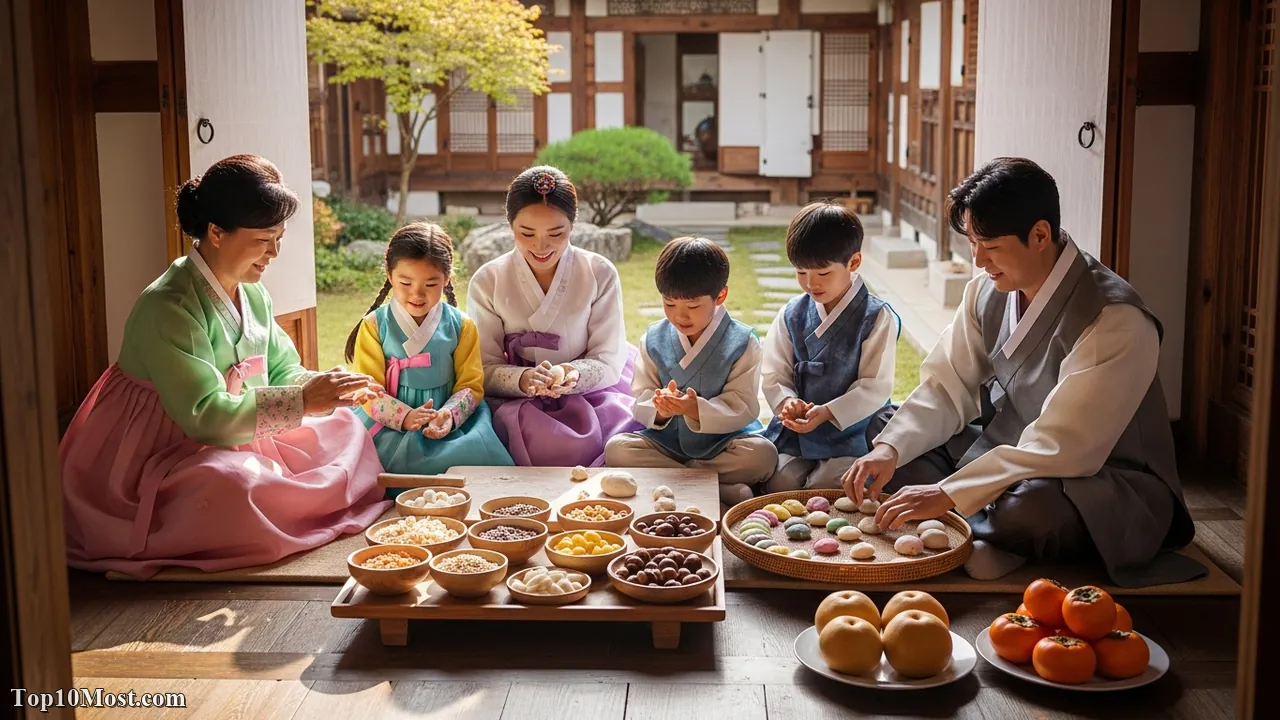
Chuseok ranks highly because of its deep emotional resonance. It is a festival grounded in filial piety and the continuity of family lines. The joy here is found in the reunion—the relief of returning home and the satisfaction of honoring one’s roots. It balances solemn rituals (charye) with lighthearted folk games and dances, creating a holistic emotional experience that grounds the participants in their history.
The visual beauty of Chuseok is unmatched, with many people donning traditional hanbok dress. Walking through a Korean village during this time, seeing families laughing together while making songpyeon, offers a touching reminder that the harvest is as much about harvesting memories as it is about crops. It is a celebration of the “roots” of the family tree.
Key Highlights:
- Key Food: Songpyeon (pine-steamed rice cakes).
- Activity: Seongmyo (visiting ancestral graves) and Ganggangsullae (circle dance).
- Timing: 15th day of the 8th lunar month (usually Sept/Oct).
Top 4. Pongal (India)
In the southern Indian state of Tamil Nadu, Pongal is a four-day explosion of color, gratitude, and sweetness. Dedicated to the Sun God (Surya), the festival is named after the dish prepared for the occasion—rice boiled in milk and jaggery until it overflows the pot. This overflowing is the central metaphor of the festival, symbolizing the wish for the family’s prosperity to “boil over” in the coming year.
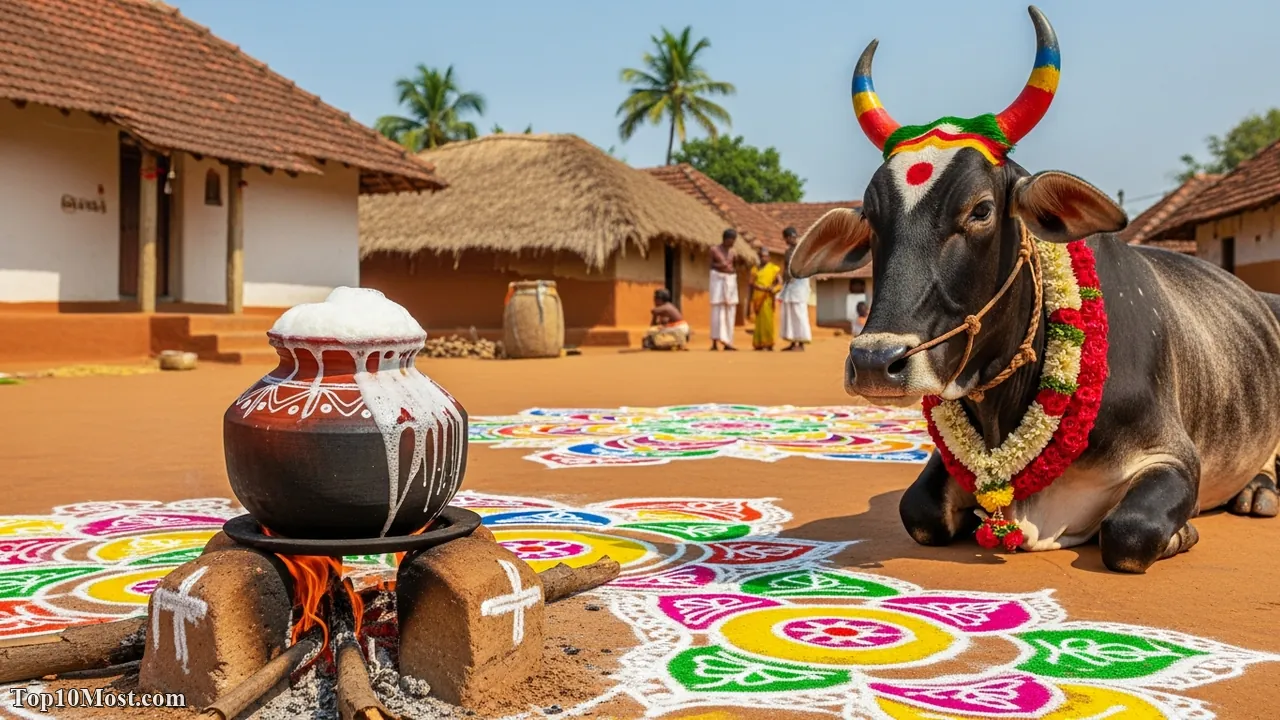
Pongal stands out for its unabashed optimism and vibrant aesthetic. We rank it fourth because it is visually one of the most joyful festivals on earth. Doorsteps are decorated with intricate kolam designs made of rice flour, cows are painted and adorned with beads and bells for Mattu Pongal, and the air is filled with the shout “Pongalo Pongal!” as the pots boil over. It is a sensory delight that celebrates the sun, the rain, the cow, and the farmer equally.
The respect shown to cattle during this festival is particularly moving. Seeing farmers decorate their bulls and cows with flower garlands and feed them sweet rice is a beautiful acknowledgment of the animal labor that makes the harvest possible. It is a festival that recognizes the entire ecosystem of agriculture with pure, unadulterated happiness.
Key Highlights:
- The Cry: “Pongalo Pongal!” is shouted when the milk boils over.
- Decorations: Elaborate Kolam patterns drawn on the ground.
- Duration: Four days, each with a specific focus (Sun, Cattle, Family).
Top 3. Oktoberfest (Germany)
While often caricatured as just a beer party, Oktoberfest in Munich is actually the world’s largest Volksfest (people’s festival) and has its roots in a royal wedding and agricultural shows. Running from late September into the first weekend of October, it attracts over six million visitors. While beer is the fuel, the engine of the festival is Bavarian tradition, featuring parades of landlords, riflemen, and traditional costumes (Tracht).
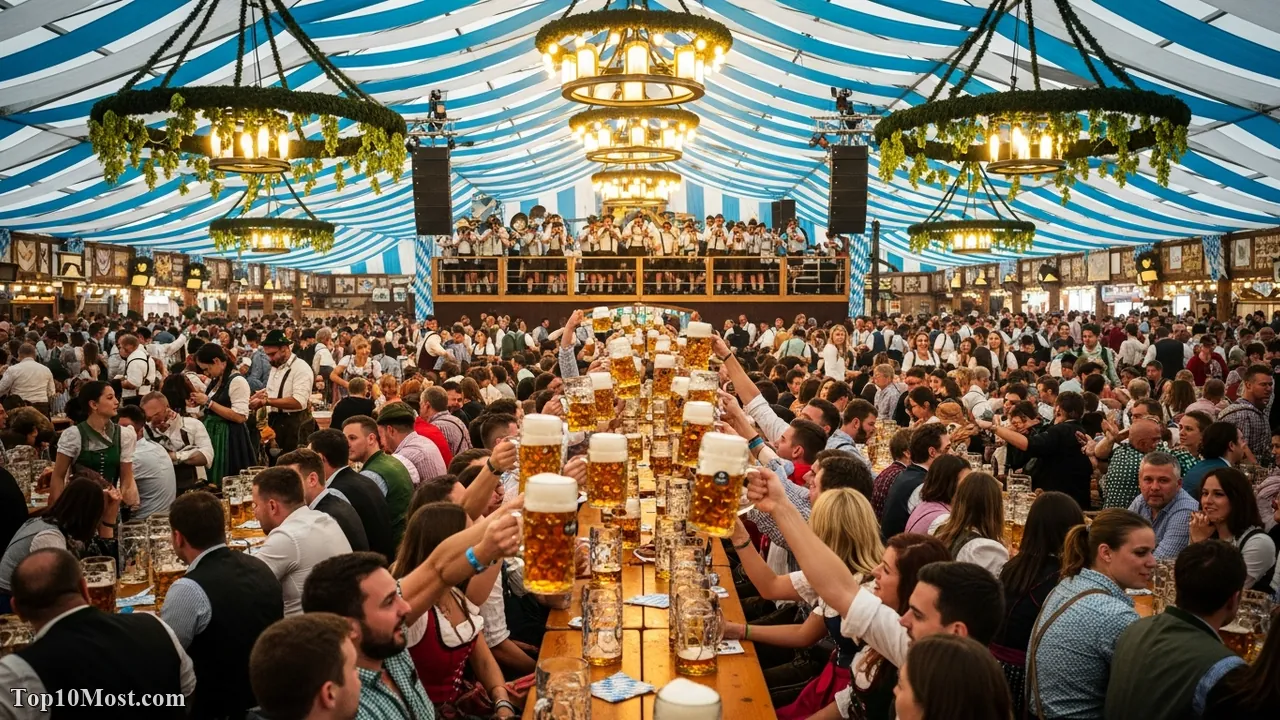
Oktoberfest sits in the top three because of its unparalleled “Joy Factor” in terms of communal energy. There is no other harvest festival where thousands of strangers stand on benches, lock arms, and sing together in unison. It is a celebration of abundance in its most boisterous form. The festival celebrates the barley and hops harvest, transforming them into “liquid gold” that dissolves social barriers.
Beyond the beer tents, the “Oide Wiesn” (Old Oktoberfest) section offers a glimpse into the festival’s past with vintage rides and traditional folk music. The joy of Oktoberfest is its ability to turn a massive crowd into a single, happy entity. It is loud, it is hearty, and it is a defiant celebration of life and leisure after the hard work of the harvest season.
Key Highlights:
- Location: Theresienwiese, Munich, Germany.
- Consumption: Over 7 million liters of beer are consumed annually.
- Attire: Wearing Lederhosen and Dirndls is standard and encouraged.
Top 2. Mid-Autumn Festival (China & Vietnam)
Celebrated across East and Southeast Asia, the Mid-Autumn Festival (or Moon Festival) honors the full moon, which is believed to be at its brightest and roundest during the harvest. This roundness symbolizes reunion and completeness. Families gather to admire the moon, light paper lanterns, and share mooncakes—dense pastries filled with lotus paste or red bean. In Vietnam, it is also largely a children’s festival, with parades of star-shaped lanterns and lion dances.
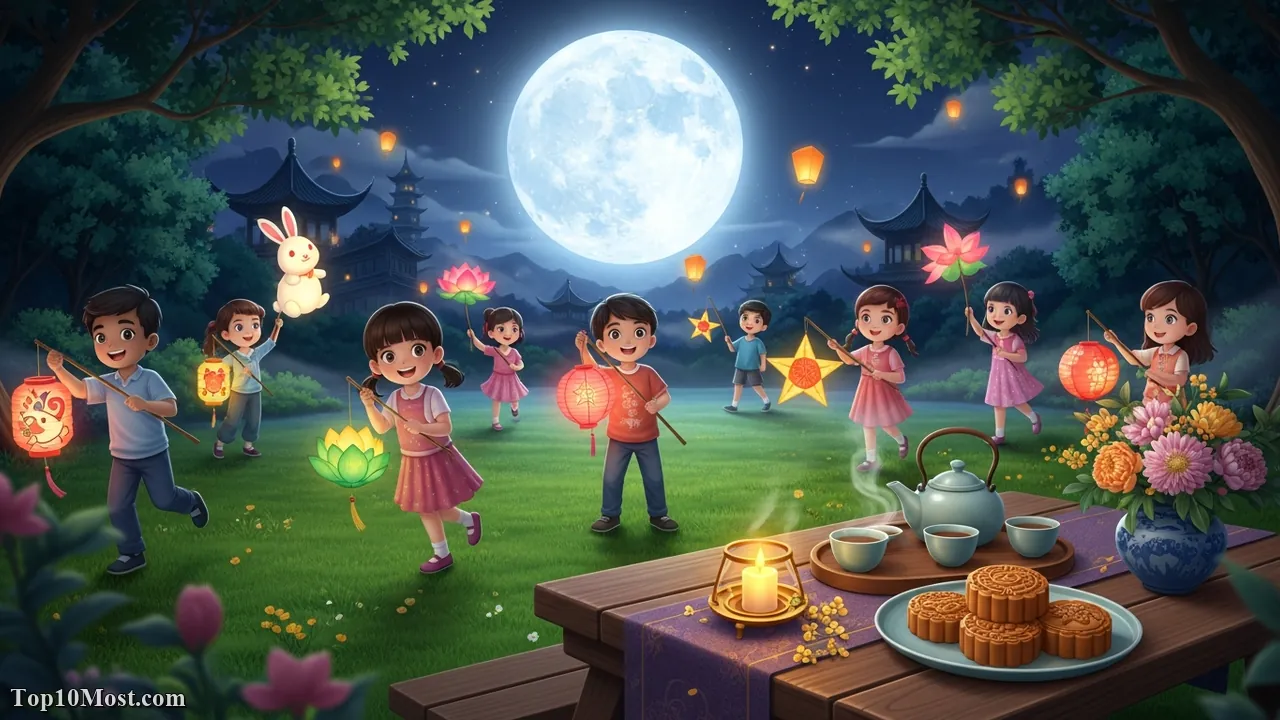
This festival is our runner-up because of its poetic beauty and emotional depth. It connects the agricultural harvest with celestial wonder. The sight of thousands of glowing lanterns floating on water or rising into the sky creates an atmosphere of magic and hope. It is a quieter, more reflective joy compared to Oktoberfest, but deeply powerful in its emphasis on unity and harmony.
The folklore surrounding the festival—such as the story of Chang’e living on the moon—adds a layer of storytelling that captivates both children and adults. Sharing a mooncake, cut into wedges equal to the number of family members, is a simple ritual that speaks volumes about the importance of holding one’s family close. It is a festival of light in the gathering dark of autumn.
Key Highlights:
- Key Symbol: The Full Moon, representing reunion.
- Food: Mooncakes (often with a salted egg yolk representing the moon).
- Visuals: Extensive use of colorful paper lanterns and dragon dances.
Top 1. Thanksgiving (USA & Canada)
Topping our list is Thanksgiving, the quintessential harvest celebration that has become the global gold standard for gratitude. While the dates differ (October in Canada, November in the USA), the core elements remain the same: a massive roasted turkey, a cornucopia of autumn vegetables, and a gathering of family and friends that transcends religious and political lines. It commemorates the survival of early settlers and their cooperation with Indigenous peoples, though the modern focus is firmly on personal gratitude.
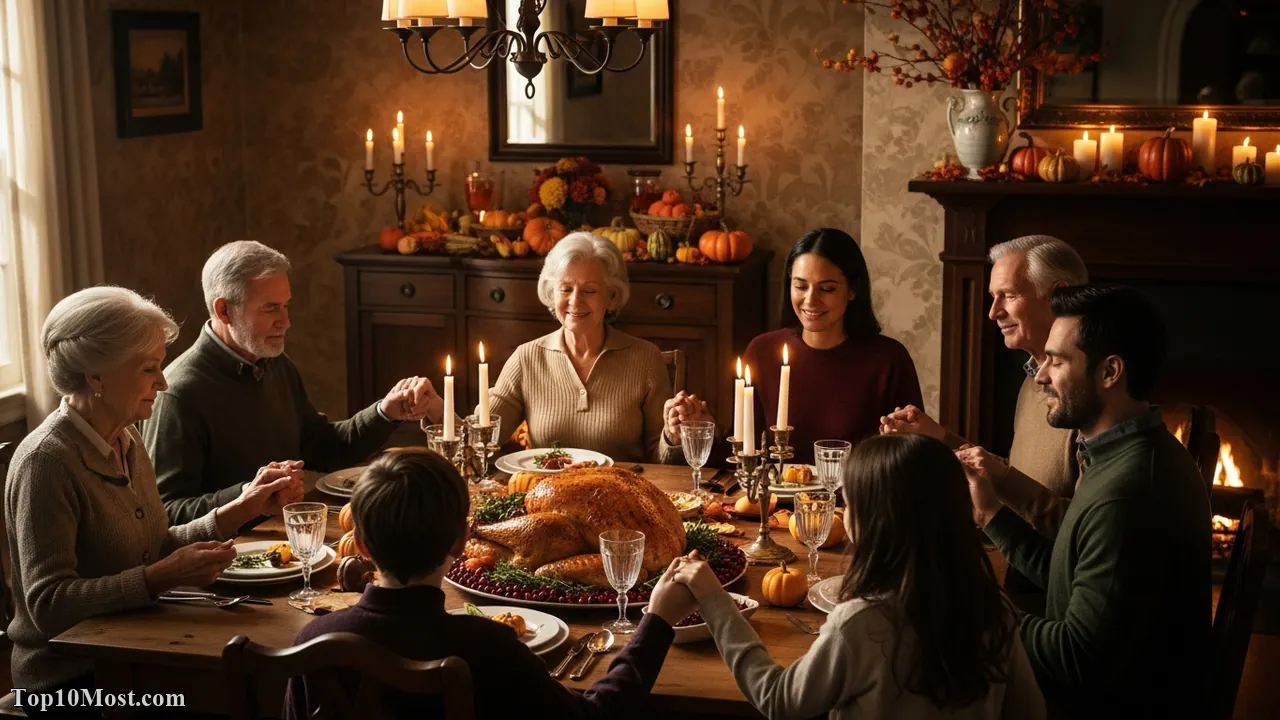
We rank Thanksgiving number one because it is the most purely distilled “Harvest Festival” in the modern consciousness. It is one of the few major holidays that is not tied to a specific religion or a gift-giving commercial frenzy; the sole purpose is to eat and to say “thank you.” This singular focus on gratitude gives it a unique emotional weight. It forces a pause in the frantic pace of modern life to appreciate the basics: food, shelter, and companionship.
There is a profound comfort in the predictability of the menu—cranberry sauce, stuffing, pumpkin pie—that acts as a culinary anchor for millions of people. Whether it is the roar of a football game in the background or the quiet moment of grace before the meal, Thanksgiving encapsulates the warmth, the abundance, and the joy of the harvest better than any other celebration. It is the ultimate “comfort food” holiday.
Key Highlights:
- Focus: Secular and interfaith gratitude, focusing on the “harvest” of life.
- Iconography: The Turkey and the Cornucopia (Horn of Plenty).
- Tradition: Often includes parades (like Macy’s) and American football.
Conclusion
From the quiet spiritual offerings in Bali to the bench-standing choruses of Munich, harvest festivals remind us that gratitude is a universal human emotion. While the crops and the customs may vary, the core impulse is the same: to pause, look at what we have gathered, and share it with those we love. These Top 10 Most Joyful Harvest Festivals offer a roadmap to experiencing the world’s diverse cultures at their most generous and welcoming moments.
As we move through late 2025 and into 2026, these festivals are more important than ever. In a digital age, they ground us in the physical world—in the taste of a yam, the light of a lantern, and the warmth of a crowded room. We hope this list inspires you to find your own moment of harvest joy, wherever you may be.