Germany, a nation renowned for its engineering and industry, holds an equally profound identity as a country of deep, enchanting woodlands. Approximately one-third of its total land area is covered by forests, remnants of the ancient Hercynian Forest that once spanned much of Europe. These woods are not mere collections of trees; they are ecological treasures, cultural icons, and the very inspiration for countless fairy tales by the Brothers Grimm.
At Top 10 Most, our objective is to explore and explain the majesty of these landscapes. This ranking is based on a reasoned analytical perspective, considering a blend of factors, including sheer size, biodiversity (especially old-growth status), unique geological features, and the forest’s cultural and historical significance as a tourist draw. Every entry is backed by verifiable sources that reflect the current time context, emphasizing the ongoing efforts to transform pure spruce plantations into stable, diverse mixed forests.
The data in this article is compiled and analyzed based on information updated as of December 2025, ensuring our guide to Germany’s green heart is as current and authoritative as possible. These forests represent the finest blend of natural preservation and scenic beauty that Germany has to offer.
Table of the Top 10 Most Beautiful and Significant Forest Regions in Germany
The following table presents our ranking of the most beautiful and ecologically/culturally significant forest regions, primarily encompassing the country’s prominent National Parks and large protected natural areas.
| Rank | Forest/Region Name | State (Bundesland) | Primary Feature/Significance | Est. Area (Total Forested Region) |
|---|---|---|---|---|
| 1 | Black Forest (Schwarzwald) | Baden-Württemberg | Largest forested mountain range; cultural icon (cuckoo clocks, fairy tales) | Approx. 6,000 km² |
| 2 | Bavarian Forest National Park (Bayerischer Wald) | Bavaria | Germany’s first and largest protected forest area; “let nature be nature” philosophy | Approx. 240 km² (National Park) |
| 3 | Saxon Switzerland National Park (Sächsische Schweiz) | Saxony | Dramatic sandstone mountains (Elbe Sandstone Mountains) with ancient forests | Approx. 93.5 km² (National Park) |
| 4 | Harz National Park | Lower Saxony, Saxony-Anhalt | Home to Mount Brocken; legendary forest steeped in myths (witches, unicorns) | Approx. 247 km² (National Park) |
| 5 | Hainich National Park | Thuringia | UNESCO World Heritage site; largest coherent deciduous forest area in Germany | Approx. 75 km² (National Park) |
| 6 | Eifel National Park | North Rhine-Westphalia | “National Park in development”; focus on returning commercial spruce forests to wilderness | Approx. 107 km² (National Park) |
| 7 | Berchtesgaden National Park | Bavaria | Germany’s only Alpine National Park; high-altitude forests and dramatic peaks | Approx. 210 km² (National Park) |
| 8 | Kellerwald-Edersee National Park | Hesse | UNESCO World Natural Heritage site protecting one of Central Europe’s largest continuous red beech forests | Approx. 57 km² (National Park) |
| 9 | Jasmund National Park | Mecklenburg-Vorpommern | Smallest National Park, famous for ancient beech forests and dramatic white chalk cliffs | Approx. 30 km² (National Park) |
| 10 | Thuringian Forest (Thüringer Wald) | Thuringia | The “Green Heart of Germany”; the largest uninterrupted forest area in Thuringia | Approx. 1,000 km² (Total region) |
Top 10. Thuringian Forest (Thüringer Wald)
The Thuringian Forest earns its spot by being recognized as the “Green Heart of Germany,” a name earned by virtue of being the largest uninterrupted forest area in Thuringia. This low-mountain range, covered extensively in lush woodland, is historically and currently defined by the famous Rennsteig, the country’s oldest and most renowned long-distance hiking trail. The forest’s beauty lies in its vast, rolling expanses of mixed woodland, providing a sense of endless green tranquility that is deeply important to the regional identity.
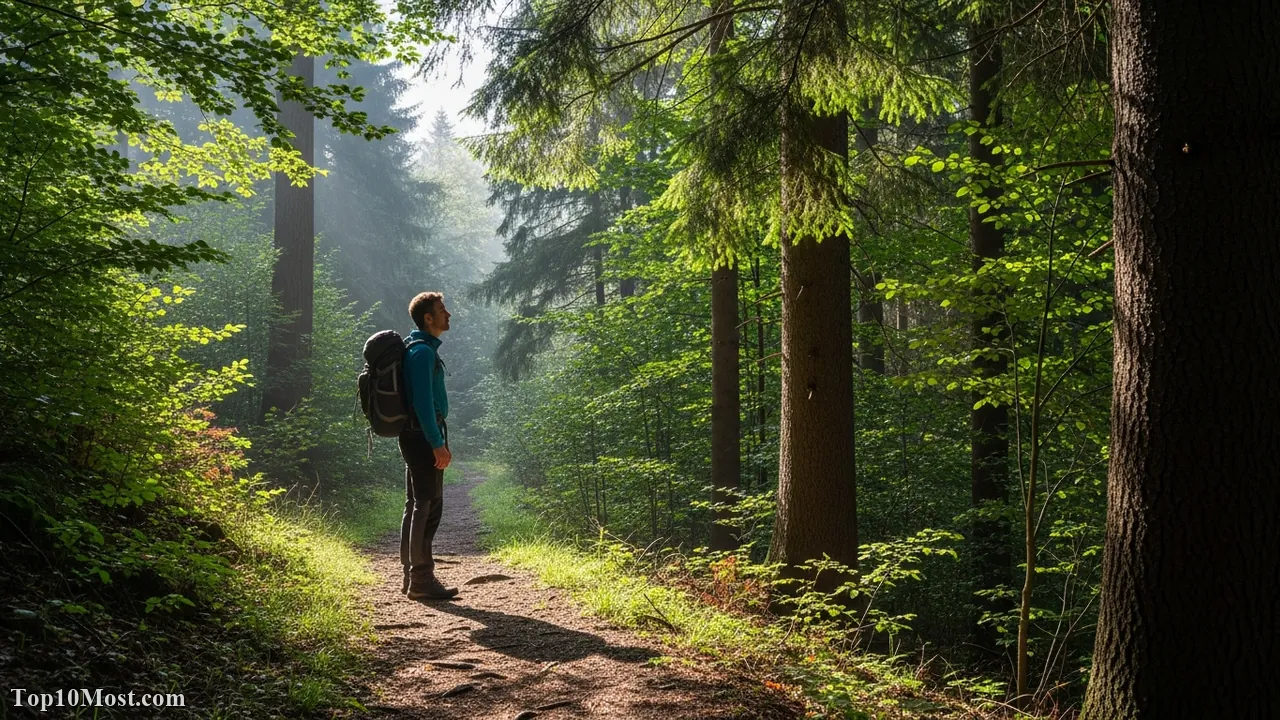
Its significance goes beyond scenic appeal; the Thuringian Forest is a crucial ecological corridor, boasting a wide network of trails that trace along its river valleys, highland meadows, and ridges. While historically dominated by commercial forestry, modern conservation efforts are focused on enhancing its natural biodiversity, particularly in its extensive network of protected landscapes. The forest remains a cornerstone of the regional economy, primarily through sustainable tourism and timber production.
To walk the Rennsteig is to travel through German history, a path once used by traders and messengers that now offers a reflective journey through pristine nature. The reflective silence and sheer scope of the Thuringian Forest serve as a poignant reminder of Germany’s enduring commitment to preserving its fundamental natural heritage, a commitment that is increasingly vital in our current time of climate consciousness.
Key Highlights:
- Primary Feature: The 169 km long Rennsteig hiking trail runs its length.
- Cultural Status: Known as the “Green Heart of Germany.”
- Ecology: Contains varied landscapes including moors, meadows, and mixed woodland.
- Significance: One of Germany’s most famous and oldest historical routes.
Top 9. Jasmund National Park
Located on the Baltic Sea island of Rügen, Jasmund National Park is a testament to the fact that beauty is not defined by size. As Germany’s smallest national park, Jasmund is dominated by the ancient Stubnitz beech forest, which dramatically meets the sea at the famous Königsstuhl (King’s Chair), a spectacular chalk cliff. The contrast between the emerald green canopy of the beech trees—which are part of a UNESCO World Heritage site—and the dazzling white of the cliffs plunging into the turquoise Baltic Sea creates one of the most uniquely breathtaking vistas in all of Germany.
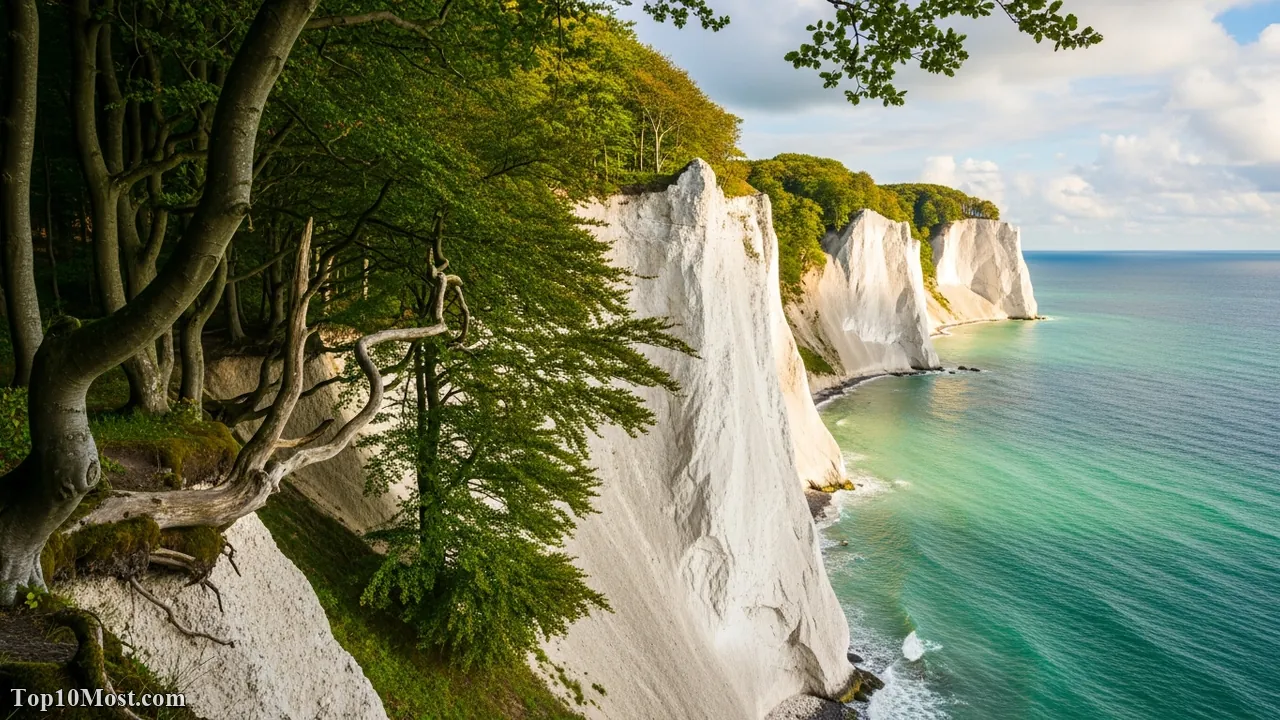
The park’s ranking is elevated by the unique geological feature of the chalk cliffs, which have been a subject for Romantic-era painters like Caspar David Friedrich. Ecologically, the old-growth beech forests, many of which have been allowed to develop naturally for centuries, are invaluable for biodiversity, hosting rare species and providing a habitat that is becoming increasingly scarce in central Europe. The forest floor, rich with ferns and mosses, offers a truly primeval experience that few other German forests can match.
Stepping onto the observation deck at the Königsstuhl, you feel an immense sense of historical continuity—a place where nature’s raw beauty has captured the human imagination for centuries. The relatively small, self-contained nature of Jasmund’s forest makes its impact even stronger; it is a perfectly preserved, miniature world where the forest meets the ocean in a sublime spectacle. This forest is a powerful example of nature as art.
Key Highlights:
- Primary Feature: Königsstuhl (King’s Chair) chalk cliffs overlooking the Baltic Sea.
- Status: Contains UNESCO World Heritage Ancient Beech Forests.
- Size: Smallest National Park in Germany, making its concentration of beauty high.
- Artistic Legacy: Famously painted by Romantic-era artist Caspar David Friedrich.
Top 8. Kellerwald-Edersee National Park
Kellerwald-Edersee National Park in Hesse holds a prestigious ranking due to its designation as a UNESCO World Natural Heritage Site, specifically for protecting a vast, continuous area of near-natural red beech forests. These majestic European beech stands are remnants of the expansive forests that once covered the continent, characterized by smooth, silver-grey trunks reaching toward the sky. The beauty here is in the quiet grandeur of the ancient trees, untouched by modern forestry and allowed to follow their natural life cycle.
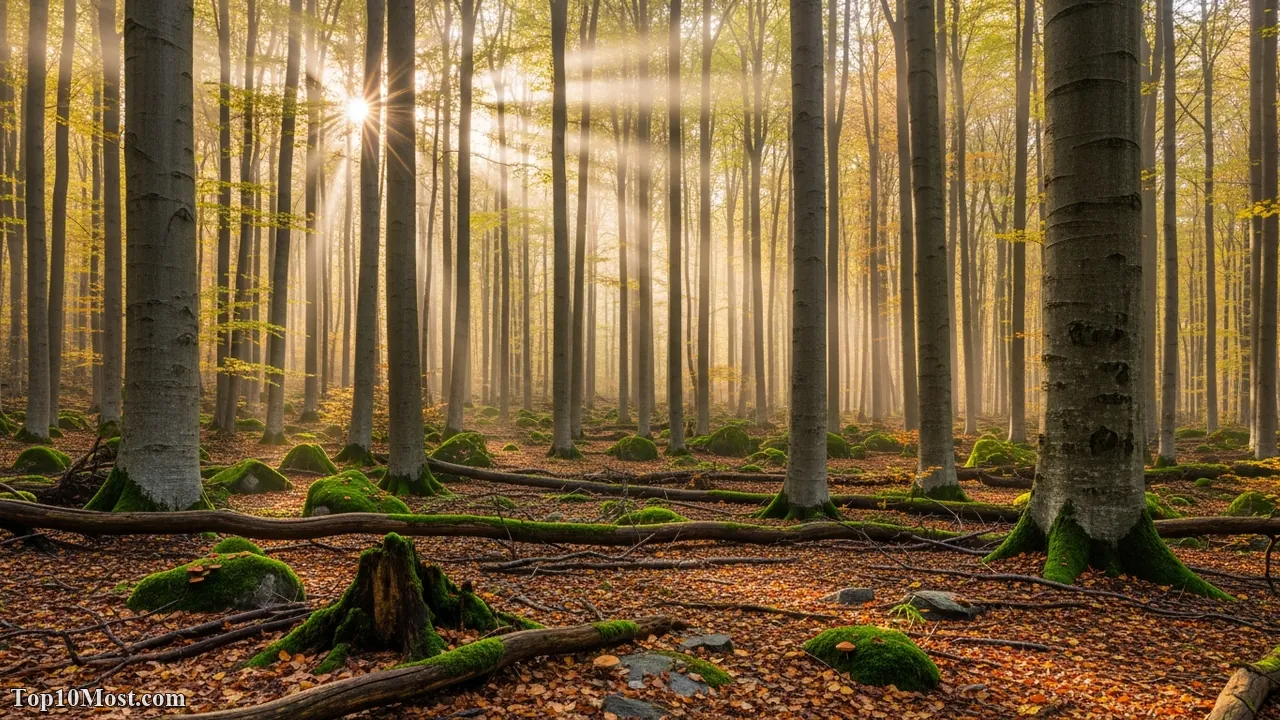
The park is a crucial sanctuary for species dependent on old forest ecosystems, including the elusive wildcat, various bat species, and rare fungi. The “ocean of beeches” is interrupted by the stunning Lake Edersee, whose fjord-like arms enhance the scenic diversity of the region, making it popular for water sports and hiking. The park’s commitment to “letting nature be nature” makes it an authoritative example of wilderness preservation in a highly cultivated country like Germany.
The deep stillness one finds walking among the veteran beech trees in Kellerwald-Edersee is profoundly spiritual. It’s an immersion into a cathedral of nature, where the interplay of light and shadow among the tall, straight trunks evokes a powerful sense of timelessness. This park is a reminder that true beauty often lies in allowing nature to express its oldest, wildest self.
Key Highlights:
- Status: UNESCO World Natural Heritage Site (Ancient Beech Forests).
- Ecology: One of Central Europe’s largest remaining continuous red beech forest areas.
- Landmark: Borders the scenic, fjord-like Lake Edersee.
- Wildlife: Important habitat for the European wildcat and over 800 species of butterflies.
Top 7. Berchtesgaden National Park
Nestled in the extreme south, Berchtesgaden National Park earns its place as Germany’s only Alpine National Park, defined by a stunning blend of high-altitude forests, towering peaks, and the pristine, emerald-green Königssee lake. The forests here are dramatically different from the lowlands, composed primarily of tough mountain spruce, fir, and pine, clinging to steep slopes and thriving in a rugged environment. The sheer verticality of the landscape, with the Watzmann massif dominating the skyline, lends the forest an unparalleled, almost intimidating, beauty.
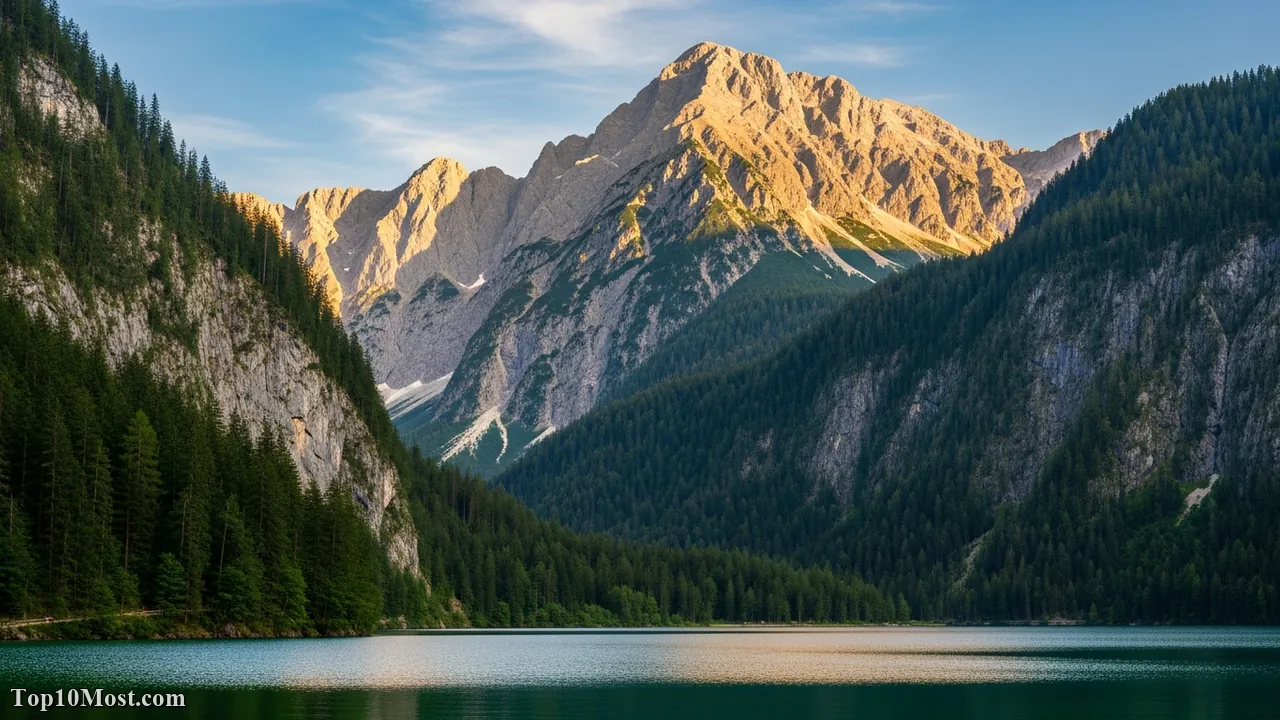
This park’s ranking is a function of its dramatic, largely untouched Alpine wilderness. It is a UNESCO-designated biosphere reserve where ecosystems range from valley floor mixed forests to high-alpine plant life. The challenge of the terrain has naturally preserved its authenticity, focusing on wildlife such as red deer, golden eagles, and the ibex. The forest acts as a critical buffer zone and a visual frame for the dramatic geological features, ensuring the Top 10 Most criteria for uniqueness are overwhelmingly met.
The experience of tracing a trail through Berchtesgaden’s forests is one of constant wonder, with every turn offering a cinematic vista of rock and wood. This forest does not whisper; it declares its majesty with silent, snow-capped peaks and deep, shaded valleys. It represents the untamed, high-altitude soul of German wilderness, a sanctuary where nature is sovereign and the human scale is utterly humbled.
Key Highlights:
- Status: Germany’s only Alpine National Park.
- Geology: Framed by the Watzmann massif and surrounding the pristine Königssee lake.
- Ecology: High-altitude mountain forest ecosystem (spruce, fir, pine).
- Protection: UNESCO Biosphere Reserve with strict nature conservation.
Top 6. Eifel National Park
Eifel National Park, located near the Belgian border in North Rhine-Westphalia, is often referred to as a “national park in development,” yet it already showcases immense beauty through its dedication to ecological restoration. The core objective is to return former commercial spruce plantations to native, species-rich deciduous forests, primarily composed of oak and beech. This transformation process, with its visible return to natural dynamics, lends the forest a compelling, evolving beauty that speaks to conservation hope in our current time.
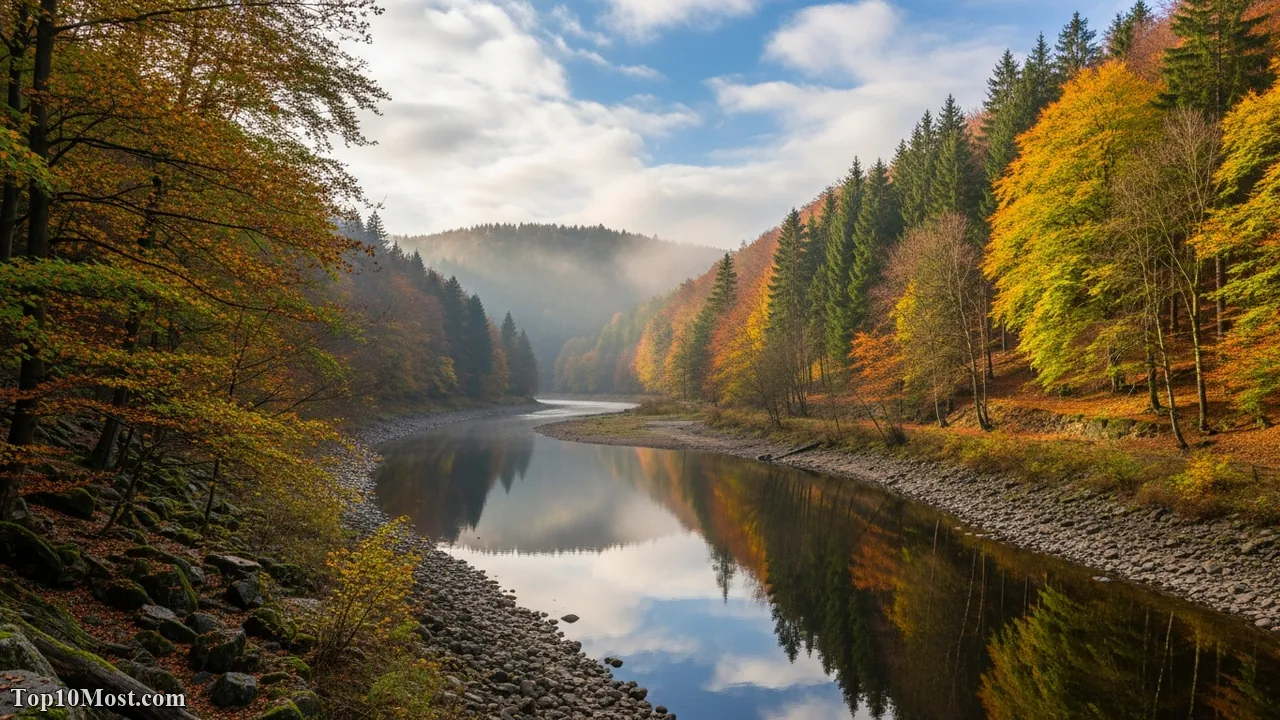
The park is defined by a diverse landscape of plateaus, deep river valleys, and the historic Wildnis-Trail (Wilderness Trail), which winds through untouched landscapes. The forest is home to charismatic species like the European wildcat and various species of owls and bats, proving that active restoration yields impressive biodiversity. Furthermore, the park includes several picturesque reservoirs, such as the Rursee, which add a stunning aquatic dimension to the dense woodland scenery.
Witnessing the Eifel is to experience a forest in the process of healing and rebirth. It’s not just a beautiful place to hike; it’s an active lesson in conservation, a demonstration of nature’s resilience when given the chance to reclaim its land. The focus on ecological succession makes this a deeply meaningful entry on our list, showing that beauty can be found not just in old perfection, but in vigorous, dynamic restoration.
Key Highlights:
- Conservation Focus: Active conversion of commercial forests back to native deciduous wilderness.
- Wildlife: Designated sanctuary for the European wildcat and red deer.
- Features: Defined by plateaus, reservoirs, and the 85 km Wildnis-Trail.
- Location: Close proximity to major urban areas, making it a critical green lung.
Top 5. Hainich National Park
Hainich National Park in Thuringia stands out for being the largest coherent deciduous forest area in Germany to be protected and allowed to return to its natural state, securing its UNESCO World Natural Heritage status. This park is the embodiment of Germany’s rich beech forest heritage, where trees—primarily beech and oak—are allowed to age and die naturally, creating a true primeval atmosphere. The untouched nature of this area, much of which was protected for decades as a military exclusion zone, has allowed the forest to mature into a spectacular, layered ecosystem.
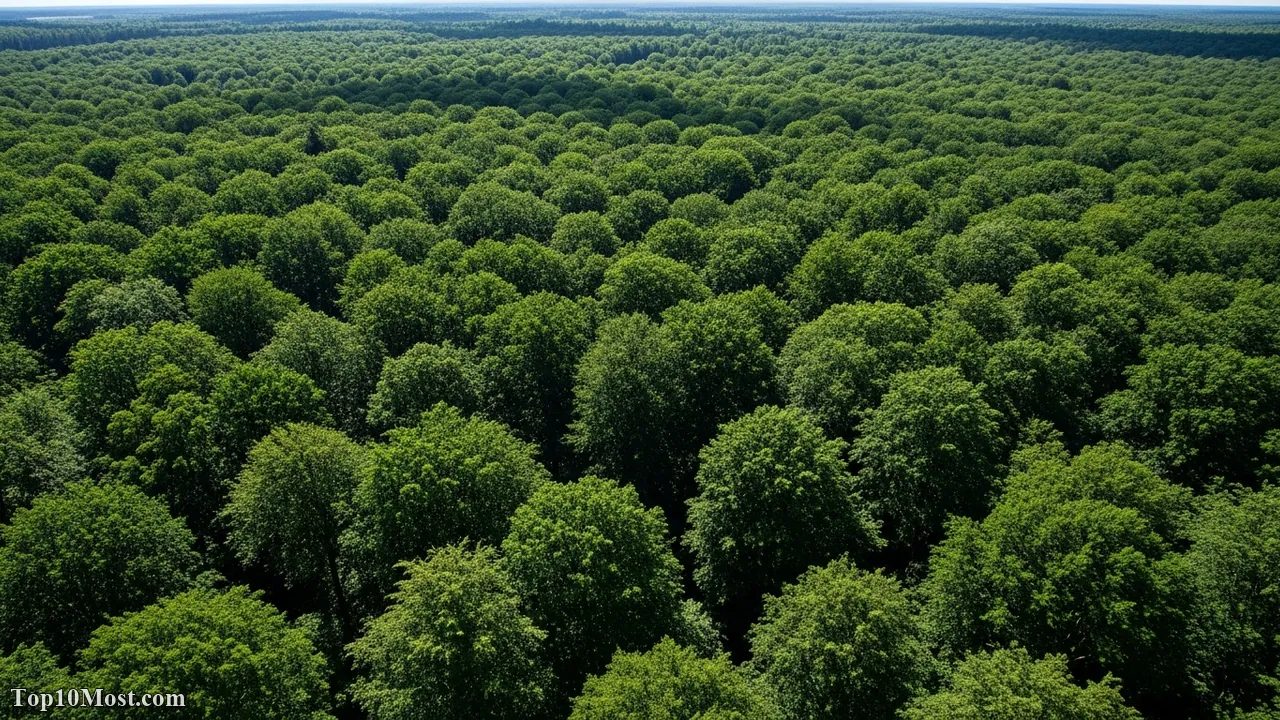
The dense forest canopy in Hainich is best viewed from the park’s most famous attraction: the Baumkronenpfad, or treetop canopy walk. This elevated trail offers a unique, analytical perspective on the forest, allowing visitors to appreciate the complexity of the ecosystem from the emergent layer down to the forest floor. Ecologically, the undisturbed nature of the forest floor and the high percentage of deadwood support a fantastic array of rare insects, fungi, and birds, showcasing pure, unmanaged biodiversity.
Walking the canopy trail in Hainich is a transformative experience, offering an intimate glimpse into the very crown of the forest. You are not just looking at trees; you are viewing a living, breathing ecosystem from a bird’s-eye perspective. The feeling of being suspended above this immense, wild blanket of green confirms its status as one of Germany’s most significant and beautiful green treasures.
Key Highlights:
- Status: UNESCO World Natural Heritage Site (Ancient Beech Forests).
- Size: Largest contiguous deciduous forest area in Germany.
- Attraction: Home to the popular Baumkronenpfad (treetop canopy walk).
- Preservation: Formerly a military zone, allowing for remarkable preservation of old-growth nature.
Top 4. Harz National Park
The Harz National Park, covering a significant part of the Harz mountain range, is perhaps the most mythical entry on our list, known historically as the site of the legendary Hexentanzplatz (Witches’ Dance Floor) and the inspiration for Goethe’s Faust. Its beauty is rugged and dramatic, characterized by high-altitude moorlands, granite outcrops, deep valleys, and extensive mixed forests of spruce and beech. The forest atmosphere, often cloaked in mist, gives it an iconic, fairy-tale quality that resonates deeply with the German cultural imagination.
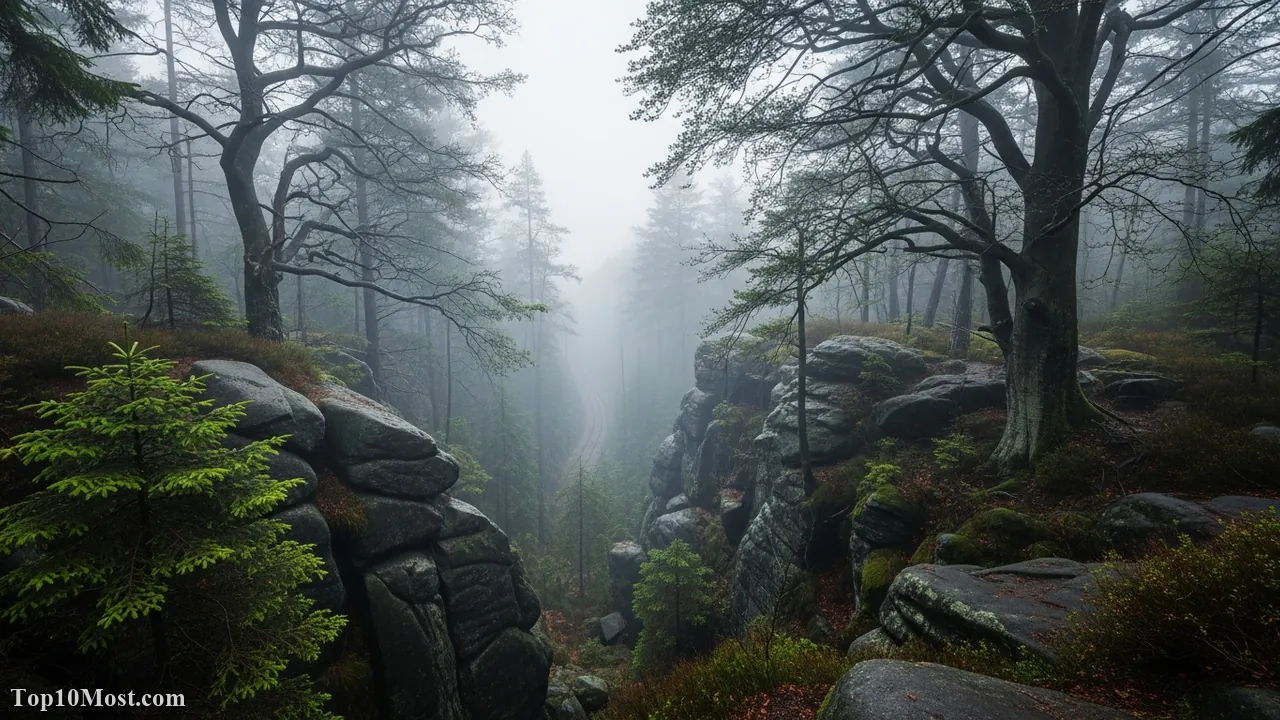
The park is an ecological highlight for its successful reintroduction of the European Lynx, whose presence signifies a healthy, functioning ecosystem. It also contains the highest peak in Northern Germany, the Brocken, whose summit is home to sub-alpine plant life and offers expansive views over the surrounding forests. The historic narrow-gauge steam trains that cut through the woodlands add a nostalgic, romantic dimension to the landscape, blending human history with raw nature.
To visit Harz is to step into a landscape charged with history and legend, where every moss-covered rock and fog-shrouded peak seems to hold a story. The forest’s inherent drama, amplified by the brooding presence of the Brocken, makes it an emotionally resonant experience. It is a place where the cultural and natural beauty of the forest are inextricably intertwined, offering more than just scenic views—it offers a connection to ancient myths.
Key Highlights:
- Cultural Icon: Setting for German myths and legends (Witches’ Dance Floor, Faust).
- Ecology: Successful reintroduction area for the European Lynx.
- Feature: Contains the Brocken, the highest peak in Northern Germany.
- Accessibility: Accessible via the historic Harz narrow-gauge steam trains.
Top 3. Saxon Switzerland National Park (Sächsische Schweiz)
The Saxon Switzerland National Park secures a top-three spot by offering a truly unique geological landscape unmatched in Germany. Its forests grow among and atop the dramatic Elbe Sandstone Mountains, a deeply eroded region of colossal rock formations, table mountains, and jagged spires. The forests here—a mixture of pine, spruce, and deciduous trees—are beautiful not just in their own right, but for the way they frame and cling to the bizarre rock formations, creating vistas that look as if they belong on another planet.
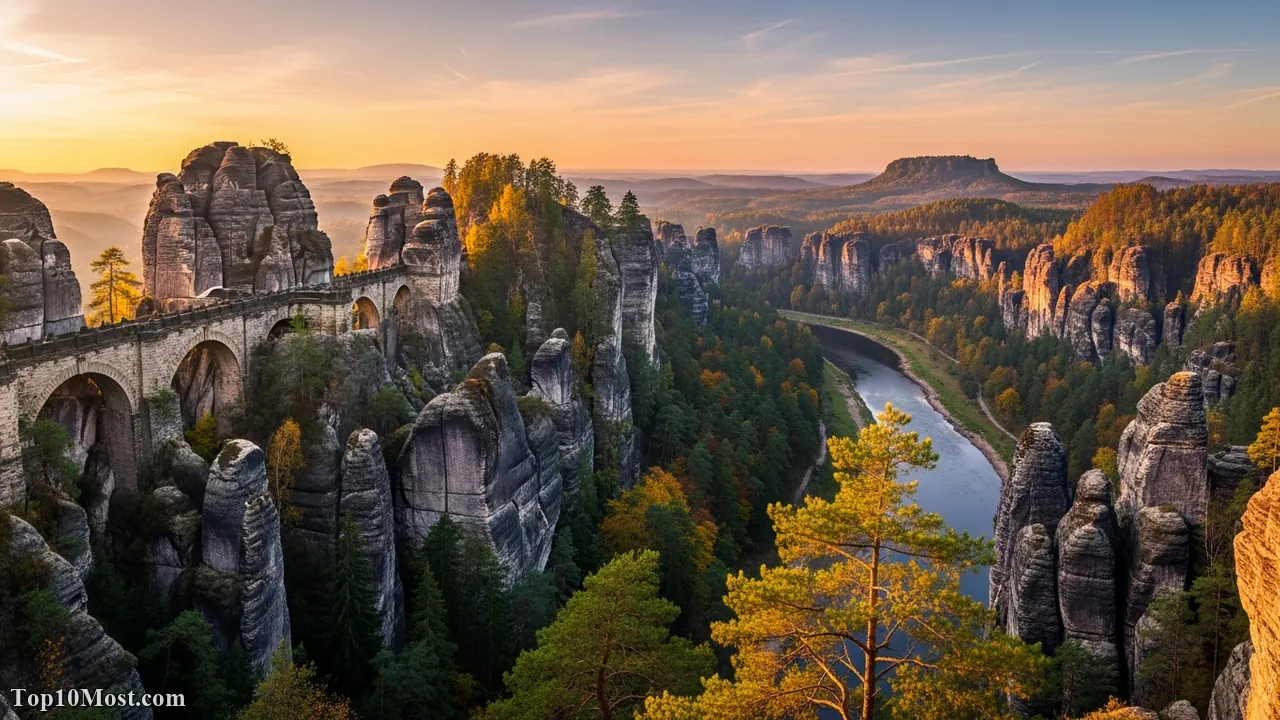
This is a forest of contrasts: deep, lush gorges carved by the Elbe River juxtaposed with the dry, high-altitude rock gardens. The area is famous for the Bastei Bridge, a spectacular stone structure that threads through the rock formations, offering a reasoned analytical perspective on the geological history of the region. The Top 10 Most authority is derived from the sheer uniqueness of the environment, attracting climbers and hikers along the historic Malerweg (Painter’s Trail).
The feeling of standing on the Bastei and looking out over the sea of green forest broken by massive stone fingers is nothing short of awe-inspiring. It’s a landscape that forces you to acknowledge the powerful, slow-motion forces of geological time. The forests of Saxon Switzerland are the quiet, green witnesses to millions of years of natural history, and their beauty is wild, rugged, and profoundly inspirational.
Key Highlights:
- Primary Feature: Forests growing within the unique Elbe Sandstone Mountains (table mountains, spires).
- Landmark: Home to the iconic Bastei Bridge and rock formations.
- Culture: Traversed by the famous Malerweg (Painter’s Trail).
- Geology: Deep river gorges and rich rock climbing history.
Top 2. Bavarian Forest National Park (Bayerischer Wald)
Holding the second spot, the Bavarian Forest National Park is Germany’s oldest national park (established in 1970) and forms, together with the adjacent Czech Šumava National Park, the largest contiguous forest reserve in Central Europe. Its guiding principle is “let nature be nature,” meaning human intervention is minimal, allowing the forest to evolve into a true wilderness, a Urwald or primeval forest. This dedication to allowing natural processes, including tree decay and wind damage, to shape the landscape has created a powerful, raw, and highly biodiverse beauty.
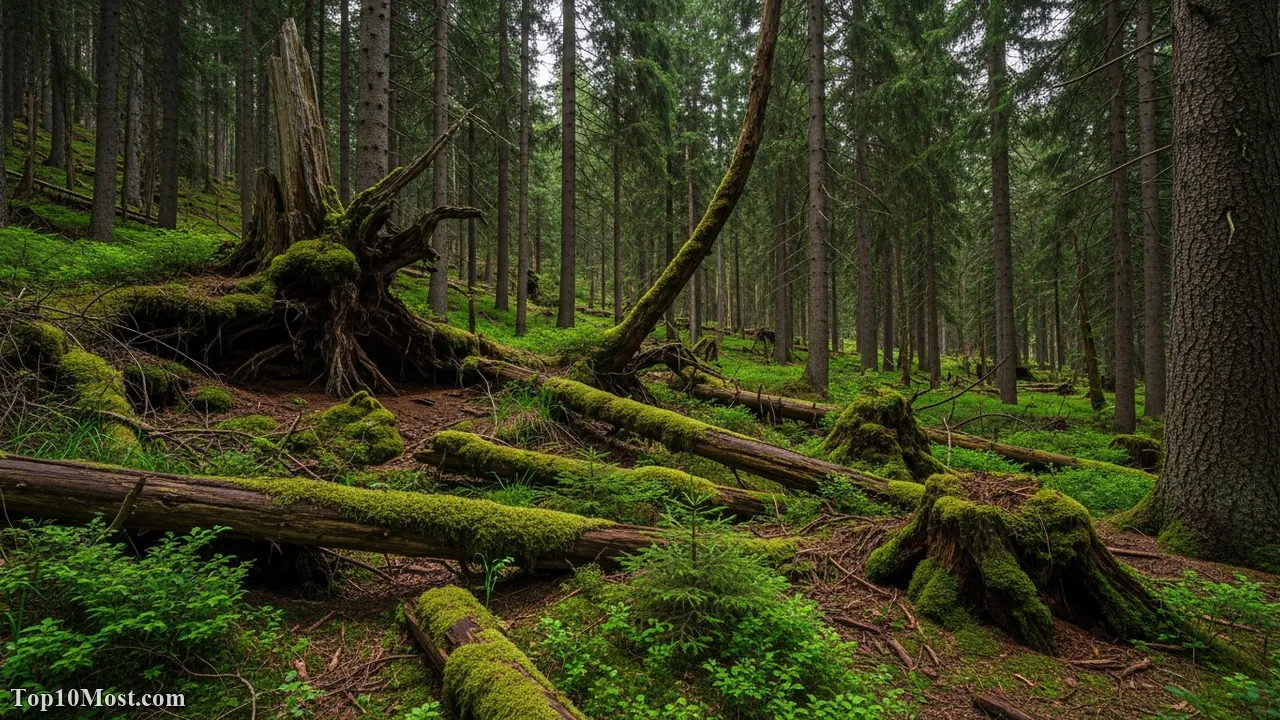
The park’s immense size and history give it unparalleled ecological authority. It is the premier showcase for Germany’s forest conservation philosophy, where yesterday’s commercial woodlands are transforming into tomorrow’s native jungle. The high percentage of deadwood provides a vital habitat for thousands of species, including the elusive Lynx, wildcat, and various rare beetles. The beauty here is in the rugged authenticity—a true return to the wild, visible in the high-mountain spruce forests and the deep, misty valleys.
To walk through the Bavarian Forest is to experience time travel. The presence of decaying trees and the sound of silence punctuated by wildlife underscore the concept of genuine wilderness. It is a powerful, almost confrontational beauty that challenges the traditional manicured European ideal, embodying the meaning behind the greatness of unmanaged nature. This forest is a living, breathing monument to Germany’s commitment to profound ecological restoration in the current time.
Key Highlights:
- Status: Germany’s first National Park (1970) and largest contiguous forest reserve in Central Europe.
- Philosophy: Guided by the principle “let nature be nature” (Urwald concept).
- Ecology: Highest biodiversity due to high deadwood content; home to the Lynx and wildcat.
- Features: Contains high mountain peaks (Großer Rachel) and ancient forest areas.
Top 1. Black Forest (Schwarzwald)
The Black Forest (Schwarzwald) reigns supreme as the Top 10 Most beautiful forest region in Germany. It is not just a forest but an entire cultural, geographical, and ecological entity—Germany’s largest forested mountain range, covering over 6,000 km². Its fame stems from its dense, dark canopy of pines and firs, which gave it the name Schwarzwald (Black Forest), and its deeply ingrained connection to German culture, being the spiritual home of the Brothers Grimm fairy tales, cuckoo clocks, and the iconic Black Forest gateau.
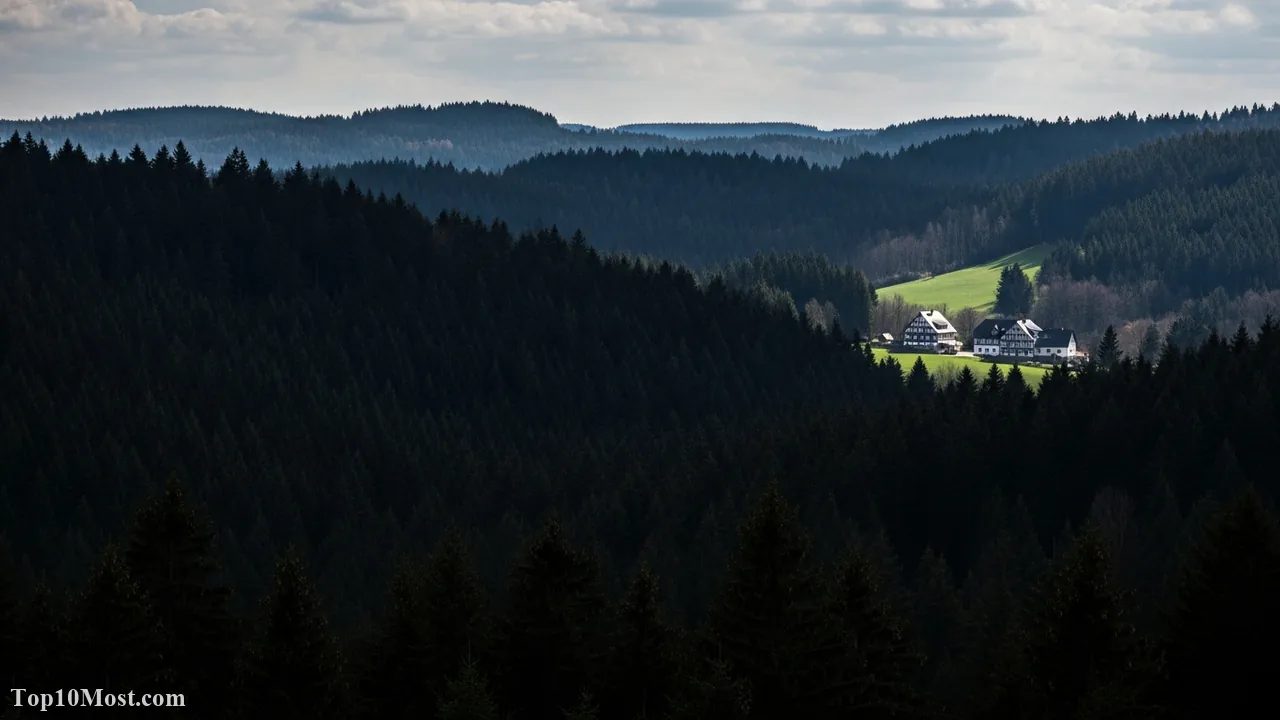
The forest’s beauty is multifaceted, ranging from the protected, untamed wilderness of the Black Forest National Park in the north, to the picturesque, rolling hills and wide valleys of the south. Its ranking is secured by this combination of immense size, vast recreational appeal (hiking, skiing, spa towns like Baden-Baden), and a rich ecological diversity that includes glacial lakes (like the Titisee) and the source of the Danube River. The ongoing efforts to diversify the forest, moving away from monocultures toward resilient mixed woods, ensure its enduring importance in the current time.
The Black Forest is more than a destination; it is an experience that touches all the senses. It has a warm, familiar feel that belies its wild heart. The deep, muffled sounds of the forest, the cool, pine-scented air, and the omnipresent sense of folklore make it the definitive German forest. It is a perfect blend of managed nature and untouched wilderness, an icon of both cultural heritage and natural grandeur, cementing its position as the most beautiful and significant forest in all of Germany.
Key Highlights:
- Status: Germany’s largest forested mountain range (approx. 6,000 km²).
- Cultural Icon: Spiritual home of Brothers Grimm fairy tales, cuckoo clocks, and Black Forest cake.
- Features: Contains the Black Forest National Park, glacial lakes (Titisee), and the source of the Danube.
- Biodiversity: Diverse landscape of high-altitude conifers, mixed forest, and famous high-road routes.
Conclusion
The forests of Germany are a profound national treasure, acting not merely as green spaces but as custodians of biological diversity and cultural myth. From the towering conifers of the Black Forest that cradle the nation’s most famous folklore, to the rugged, restored wilderness of the Bavarian Forest National Park, each entry on this Top 10 Most list tells a story of resilience, natural beauty, and dedicated conservation. In a world increasingly defined by urbanity, these forests offer essential sanctuaries—places of reflection, renewal, and profound connection to the natural world.
Our analysis confirms that the beauty of a forest is often directly proportional to its protection and allowance for natural development. The dedication of German forestry and conservation efforts to promote resilient, mixed-species forests ensures that these majestic landscapes will continue to define the nation for generations to come. They are the green lungs of Central Europe, and their continued health is a vital measure of Germany’s ecological commitment.