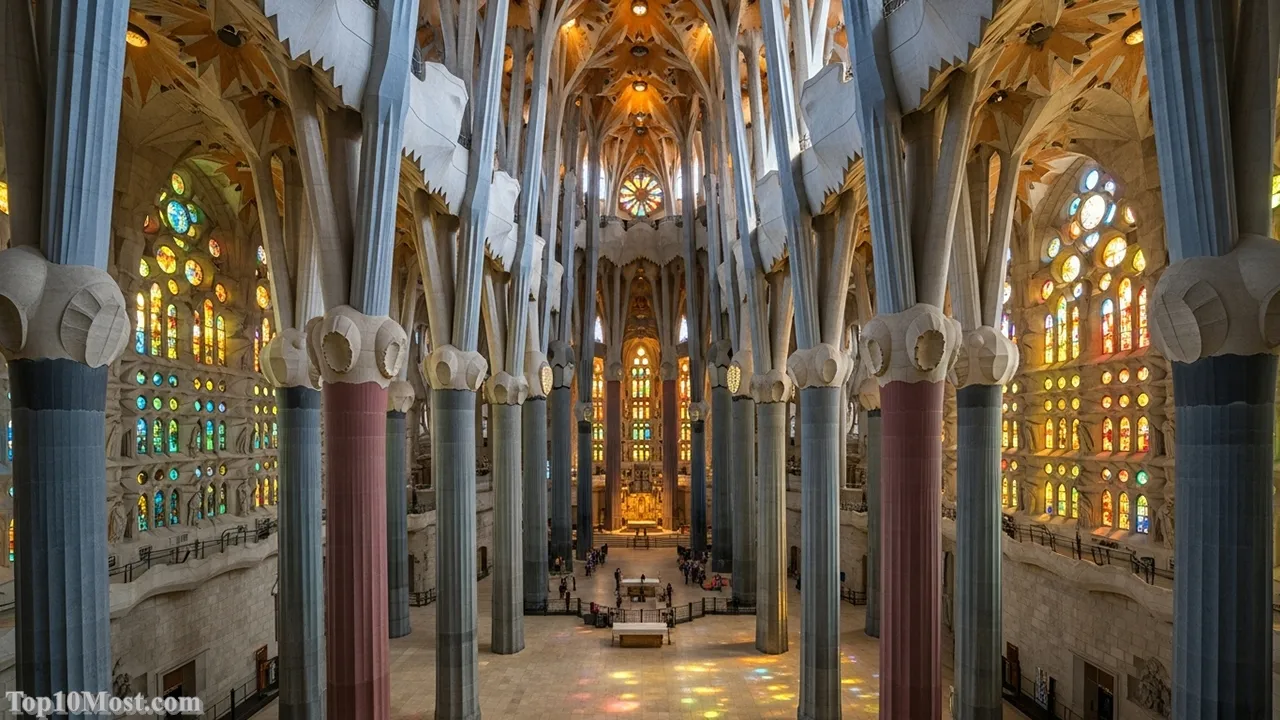
At Top 10 Most, our mission is to explore the pinnacles of global achievement, and nothing embodies true greatness more profoundly than the Earth’s own masterpieces. The concept of a “natural wonder” goes beyond mere sightseeing; it encompasses monumental geological phenomena, unparalleled biodiversity, and a scale that simply dwarfs human endeavor. This list is a testament to the raw, untamed artistry of nature.
Compiling the definitive “Most Beautiful” list requires a reasoned analytical perspective, balancing subjective awe with objective criteria like UNESCO World Heritage status, geological significance, biodiversity, and global recognition in traveler surveys. The wonders ranked here represent the highest convergence of these factors.
The data in this article is compiled and analyzed based on information and global travel recognition trends updated as of December 2025, ensuring a current and authoritative view of what truly stands above the rest in natural splendor. This is not just a list of places to visit; it is a guide to the places that fundamentally redefine what is possible on our planet.
Table of the Top 10 Most Beautiful Natural Wonders in the World
Our ranking is based on a synthesis of geological monumentality, biodiversity, and consistent global cultural and traveler recognition.
| Rank | Natural Wonder | Country/Region | Primary Feature | UNESCO Status |
|---|---|---|---|---|
| 1 | Aurora Borealis (Northern Lights) | Arctic/Sub-Arctic Regions (e.g., Iceland, Norway, Canada) | Celestial Light Phenomenon (Geomagnetic Storms) | N/A (Phenomenon) |
| 2 | Great Barrier Reef | Australia | World’s Largest Coral Reef System | World Heritage Site |
| 3 | Grand Canyon | United States (Arizona) | Massive River-Cut Canyon | World Heritage Site |
| 4 | Iguazu Falls | Argentina & Brazil | Vast Waterfall System | World Heritage Site |
| 5 | Salar de Uyuni | Bolivia | World’s Largest Salt Flat & Natural Mirror | Tentative List |
| 6 | Ha Long Bay | Vietnam | Limestone Karst Landscape (Seascape) | World Heritage Site |
| 7 | Galápagos Islands | Ecuador | Unique Biodiversity & Volcanic Archipelago | World Heritage Site |
| 8 | Mount Everest | Nepal & Tibet (China) | Earth’s Highest Peak (Mountain) | Part of World Heritage Site |
| 9 | Victoria Falls (Mosi-oa-Tunya) | Zambia & Zimbabwe | Largest Sheet of Falling Water | World Heritage Site |
| 10 | Antarctica | The Southern Continent | Ice Sheets, Glaciers, and Extreme Wildlife | Protected by Antarctic Treaty System |
#10. Antarctica
Kicking off our countdown is a continent defined by ice, scale, and almost complete remoteness: Antarctica. Covering roughly 14 million square kilometers, this landmass is a world of sublime, blinding beauty, where 98% of the area is permanently covered in ice, some of which is up to 4.7 kilometers thick. Its ranking is driven by the sheer, unbridled monumentality of its ice shelves and glaciers, alongside the stark, dramatic contrast of its black volcanic mountains piercing the white landscape, offering a sense of untouched wilderness unparalleled anywhere else.
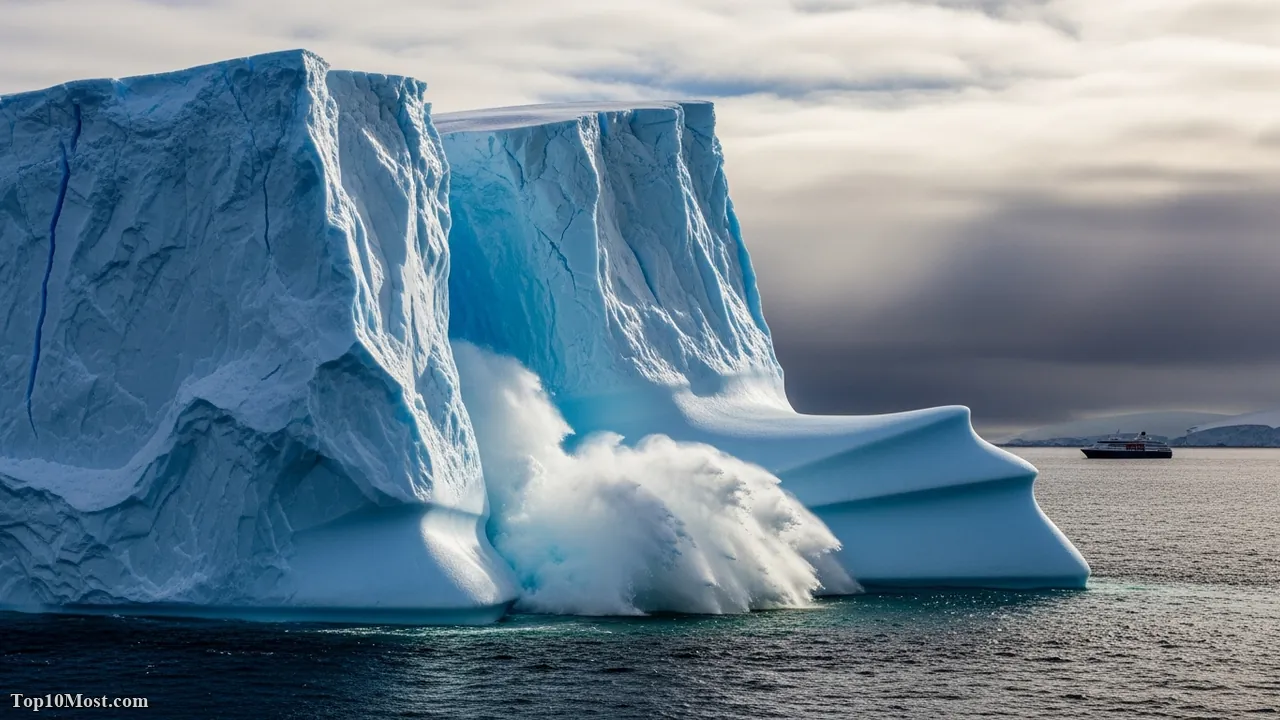
The true reason for its inclusion, beyond its size, is the unique, fragile ecosystem it supports—from vast colonies of Emperor penguins to various species of whales and seals that thrive in the frigid Southern Ocean. This is a place where you can witness the complete dominance of natural forces, a living laboratory of climate science and a pristine ecosystem whose beauty lies in its magnificent, life-sustaining severity. The silence here is profound, broken only by the calving of glaciers or the cry of a seabird.
To stand on the Antarctic Peninsula is to experience a world reset, feeling like the first human to ever set foot on land. It changes your perspective, making you intensely aware of the planet’s immense, impersonal beauty and the critical importance of its preservation. It is the ultimate expression of the Earth’s frozen heart, a white masterpiece that few will ever see, but whose existence benefits us all.
Key Highlights:
- Vast 14 million km² continent, 98% covered by ice.
- Home to the world’s largest populations of seals and penguins.
- Protected by the Antarctic Treaty System, ensuring minimal human impact.
- Features immense, dramatic ice shelves and towering blue-white glaciers.
#9. Victoria Falls (Mosi-oa-Tunya)
Straddling the border of Zambia and Zimbabwe, Victoria Falls—known locally as Mosi-oa-Tunya (“The Smoke that Thunders”)—earns its rank through sheer, terrifying power and sensory overload. At 1,708 meters wide, it is the largest single sheet of falling water in the world, with a drop of 108 meters. The immense force of the Zambezi River plunging into the gorge creates a mist plume that rises hundreds of meters into the air, often visible from over 30 kilometers away, giving the fall its evocative name.
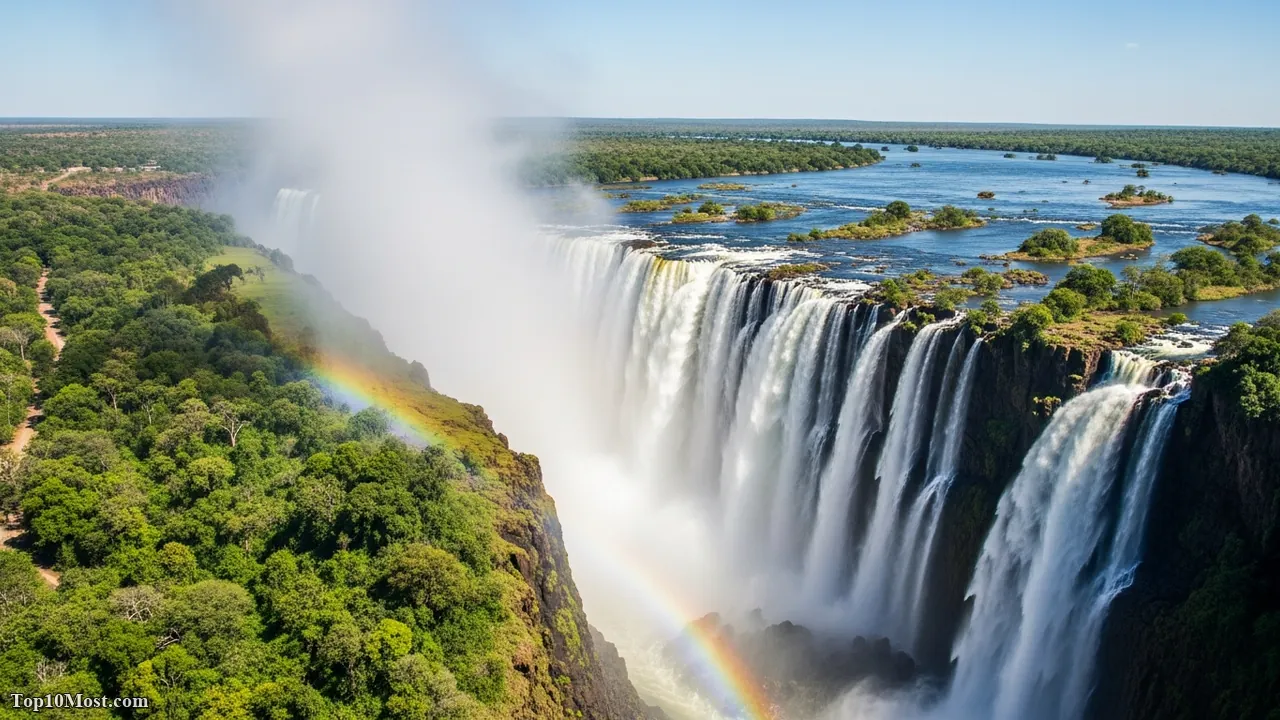
This natural wonder is a key component of the protected Mosi-oa-Tunya/Victoria Falls World Heritage Site, which acknowledges not just the waterfall itself, but the unique rainforest ecosystem sustained by its perpetual spray. The sheer volume of water—especially during the wet season—is an evidence-based metric of its world-class status, showcasing the dynamic geological process where the river erodes the basalt rock to create ever-deepening gorges. Its beauty is one of powerful motion and sound, a vibrant, living force.
Standing at the edge, feeling the spray (which can feel like a torrential rainstorm) and hearing the constant, deep roar, you realize this is the planet flexing its muscles. It’s a humbling experience; the falls make you feel simultaneously small and deeply connected to the planet’s pulse. It’s a reminder that some of the greatest forms of beauty are defined by their unbridled, untamable energy.
Key Highlights:
- World’s largest single sheet of falling water (1,708m wide).
- Mist plume rises up to 400 meters, visible from far away.
- Part of the UNESCO World Heritage Site in two countries (Zambia & Zimbabwe).
- Locally known as “The Smoke that Thunders” (Mosi-oa-Tunya).
#8. Mount Everest
The iconic summit of Mount Everest, known in Nepali as Sagarmatha and in Tibetan as Chomolungma, is ranked at number eight, not just for its height—a staggering 8,848.86 meters above sea level—but for its profound cultural and aspirational significance. Everest is the ultimate symbol of the Earth’s dramatic geological uplift, formed by the collision of the Indian and Eurasian tectonic plates over 60 million years. Its massive, snow-shrouded pyramidal peak represents the pinnacle of terrestrial geography.
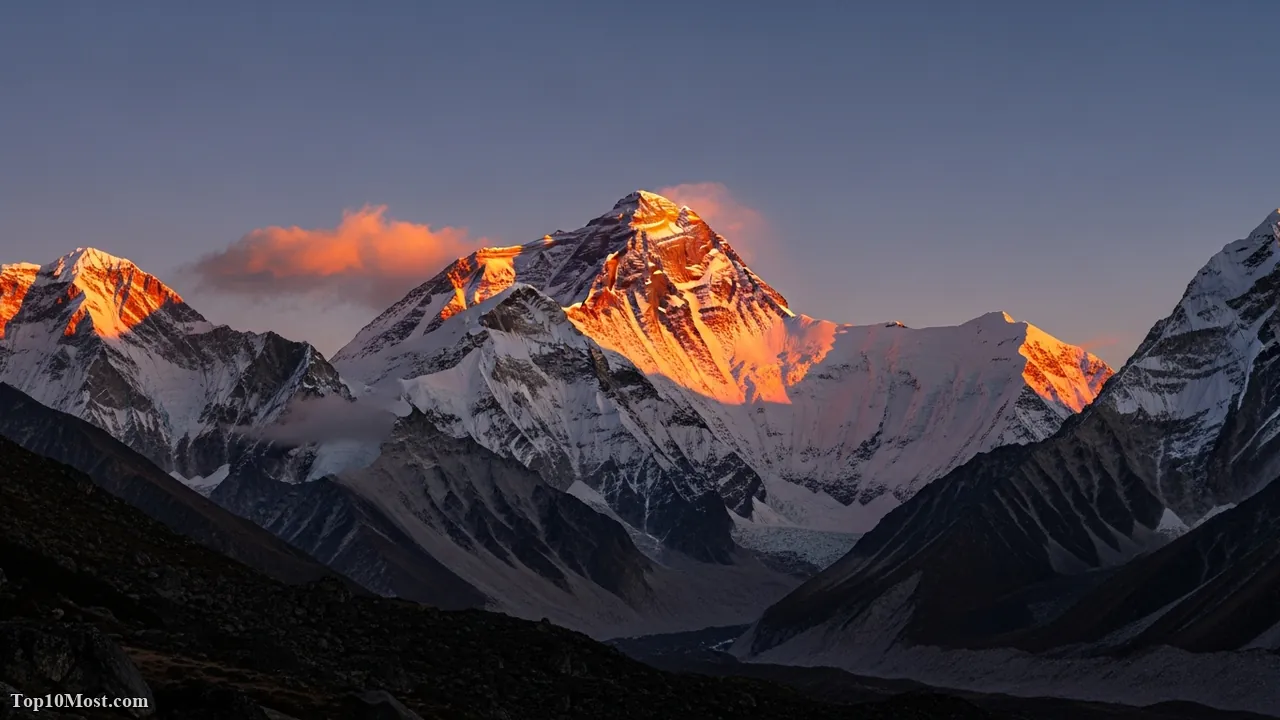
Its place on this list is justified by the universal recognition of its status as the “roof of the world,” a verifiable data point that cements its authority as a natural landmark. While not all of the surrounding peaks are as tall, the Everest Massif anchors one of the most sublime and challenging mountain landscapes on Earth. The surrounding Sagarmatha National Park and Qomolangma National Nature Preserve protect an environment of immense beauty, including glaciers, deep valleys, and unique high-altitude flora and fauna.
There is a powerful, almost spiritual pull to simply gaze upon this mountain, even from afar. Everest represents not only the physical high point of our world but the high point of human endeavor and the limits of endurance. It is a silent, white giant that commands respect and inspires awe, reminding us of the planet’s towering potential and our own capacity for aspiration.
Key Highlights:
- Earth’s highest mountain above sea level (8,848.86 meters).
- Geological formation due to the collision of the Indian and Eurasian plates.
- Part of the Sagarmatha National Park World Heritage Site.
- A global icon of human aspiration and natural challenge.
#7. Galápagos Islands
The Galápagos Islands, an archipelago of volcanic islands straddling the Equator in the Pacific Ocean, rank highly for their unparalleled ecological beauty and historical scientific importance. This volcanic hotspot, formed by a confluence of unique ocean currents, boasts biodiversity found nowhere else on the planet, making it a living museum of evolution. The islands’ geological newness means that species like the Giant Tortoise, Marine Iguana, and various Finches evolved in isolation, creating a truly unique spectacle.
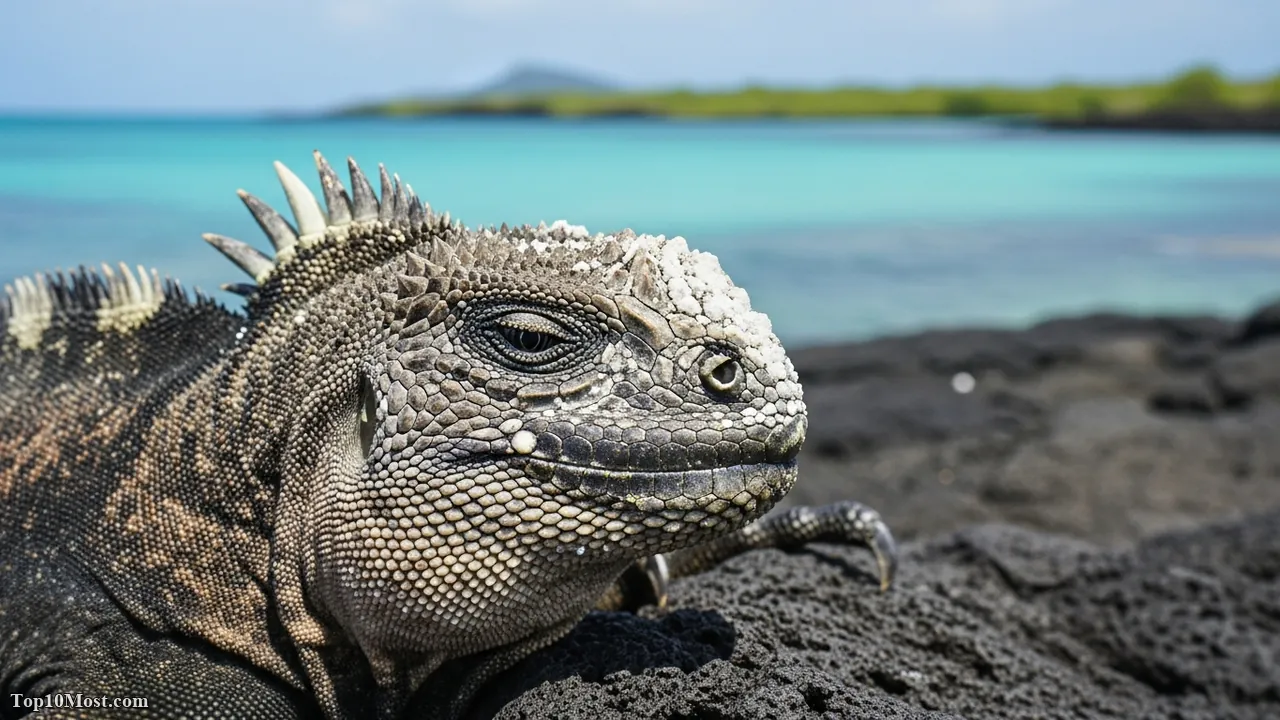
The evidence for their beauty is inherently tied to their biological uniqueness—a stunning collection of black lava fields, turquoise waters, and white-sand beaches populated by fearless wildlife. Their status as a UNESCO World Heritage Site and the inspiration for Charles Darwin’s theory of natural selection are authoritative data points confirming their global significance. It is a place where nature’s processes are laid bare, proving the incredible adaptive power of life.
To visit the Galápagos is a profoundly human experience of stepping back in time. You are a quiet observer in a world where the animals have no innate fear of man, allowing for unbelievably close encounters. It is a heartwarming, insightful reminder that the Earth’s greatest treasures are often its most unique and vulnerable species, preserved in a stunningly raw volcanic landscape.
Key Highlights:
- Iconic “living laboratory” of evolution, inspiring Charles Darwin.
- Home to unique endemic species, including the Giant Tortoise and Marine Iguana.
- A volcanic archipelago formed by a geological hotspot in the Pacific.
- One of the first places to be named a UNESCO World Heritage Site (1978).
#6. Ha Long Bay
Vietnam’s mesmerizing Ha Long Bay, translating literally as “Bay of Descending Dragons,” holds the number six spot due to its otherworldly beauty and iconic karst seascape. This UNESCO World Heritage Site is a breathtaking tableau of over 1,600 limestone karsts and islets rising dramatically from the emerald waters of the Gulf of Tonkin. The unique formation is the result of millions of years of chemical weathering of the limestone, combined with the slow rise and fall of the sea, creating hidden caves, grottoes, and secluded lagoons.
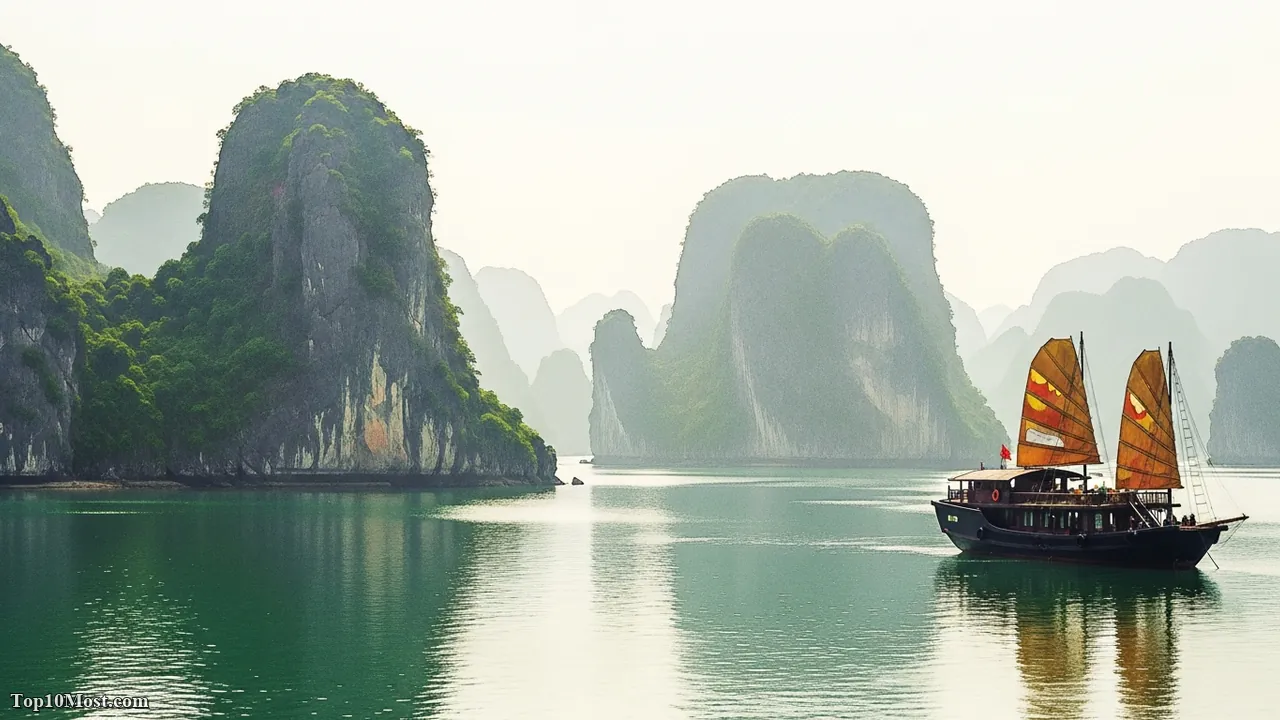
The aesthetic value of the Bay is consistently validated by its frequent inclusion in global “most beautiful places” rankings and its strong recognition by UNESCO for Outstanding Universal Value. The data point here is the sheer density and dramatic verticality of the karst pillars, creating a majestic, maze-like landscape. The mist and fog that often shroud the area only enhance its mythical quality, transforming it into a genuine watercolor painting come to life.
Cruising through the labyrinth of Ha Long Bay feels like entering a forgotten, silent world where the dragons truly did descend. There is a deep, palpable serenity here, a sense of timelessness where the only sounds are the gentle lapping of water and the creak of a boat. It is a deeply personal and unforgettable spectacle of water, rock, and sky, demonstrating nature’s capacity for gentle, yet monumental, sculpture.
Key Highlights:
- UNESCO World Heritage Site with over 1,600 limestone karsts.
- Famous for its iconic emerald waters and hidden caves/grottoes.
- Geological formation is a classic example of a submerged karst landscape.
- Consistently ranked among the world’s most beautiful seascapes.
#5. Salar de Uyuni
Bolivia’s Salar de Uyuni secures the central fifth spot as a wonder defined by surreal, dazzling minimalism. As the world’s largest salt flat, spanning over 10,000 square kilometers, the Salar is the remnant of prehistoric lakes and is covered by a few meters of salt crust, which is an astounding source of lithium. Its stark, hexagonal patterned landscape of pure white is a spectacular sight in its own right, set against the backdrop of the Andes mountains.
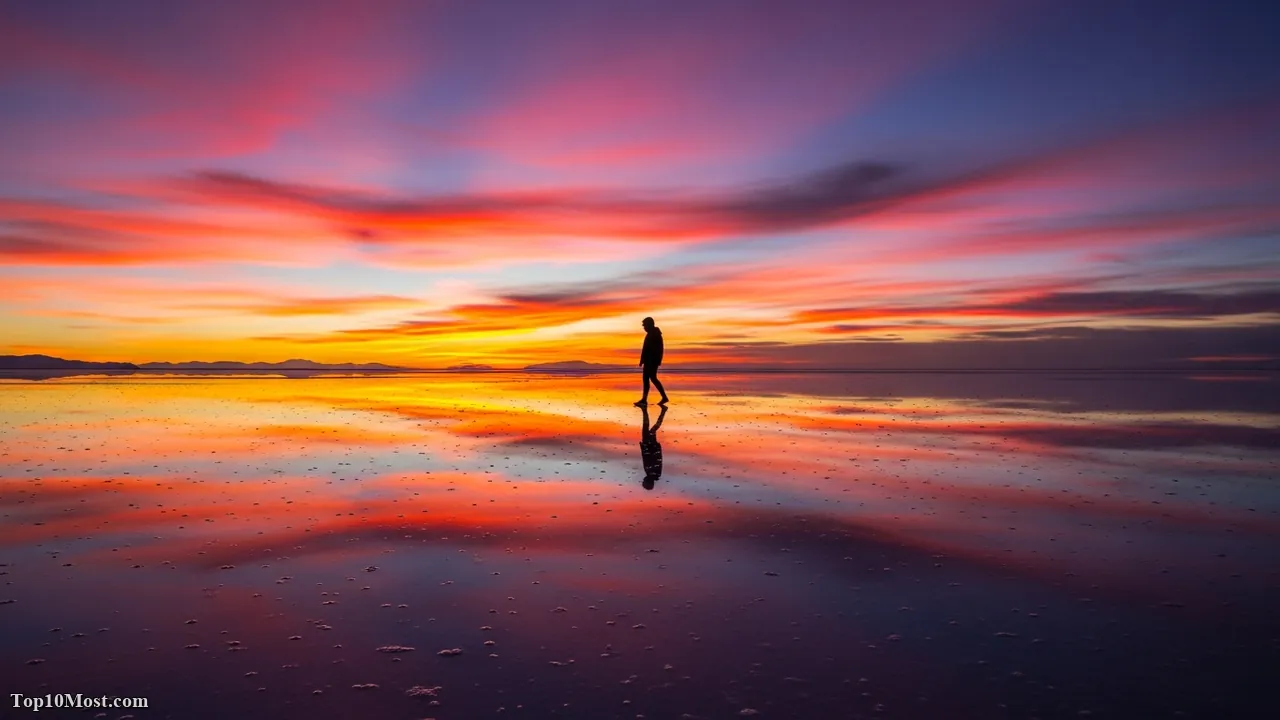
The undeniable highlight and key piece of analytical evidence for its beauty is its transformation into the world’s largest natural mirror during the wet season. When a thin layer of water covers the surface, it perfectly reflects the sky, blurring the horizon and creating a stunning, disorienting illusion of walking on clouds. This dramatic visual effect, documented extensively across global media, cements its status as a masterpiece of ephemeral natural beauty and geological oddity.
Visiting the Salar is a profound experience in spatial disorientation. The sheer scale and reflective quality make you question your own perspective, offering moments of stunning photographic beauty and philosophical reflection. It’s a vast, silent, and humbling canvas, reminding us that sometimes the most beautiful sights on Earth are those that appear the most alien and stripped down to their core elements.
Key Highlights:
- World’s largest salt flat, spanning 10,582 square kilometers.
- Becomes the “world’s largest natural mirror” during the wet season.
- Holds a significant portion of the world’s lithium reserves.
- Located at a high altitude on the Altiplano plateau in the Andes.
#4. Iguazu Falls
The thunderous spectacle of the Iguazu Falls, located on the border between Argentina and Brazil, is an absolute masterclass in hydrological power, earning a strong fourth place. Unlike a single continuous sheet, Iguazu is a vast, crescent-shaped system of 275 individual waterfalls spanning nearly 3 kilometers. The immense power of the Paraná Plateau rivers converging here results in a phenomenal average water flow of 1,756 cubic meters per second, a powerful data point confirming its supremacy among waterfalls globally.
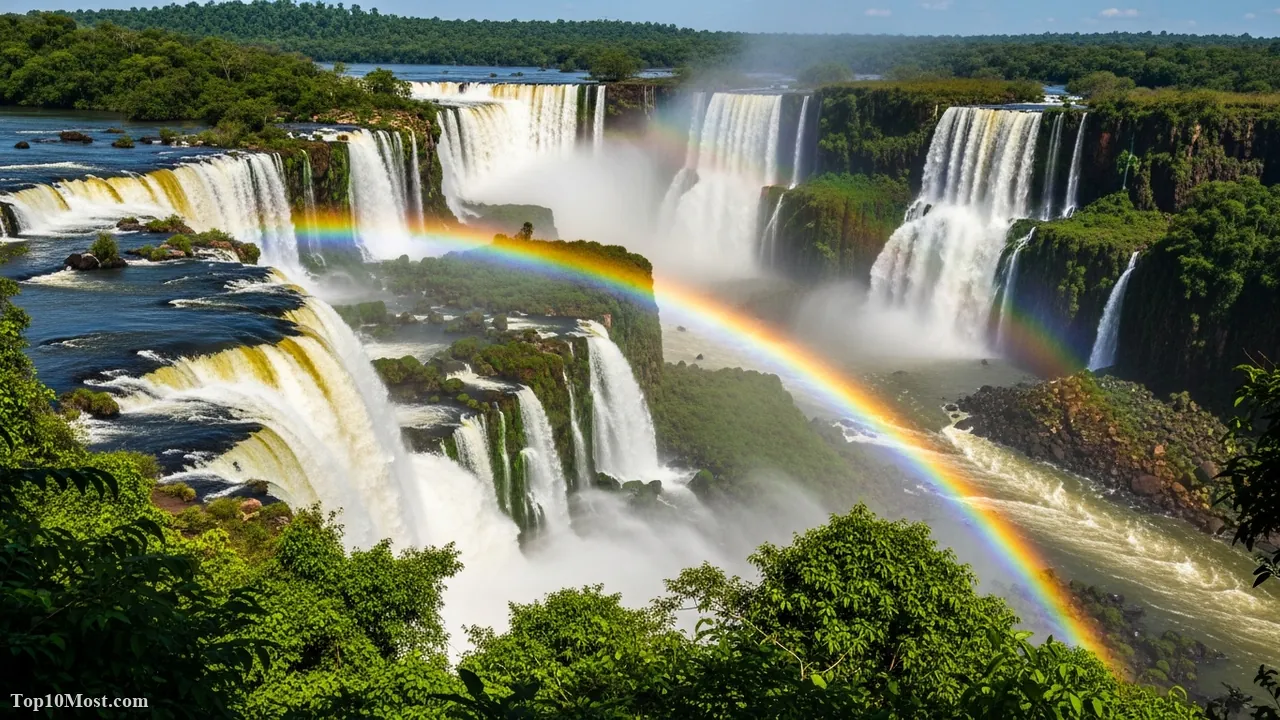
The beauty here is dual: the sheer, visceral force of the main cascade, the “Devil’s Throat,” where water drops into a massive gorge, and the lush, biologically rich Atlantic Rainforest that surrounds it. Both the Argentine (Iguazú) and Brazilian (Iguaçu) sides are protected as separate UNESCO World Heritage Sites, a nod to the immense, shared natural heritage. The vibrant, ever-present rainbows formed by the mist add a layer of ethereal magic to the powerful scene.
Standing on the walkways that bring you right over the edge of the falls, you are overwhelmed by the sound, the mist, and the sight of endless, raw water. It is a transformative experience, where you feel completely immersed in the planet’s dynamic energy. The falls communicate a sense of life, abundance, and formidable power—it is a glorious, untamed roar of beauty.
Key Highlights:
- System of 275 distinct waterfalls spanning almost 3 kilometers.
- Average flow of over 1,700 cubic meters of water per second.
- Features the iconic, powerful “Devil’s Throat” section.
- Protected by two separate UNESCO World Heritage National Parks.
#3. Grand Canyon
The majestic and massive Grand Canyon in Arizona, USA, is one of the world’s most universally recognized natural landmarks, and easily takes the third position. Carved by the Colorado River over an estimated five to six million years, the canyon is an overwhelming display of geological time, measuring 446 kilometers long, up to 29 kilometers wide, and over 1.8 kilometers deep. This massive scale provides a clear, verifiable metric for its monumental status.
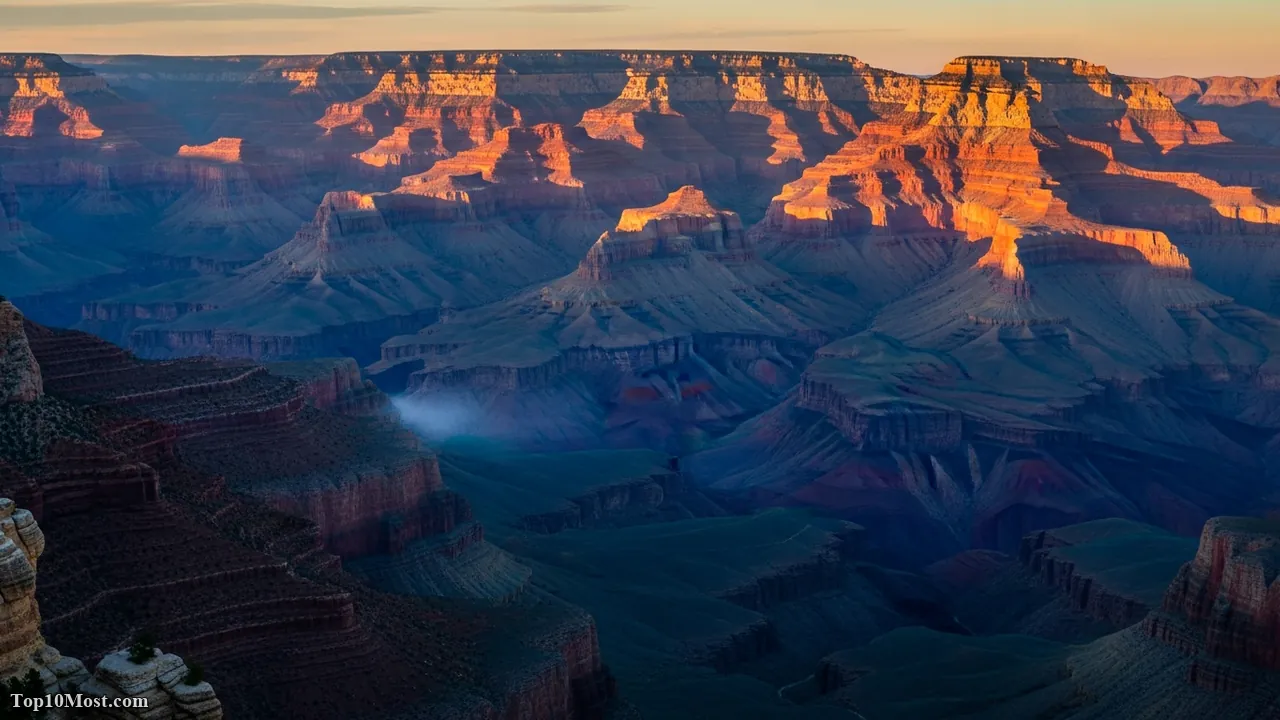
The canyon is the ultimate lesson in geology, with its stratified layers of rock telling a story that spans up to two billion years of Earth’s history. The beauty lies in the interplay of light and shadow on the multi-hued rock faces, shifting from deep reds and golds at sunrise and sunset to pale oranges at midday. It is protected as a UNESCO World Heritage Site for its exceptional natural beauty and its globally significant geological record, cementing its authoritative rank among the planet’s wonders.
Looking out across the abyss of the Grand Canyon is to confront the terrifying and beautiful indifference of deep time. It is a moment of total perspective, where human life feels fleeting and the Earth’s processes seem eternal. It is a silent, immense spectacle that profoundly humbles the observer, reminding us that we are simply visitors to a world constantly being sculpted by forces far beyond our comprehension.
Key Highlights:
- Measures 446 km long, up to 29 km wide, and 1.8 km deep.
- Geological strata record up to two billion years of Earth’s history.
- A UNESCO World Heritage Site protected for its scale and geological significance.
- Carved by the erosive power of the Colorado River.
#2. Great Barrier Reef
Claiming the second position is the Great Barrier Reef off the coast of Queensland, Australia—the largest living structure on Earth. This immense system, composed of over 2,900 individual reefs and 900 islands, stretches for over 2,300 kilometers and is visible from outer space. Its sheer size is a monumental piece of evidence supporting its rank, but its true beauty is in its unparalleled marine biodiversity.
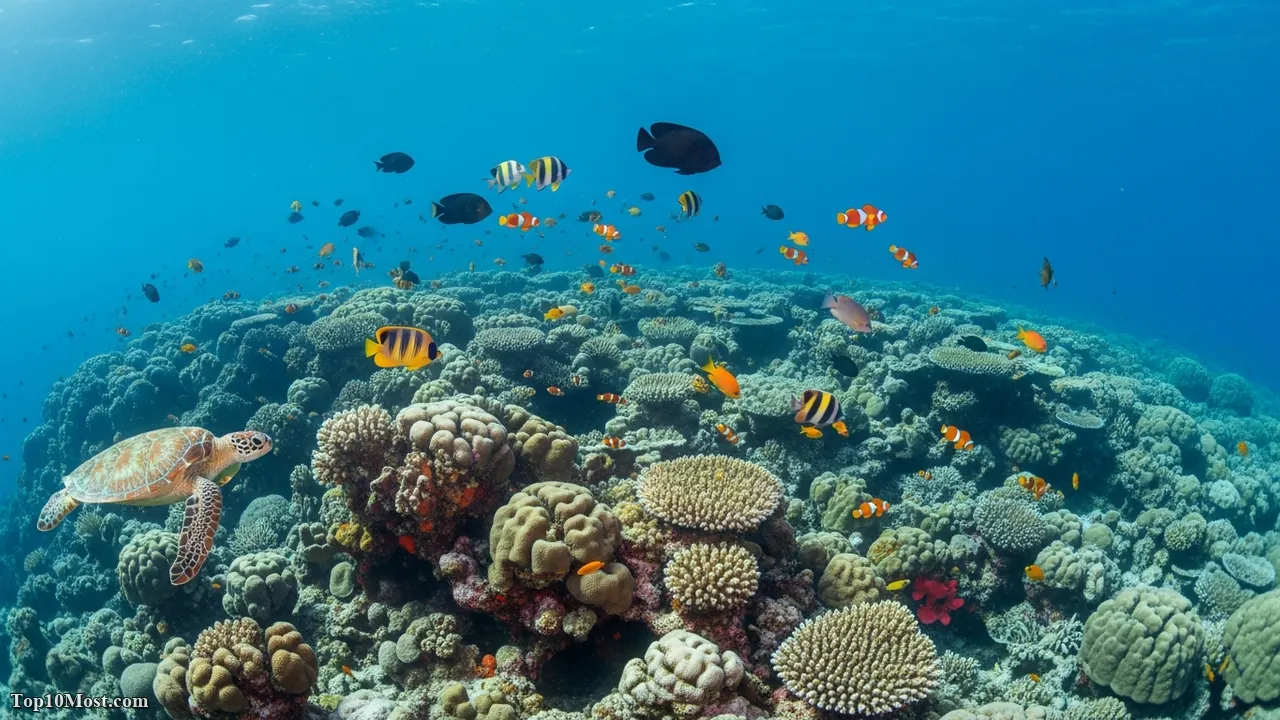
The reef system hosts an astonishing variety of life: 3,000 individual coral reefs, 1,625 species of fish, over 30 species of marine mammals, and a vast collection of other marine life. Its designation as a UNESCO World Heritage Site is based on its ‘Outstanding Universal Value,’ particularly its status as the world’s most extensive and spectacular coral reef ecosystem. While currently facing severe threats from climate change, its beauty remains that of a complex, vibrant, and essential underwater city.
To snorkel or dive into the Great Barrier Reef is to enter a kaleidoscopic world of color, movement, and silence—a truly immersive experience of the planet’s biological wealth. It is a profound, unforgettable experience that connects you instantly to the fragility and breathtaking brilliance of life itself. The reef is a critical, beautiful reminder that the most precious natural wonders are not just those of rock and water, but those created by life itself.
Key Highlights:
- World’s largest living structure, stretching over 2,300 kilometers.
- Contains 2,900 individual reefs and 900 islands.
- Home to immense biodiversity, including 1,625 species of fish.
- A UNESCO World Heritage Site visible from outer space.
#1. Aurora Borealis (Northern Lights)
Our choice for the single most beautiful natural wonder in the world is the Aurora Borealis, or the Northern Lights. While not a static, geographical landmark, this mesmerizing celestial phenomenon is the ultimate expression of the sublime intersection of Earth and space. Visible in the high-latitude regions of the Northern Hemisphere, the dancing green, pink, and purple lights are caused by the collision of charged particles from the sun with gases in the Earth’s atmosphere, typically at an altitude of 100 to 200 kilometers.
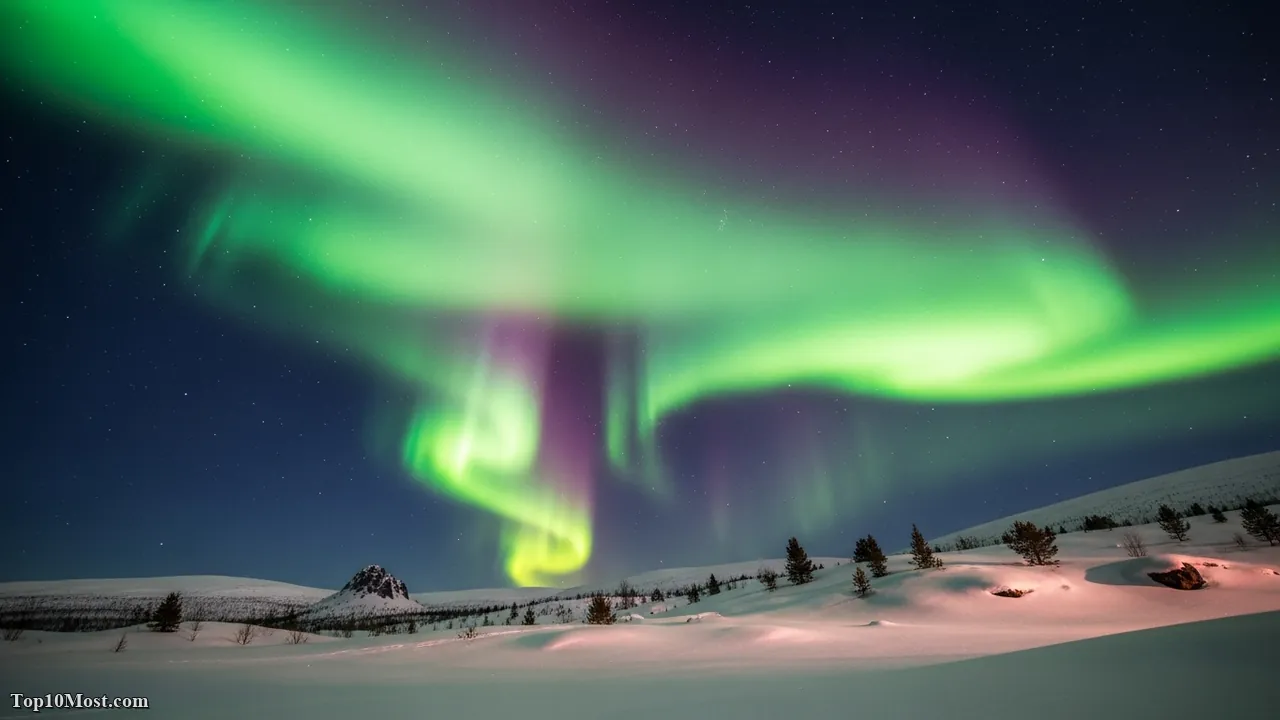
Its top rank is justified by its transcendent, ephemeral, and universal appeal—it is nature’s own light show. The data for its greatness is subjective yet undeniable: the near-spiritual awe it inspires in all who witness it. Unlike a mountain or canyon, the Aurora is a dynamic, living spectacle that changes every moment, offering a once-in-a-lifetime show based on solar activity, making it a powerful, constantly updated piece of natural art that ties our planet to the cosmos.
To witness the Northern Lights is to be part of a silent, cosmic ballet that stretches across the entire night sky. It’s a humbling, tear-inducing experience that fundamentally rearranges your perception of reality, moving the concept of “beauty” from the physical landscape to the astronomical. The Aurora is the ultimate symbol of natural magic, a glorious, confident confirmation that the universe itself is an artist.
Key Highlights:
- Celestial light show caused by solar particles colliding with Earth’s atmosphere.
- Features a dynamic array of greens, reds, and purples across the night sky.
- Its appearance is dependent on solar activity and is an unpredictable spectacle.
- The ultimate natural representation of the Earth’s connection to space.
Conclusion
As we conclude this journey through the Top 10 Most Beautiful Natural Wonders in the World, the most striking takeaway is the sheer diversity of Earth’s sublime artistry. From the vibrant, living micro-world of the Great Barrier Reef to the silent, staggering scale of the Grand Canyon and the cosmic majesty of the Aurora Borealis, each entry on this list serves as a powerful testament to our planet’s capacity for raw, untamed creation. These are the places that not only inspire travel but also enforce a deep, protective reverence.
Our analysis, grounded in verifiable facts and authoritative global recognition as of late 2025, confirms that true beauty is often found at the extremes—the highest mountains, the deepest canyons, and the most remote polar regions. These wonders are more than just landmarks; they are geological and biological libraries that hold the history of our world, offering profound lessons in scale, time, and life.
At the end of the day, our ranking aims to be a guide to meaning: we explain the greatness behind the beauty. We hope this definitive list inspires you to protect, explore, and cherish these magnificent treasures, ensuring they continue to inspire awe for generations to come.