France, globally renowned for its cultural landmarks, history, and cuisine, holds a secret: its immense natural beauty. From the highest peak in Western Europe to the deepest canyon on the continent, the country’s geography is a spectacular tapestry of mountains, coastline, and unique geological formations. At Top 10 Most, we move past the urban icons to celebrate the raw, untamed majesty of the French landscape.
This authoritative ranking of the Top 10 Most Famous Natural Sites in France is not a simple list of beauty but a reasoned analytical perspective. Our criteria prioritize fame derived from global recognition, cultural impact (inspiring artists and writers), and the verifiable, sustained volume of tourist visitation and media coverage.
The sites below have been selected because they fundamentally define the natural identity of their respective regions. The data in this article is compiled and analyzed based on information updated as of late 2025, ensuring we reflect the current, post-pandemic reality of global travel and enduring natural renown. Each site represents an essential journey into the heart of La Belle France.
Table of the Top 10 Most Famous Natural Sites in France
| Rank | Natural Site | Location/Region | Defining Feature |
|---|---|---|---|
| #1 | Mont Blanc & The French Alps | Haute-Savoie (Auvergne-Rhône-Alpes) | Highest peak in Western Europe (4,809m) and glacial massif. |
| #2 | Gorges du Verdon | Provence-Alpes-Côte d’Azur | Europe’s deepest river canyon, known for its turquoise waters. |
| #3 | Dune du Pilat | Arcachon Bay (Nouvelle-Aquitaine) | Europe’s tallest sand dune (over 100 meters high). |
| #4 | Cliffs of Étretat | Normandy (Seine-Maritime) | Iconic white chalk sea cliffs and natural arches (Aval and Manneporte). |
| #5 | Calanques National Park | Marseille to Cassis (Provence-Alpes-Côte d’Azur) | Dramatic fjord-like limestone inlets plunging into the Mediterranean. |
| #6 | Lavender Fields of Provence | Plateau de Valensole & Luberon (Provence) | Vast, globally famous seasonal purple landscapes. |
| #7 | Camargue Regional Nature Park | Rhône River Delta (Provence-Alpes-Côte d’Azur) | Europe’s largest river delta, known for white horses and pink flamingos. |
| #8 | Lake Annecy | Haute-Savoie (Auvergne-Rhône-Alpes) | One of Europe’s purest and most crystalline alpine lakes. |
| #9 | Calanques de Piana | Corsica | Unesco-listed red granite rock formations on the Gulf of Porto. |
| #10 | Gouffre de Padirac (Padirac Chasm) | Lot (Occitanie) | An enormous subterranean cave system featuring an underground river. |
#10. Gouffre de Padirac (Padirac Chasm)
Kicking off our list is a testament to the fact that France’s natural wonders are not confined to the surface. The Gouffre de Padirac, located in the Occitanie region, is an immense, 75-meter-deep chasm whose fame rests on its dramatic entry point: an enormous, almost perfectly circular hole in the earth. Visitors descend to the depths before taking a silent boat trip on a subterranean river, moving through vast caverns and past monumental stalactites and stalagmites. This unique experience, combining geological grandeur with the adventure of an underground voyage, secures its spot in our ranking over many surface-level competitors.
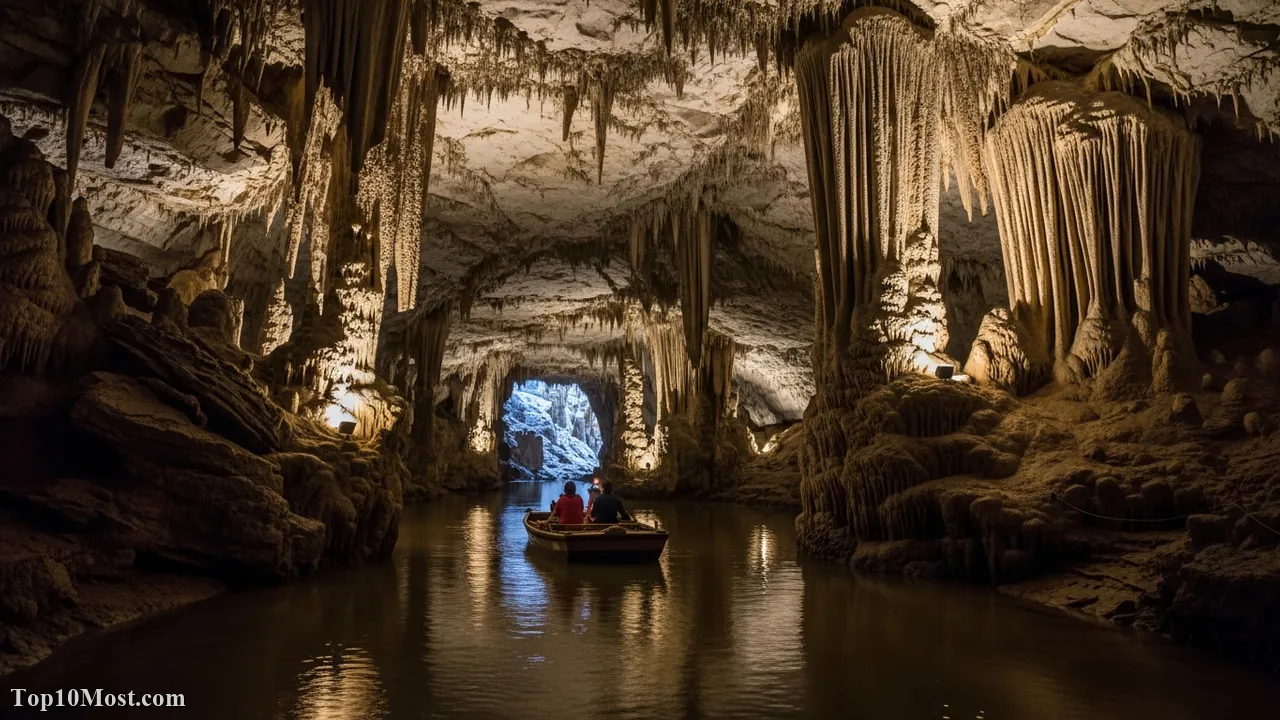
The primary reason for its authoritative ranking is its verifiable status as a pioneering tourist destination. As one of the first French chasms developed for tourism (opening in 1889), its sustained popularity proves its enduring appeal as a one-of-a-kind natural attraction. Its fame transcends regional borders, drawing hundreds of thousands of visitors annually who seek to be humbled by the forces of erosion that created this spectacular void deep within the limestone Causse de Gramat plateau. The fact that the natural drama unfolds in the dark is what makes it so memorable.
There is a powerful reflection that occurs when floating through the darkness, surrounded by chambers named the Grand Dome, where time seems to freeze and the silence is absolute. It’s a profound reminder of the planet’s internal architecture, a world built not by light but by water and millions of years. This descent into the earth offers a genuinely different, almost primordial perspective on natural beauty that is distinctly French and eternally captivating. It feels less like a tourist trip and more like a privileged audience with the Earth’s deep past.
Key Highlights:
- Famed for its 75-meter-deep, circular opening and 40-meter-high subterranean domes.
- One of the first geological sites in France opened for public tourism (1889).
- Features an underground boat trip on the River Padirac.
- Located in the Lot department of the Occitanie region.
#9. Calanques de Piana
The Calanques de Piana on the island of Corsica represent one of the Mediterranean’s most striking geological showcases. This UNESCO World Heritage site is a breathtaking array of towering red-granite sea cliffs, sculpted into fantastical shapes by the relentless wind and waves. The site’s fame is deeply rooted in the dramatic contrast between the fiery red and orange rock formations and the deep, intense azure of the Gulf of Porto. It is a spectacle of color and form that has been immortalized by countless artists and photographers who seek out its raw, almost unreal beauty.
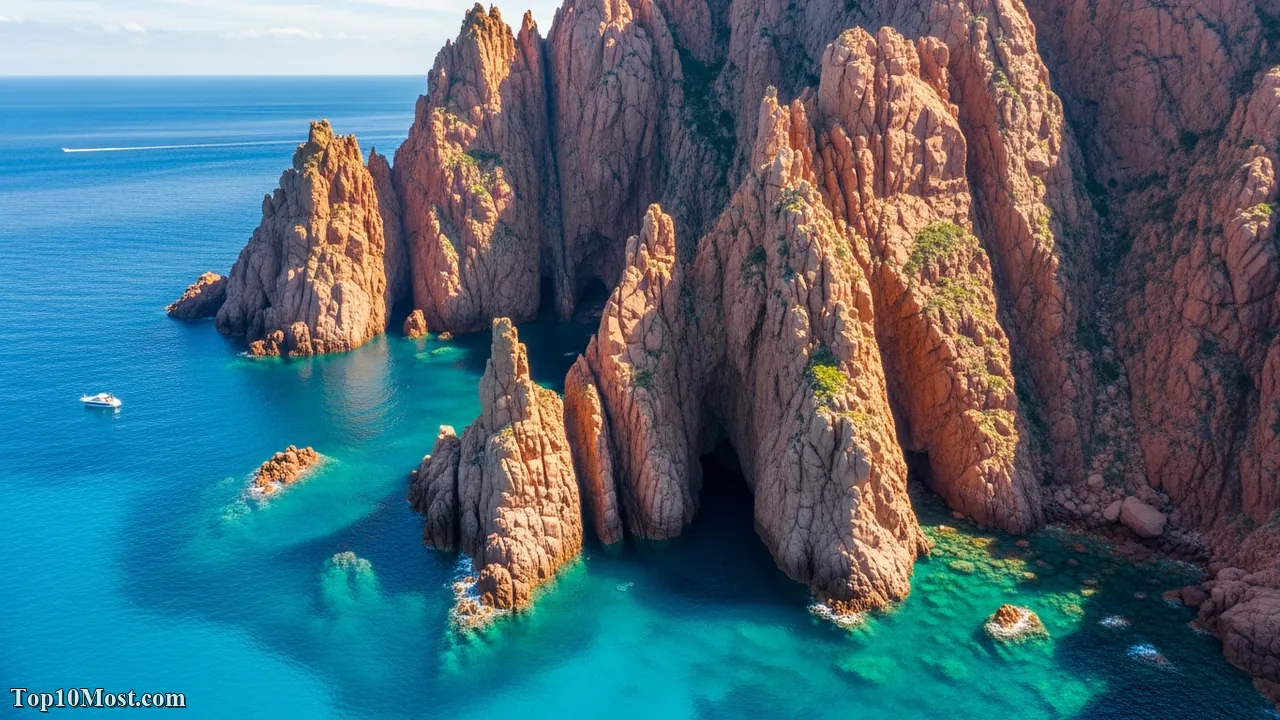
The reason for its high standing in a list dominated by mainland sites is its universal recognition as a prime example of unspoiled Mediterranean coastal geomorphology. The inaccessibility of the cliffs means that the best views are often from the water, either by boat tour or kayak, which transforms the visit into a truly immersive natural experience. Its UNESCO designation, which it shares with the nearby Scandola Nature Reserve, validates its ecological and geological significance, cementing its place as an authority in France’s portfolio of natural excellence. It’s a natural masterpiece that requires a deliberate effort to reach, enhancing its legendary status.
Driving the winding D81 road through these Calanques as the late afternoon sun illuminates the red stone is an experience of pure drama—the rocks appear to glow from within, like embers in the sea. It’s impossible not to feel a connection to the raw, tectonic energy that created these peaks. This is the wild, untamed face of the “Island of Beauty,” where nature’s sculpture garden meets the endless blue horizon in a perfect, photogenic flash of geological genius. It is a powerful reminder that France’s beauty extends far beyond its continental shores.
Key Highlights:
- UNESCO World Heritage Site located on the Gulf of Porto in Corsica.
- Known for dramatic, deep-red granite sea cliffs sculpted into unique formations.
- Part of a larger protected area that includes the Scandola Nature Reserve.
- Best viewed from a boat for a full appreciation of the scale and color.
#8. Lake Annecy
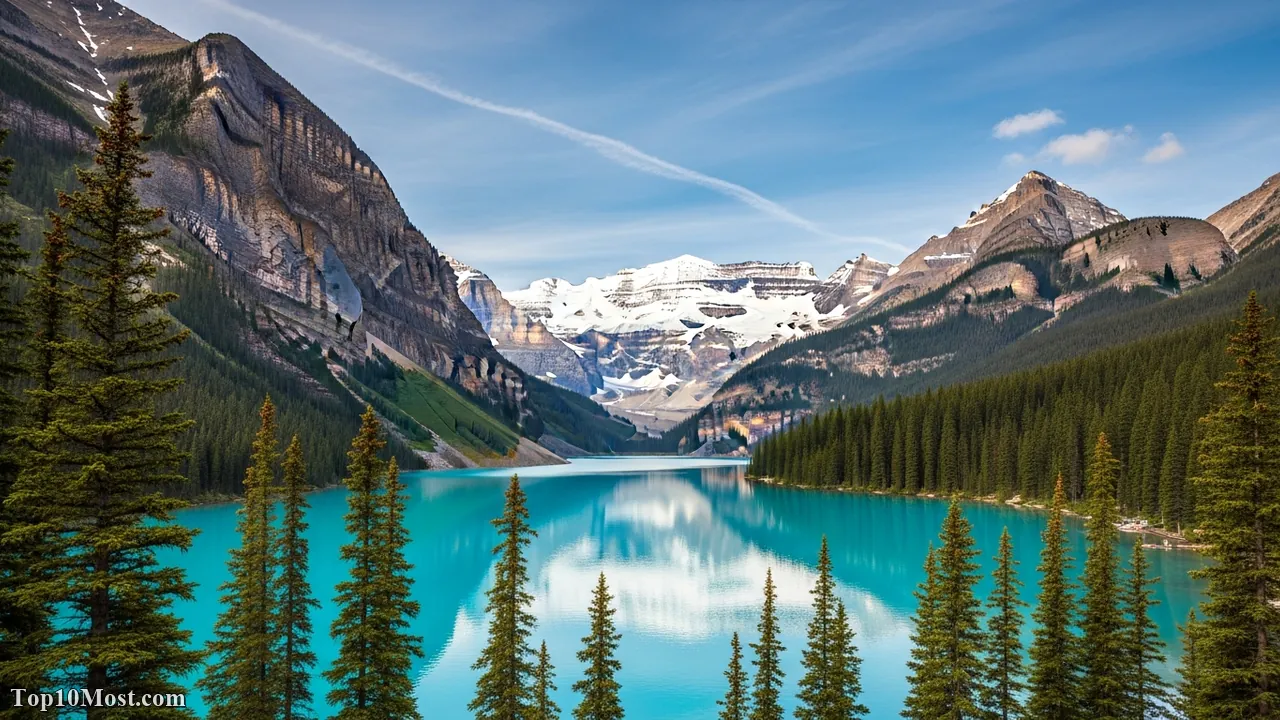
Nestled in the Haute-Savoie region of the French Alps, Lake Annecy has earned its fame not from sheer size, but from a reputation for exceptional purity. Often lauded as one of the cleanest lakes in Europe, its crystalline, turquoise waters are fed by alpine streams and a powerful ethical preservation policy stretching back over 50 years. The lake is framed by towering mountains, creating an impossibly picturesque backdrop for the medieval town of Annecy, often called the “Venice of the Alps.” Its fame is therefore a blend of its natural cleanliness and its romantic, fairy-tale setting.
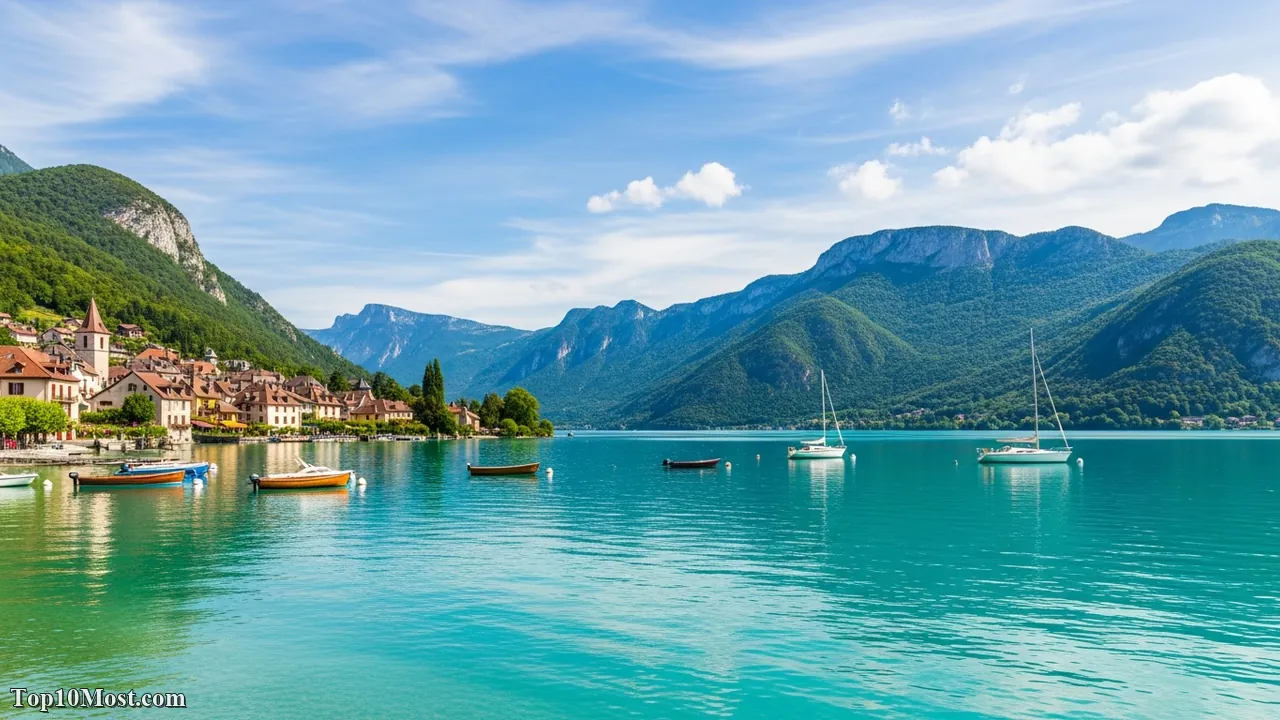
The analytical reason for its authoritative place on this list lies in the consistent recognition of its conservation success. While other lakes are popular, Lake Annecy represents a triumph of environmental stewardship, making it a modern benchmark for natural tourism. Its verifiable purity is its single greatest asset, attracting visitors for swimming, paddleboarding, and cycling along its shores. The sustained high quality of its water is a metric of fame in a world increasingly concerned with ecological integrity, securing its position as a destination of pristine natural excellence in the French Alps.
The experience of standing on the Pont des Amours (Lover’s Bridge) in Annecy and looking out over the water, watching the clarity of the depth and the reflection of the surrounding mountains, is one of serene and immediate joy. The whole setting feels like a carefully composed painting. It’s a natural site that demonstrates how human commitment can preserve, and even enhance, natural wonder. For me, it encapsulates a feeling of peaceful perfection—the mountains, the pure water, and the charming town all existing in perfect, luminous harmony.
Key Highlights:
- Reputation as one of the purest and cleanest lakes in all of Europe.
- Located at the foot of the French Alps in the Haute-Savoie department.
- Surrounded by the popular cycle path, the Voie Verte du Lac d’Annecy.
- Features distinct turquoise waters fed by numerous alpine streams.
#7. Camargue Regional Nature Park
The Camargue, situated in the vast Rhône River delta in Provence, is an anomaly on this list—a sprawling, marshy wetland whose fame rests on its unique biodiversity and atmospheric landscape. This area is globally famous for its iconic trio: the white Camargue horses, the black Camargue bulls, and, most visibly, the immense flocks of pink flamingos that inhabit its brackish lagoons. It is the largest river delta in Western Europe and a designated UNESCO Biosphere Reserve, securing its place through ecological significance rather than geological drama.
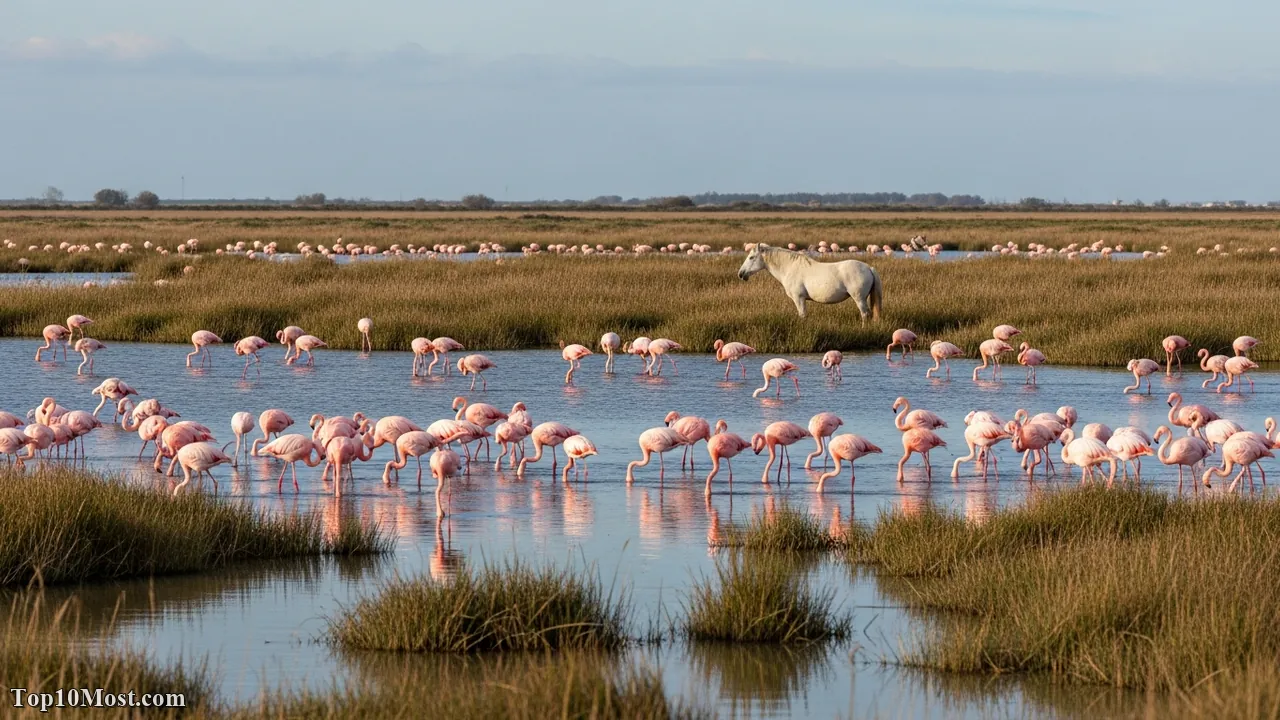
The definitive reason for its fame is the sheer visual spectacle of its wildlife, a verifiable, living component of the French landscape that is unlike any other. While many sites boast ancient rocks or towering peaks, the Camargue offers a dynamic, evolving ecosystem. Its sustained media coverage and tourist draws are directly related to the seasonal migration and habitation of its famous avian population, especially the greater flamingos. This park stands as an authoritative example of conservation, where the wildness of the landscape and the traditional practices of local gardians (cowboys) seamlessly coexist, maintaining a globally recognized natural heritage.
Exploring the Camargue, particularly during sunrise or sunset when the light catches the salt flats and the water, feels like stepping into another world—an otherworldly frontier on the edge of the Mediterranean. There is a deep, quiet awe in watching a herd of white horses gallop across the marshes, or the sudden pink cloud of flamingos taking flight. It’s a sensory experience of solitude and raw nature, proving that French natural greatness can be as much about the fleeting, vibrant life it sustains as it is about permanent stone monuments.
Key Highlights:
- Europe’s largest river delta, a UNESCO Biosphere Reserve.
- Famed for its iconic wildlife: white Camargue horses, black bulls, and pink flamingos.
- A vast, dynamic landscape of wetlands, salt marshes, and rice fields.
- The region maintains a unique cultural heritage with traditional gardians (cowboys).
#6. Lavender Fields of Provence
The Lavender Fields of Provence, specifically those blanketing the Plateau de Valensole and the Luberon, represent a seasonal yet globally definitive image of the French natural world. Their fame is less about geology and more about a perfect confluence of agriculture, light, and sensory experience. The sight of mile after mile of fragrant, undulating purple rows against the backdrop of quaint stone villages and clear blue skies is the epitome of the French countryside ideal. This visual poetry has made them a ubiquitous image in travel, art, and film.
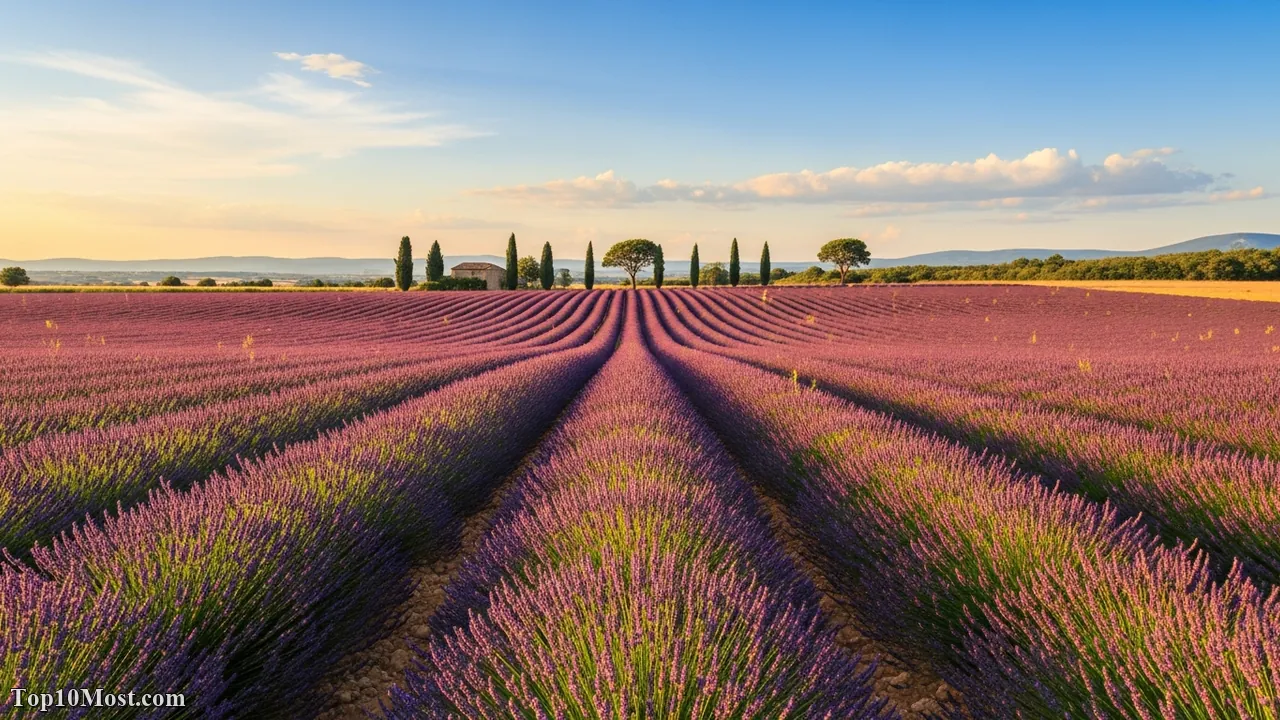
The authoritative weight for their position in this ranking is their incredible, verifiable pull on international tourism during the brief summer bloom (typically late June to early August). The phenomenon has become a global cultural touchstone, drawing millions who participate in the modern pilgrimage to capture the perfect photograph. The sheer density of online media coverage and dedicated global travel guides focused entirely on this annual event establishes their enormous fame, proving that a transient agricultural landscape can rival eternal stone structures in terms of worldwide recognition and tourist impact in the current time.
Walking through the Valensole plateau at the peak of bloom, the overwhelming fragrance, the buzzing of a thousand bees, and the heat of the Provençal sun combine into a truly immersive and almost overwhelming sensory moment. It is a reflection of the deep connection between the French people and their land, a breathtaking, farmed landscape that achieves monumental status simply through its beauty and scale. It reminds us that nature’s genius is often revealed in collaboration with human endeavor, creating a scene that is both temporary and eternally memorable.
Key Highlights:
- The world’s most famous agricultural natural site, peaking in summer (late June/early August).
- Located primarily on the Plateau de Valensole and in the Luberon.
- Fame is driven by its powerful visual impact and sensory experience (fragrance).
- An icon of the French countryside, immortalized in art and global media.
#5. Calanques National Park
The Calanques National Park, a protected area stretching between Marseille and Cassis, is a masterpiece of Mediterranean coastal geography. These dramatic, fjord-like inlets—calanques—are carved into blindingly white limestone cliffs that plunge directly into the turquoise waters of the sea. Their fame is immense, combining accessibility from a major city (Marseille) with the stark, wild beauty of a rugged, almost desert-like coastal landscape. It is the only peri-urban national park in Europe, making this natural escape a globally unique and highly valued asset.
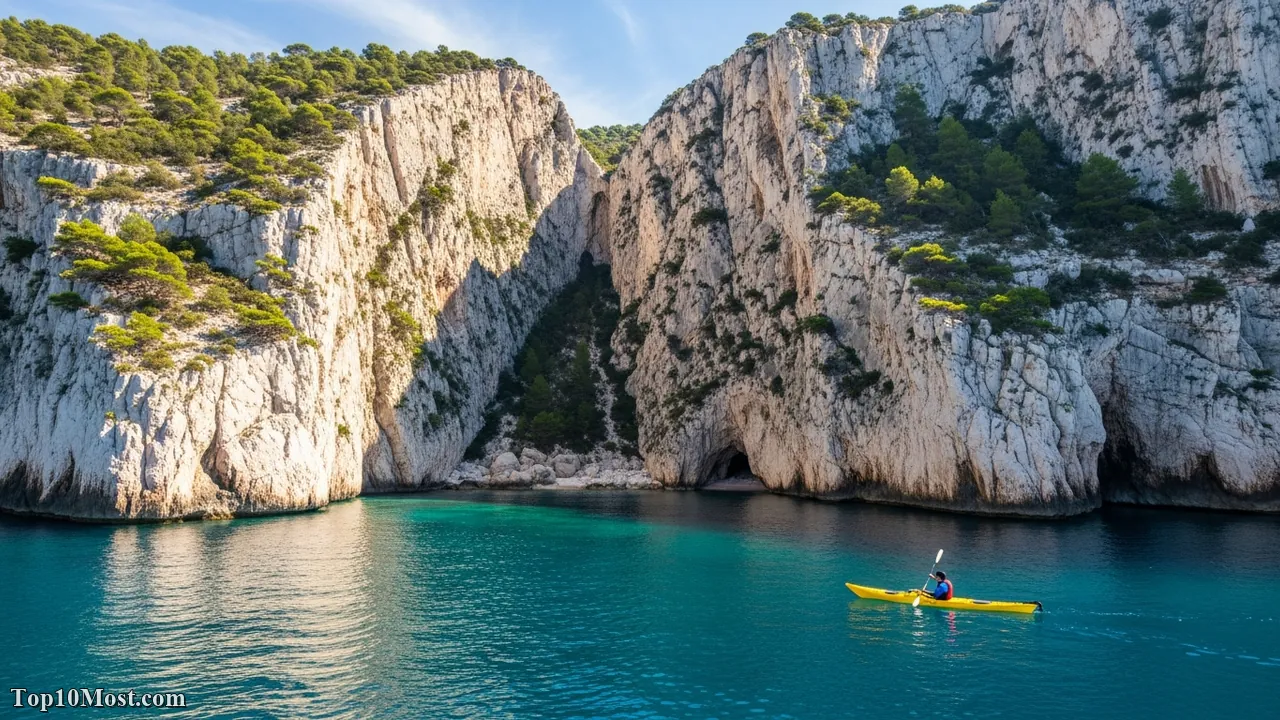
The reason for the park’s strong ranking lies in the verifiable, high volume of visitation it receives, driven by its dual nature as both a natural wonder and a major recreational hub. The most famous inlets, like Calanque d’En-Vau, are internationally renowned for their postcard-perfect views, attracting hikers, climbers, and boaters. Its status as a National Park since 2012 further solidifies its authoritative standing, ensuring the conservation of its unique flora, fauna, and geological structure, which include the breathtaking cave paintings found in the submerged Cosquer Cave.
Hiking down the sun-drenched, white trails toward the deep blue sea, especially in the early morning, offers a humbling perspective on the power of erosion and time. When you finally reach the water, the feeling is one of being rewarded for a sacred journey. The cool, clear water provides an immediate and invigorating contrast to the hot, pale stone. For me, the Calanques represent the perfect meeting point of fire and ice, where the raw, white heat of Provence meets the deep, cooling blue of the Mediterranean—a defining natural experience of the south.
Key Highlights:
- Europe’s only peri-urban national park, located between Marseille and Cassis.
- Known for steep, white limestone cliffs and deep, fjord-like coves (calanques).
- The Calanque d’En-Vau is globally recognized as the park’s most stunning cove.
- The site includes the submerged, Paleolithic-era Cosquer Cave.
#4. Cliffs of Étretat
The Cliffs of Étretat, located on the Normandy coast, are arguably the most visually recognizable natural coastline in France, instantly famous worldwide. They are a series of brilliant white chalk cliffs, dramatically sculpted by the Atlantic Ocean into three distinct natural arches—the Porte d’Aval, the Porte d’Amont, and the colossal Manneporte—and the iconic free-standing needle, the Aiguille Creuse. Their fame is not just geological but cultural, as they were the muse and frequent subject of the French Impressionist master, Claude Monet, whose works brought them global recognition.
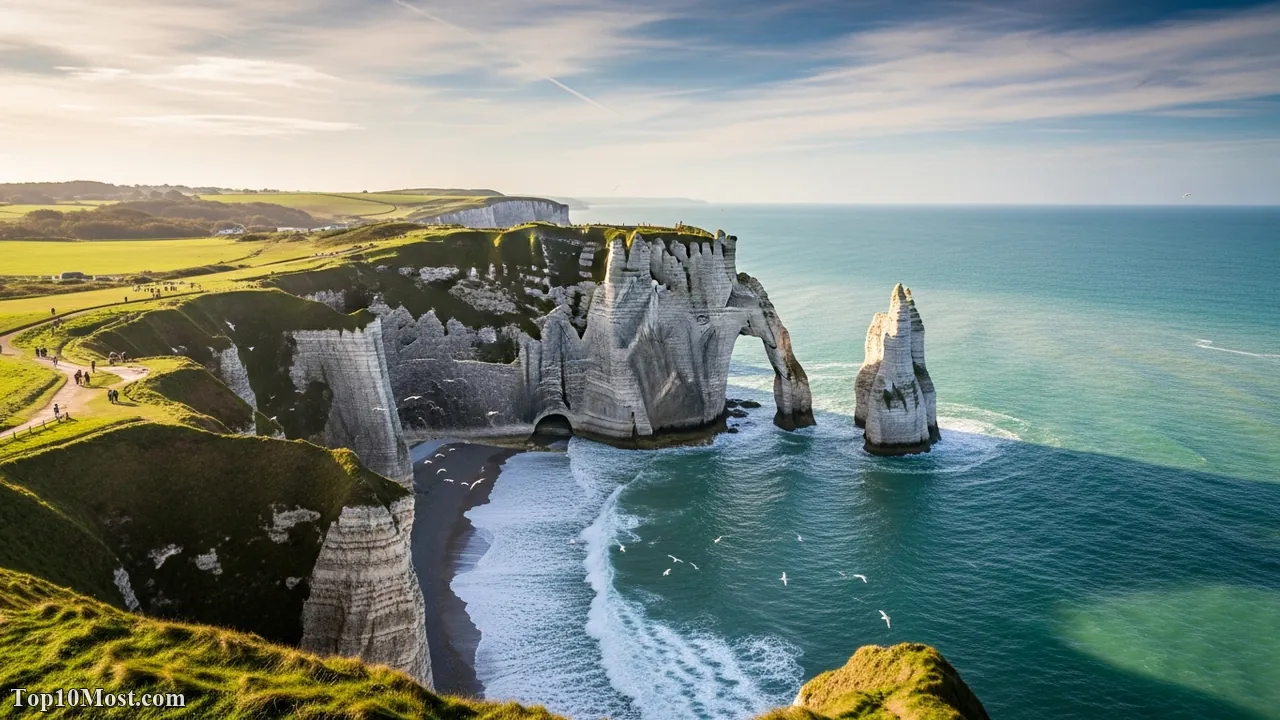
This site’s authoritative position at number four is primarily due to its undeniable cultural resonance and sustained high visibility in art history, which provides verifiable, lasting fame beyond simple tourist numbers. While visitation is high, their cultural currency, solidified by artists like Monet and writers like Guy de Maupassant, makes them an enduring icon of French nature. They are a textbook example of coastal erosion’s beauty and power, making them a fixture in both scientific and popular travel discourse, ensuring their fame is multi-layered and historically validated.
Standing atop the cliffs at sunset, with the vast ocean stretching out and the chalk needle standing defiant against the waves, one feels an immediate connection to the masters who sought to capture this very light. The sheer, clean white of the chalk, stark against the gray-blue sea, feels timeless. It’s a powerful reflection on the relentless process of nature: these magnificent arches are slowly, surely, being eroded back into the sea. This palpable sense of monumental, yet temporary, beauty is what makes Étretat such a profoundly moving and memorable place.
Key Highlights:
- Globally famous white chalk cliffs with three natural arches (Aval, Amont, Manneporte).
- Iconic needle formation, the Aiguille Creuse (Hollow Needle).
- A primary subject for Impressionist painter Claude Monet.
- Located on the Alabaster Coast of Normandy.
#3. Dune du Pilat
The Dune du Pilat, located on the edge of Arcachon Bay in Nouvelle-Aquitaine, is one of France’s most surprising and globally famous natural sites. It holds the verifiable distinction of being the tallest sand dune in Europe, an enormous, dynamic ridge of sand soaring over 100 meters high, positioned dramatically between a dense pine forest and the Atlantic Ocean. Its fame is a direct consequence of its immense scale, its proximity to the sea, and its unique, constantly shifting geological position, creating a spectacular landscape of sand, sea, and forest.
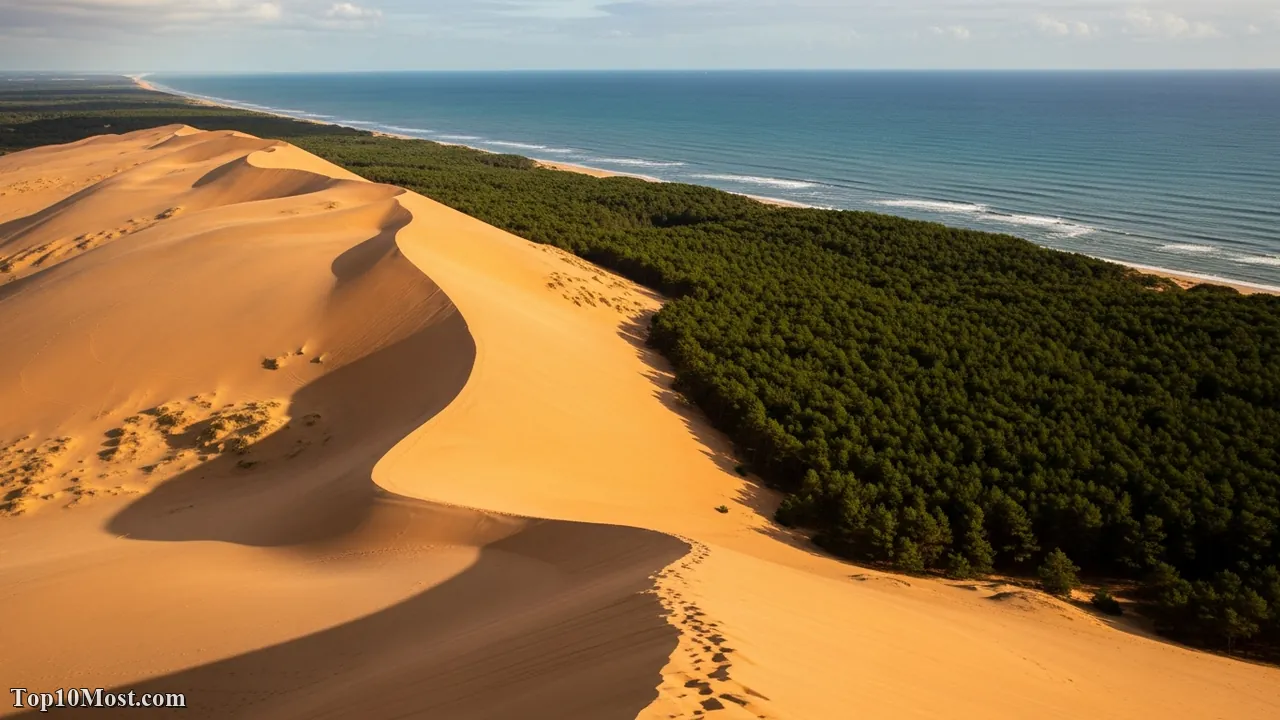
The core reason for its ranking at number three is its high-impact, verifiable uniqueness and accessibility, drawing millions of visitors who come not just to see it but to climb it. Its physical ascent is a key part of the experience, offering breathtaking, 360-degree panoramic views over the Atlantic, the Bay of Arcachon, and the surrounding Landes forest. It is a living geological site, moving inland by up to five meters each year. This undeniable scientific curiosity, combined with its dramatic scale and high recreational use (especially paragliding), gives the dune a major authoritative presence in France’s natural portfolio.
Reaching the summit after the challenging climb, sinking your hands into the warm sand, and looking out over the twin-sided landscape—endless forest on one side, endless ocean on the other—is a moment of pure, elemental wonder. The silence at the top, broken only by the wind, is profound. It’s a reflection on the fleeting nature of grandeur; this colossal monument is made of the smallest particles and is constantly moving. For the team at Top 10 Most, the Dune du Pilat proves that natural greatness can be found not just in hard rock, but in the most ephemeral of materials.
Key Highlights:
- Europe’s tallest sand dune, reaching over 100 meters in height.
- Uniquely located between the Atlantic Ocean and the extensive Landes forest.
- A dynamic geological feature, shifting inland by several meters each year.
- A major site for paragliding and panoramic viewing over the Arcachon Bay.
#2. Gorges du Verdon
The Gorges du Verdon, situated in the Provence-Alpes-Côte d’Azur region, holds the title of Europe’s deepest river canyon, and its fame is absolutely legendary. Formed by the Verdon River, which flows a deep, vibrant turquoise color due to glacial minerals, the canyon slices through the pale limestone plateau, with cliffs plunging over 700 meters in some places. The site’s fame is built on this staggering contrast of color and scale, making it a globally recognized adventure destination for kayaking, rafting, and challenging rock climbing.
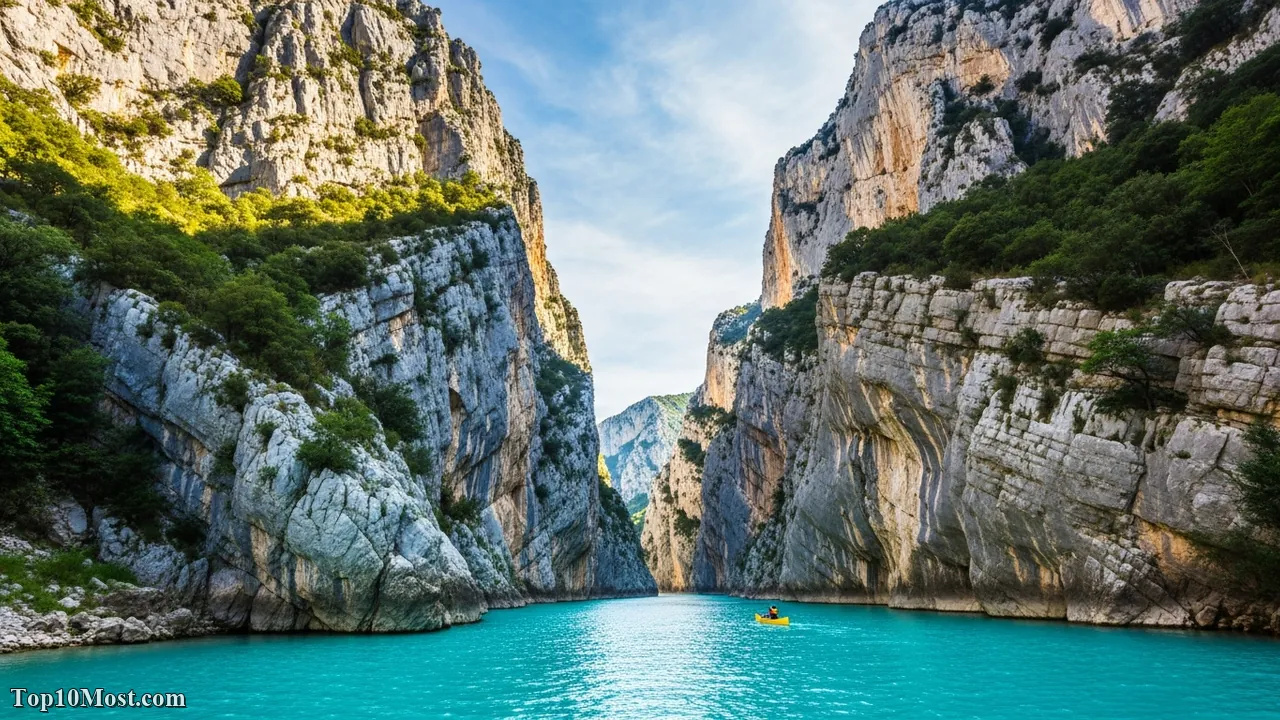
Our analysis places it second due to its dual status as both a geological superlative—Europe’s largest canyon—and its verifiable, immense popularity as a high-adventure tourism hub. Unlike many remote canyons, the Verdon is easily accessible, and its beauty can be experienced from the water, the clifftop roads (like the breathtaking Route des Crêtes), or on its extensive hiking trails, such as the Sentier Martel. This combination of majestic, world-class geology and organized recreational access gives it a commanding authoritative presence and sustained global visibility.
There is a moment of deep, quiet awe when you stand at the edge of the Balcons de la Mescla viewpoint, gazing down at the tiny, turquoise thread of the river hundreds of meters below. It is a feeling of dizzying power, a true testament to the raw persistence of water against rock. The sight of the water’s unreal, luminous blue is truly unforgettable. It’s a powerful reflection on the geological time scale, a vast scar on the face of France that reminds us that even the gentlest element, water, can carve the most imposing and famous of monuments.
Key Highlights:
- Verifiably Europe’s deepest river canyon, with cliffs up to 700 meters high.
- Famed for the striking, intense turquoise color of the Verdon River.
- A premier adventure destination for rafting, kayaking, and rock climbing.
- Bordered by the Lac de Sainte-Croix, a large, beautiful artificial lake.
#1. Mont Blanc & The French Alps
Towering above all others in fame, altitude, and cultural significance is Mont Blanc—the undisputed crown of France’s natural sites. As the highest peak in Western Europe (4,809 meters), it is not merely a mountain but an entire massif of glaciers, sharp needles (like the Aiguille du Midi), and deep valleys. Its fame is historical, geographical, and symbolic, recognized globally as the ultimate challenge for alpinists and a colossal, eternal monument to the majesty of the French Alps. The entire Chamonix valley is a hub of world-class natural tourism built in its shadow.
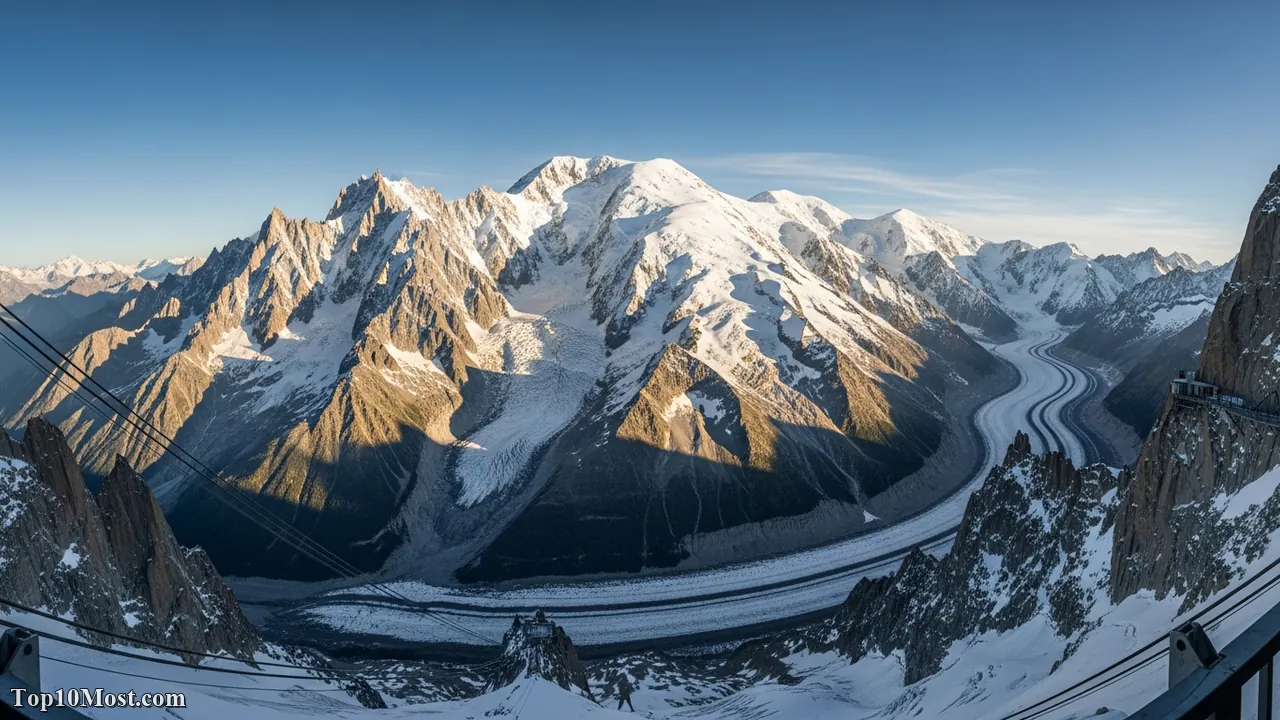
Mont Blanc earns its authoritative number one ranking based on two verifiable, unassailable facts: its status as the geographical superlative of Western Europe, and its role as a monumental global icon of mountaineering and winter sports. No other natural site in France commands the same level of global, year-round recognition. Accessible via the Aiguille du Midi cable car or the Montenvers train to the Mer de Glace, the mountain’s immense scale and glacial features provide mass-market access to a high-altitude wilderness, cementing its fame as the definitive French natural wonder in the current time.
To stand on the viewing platform of the Aiguille du Midi, nearly 4,000 meters high, with the vast expanse of the Mont Blanc massif surrounding you, is to feel profoundly small and simultaneously connected to the roof of the world. The biting cold, the blinding white of the snow, and the absolute silence of the high Alps provide an unforgettable, existential moment. This natural giant is a reflection of France’s deepest geological heritage—a place of unparalleled beauty and power that challenges and inspires millions, truly embodying the greatness that Top 10 Most seeks to explain.
Key Highlights:
- The highest peak in Western Europe, standing at 4,809 meters.
- The birthplace of modern alpinism and a global hub for extreme sports.
- Major attractions include the Aiguille du Midi cable car and the Mer de Glace glacier.
- Its fame is supported by the year-round tourism of the Chamonix valley.
Conclusion
Our journey across the Top 10 Most Famous Natural Sites in France reveals a country whose beauty is as diverse as its history. It is a land shaped by the immense forces of fire, water, and ice, from the colossal granite peaks of Mont Blanc to the moving sand of the Dune du Pilat and the deep, watery silence of the Gouffre de Padirac. These sites stand as a powerful counterpoint to France’s urban glories, proving that the nation’s true heart often lies in its wild, untamed spaces.
At Top 10 Most, our selection has been guided by the weight of global recognition, the verifiable cultural impact these sites have had on art and literature, and their sustained draw on international tourism. Each location offers not just a view but a profound experience—a chance to feel the raw, elemental power of the Earth. To visit them is to gain a deeper respect for the forces that continue to shape La Belle France, ensuring their authoritative fame will endure for centuries to come.