The concept of “grace” in the avian world goes beyond simple beauty; it is a measure of mastery over the air itself. While speed and power often dominate discussions of flight, true grace is found in the economy of motion—the silent glide of an owl, the effortless dynamic soaring of an albatross, or the acrobatic fluidity of a kite. It is the ability to navigate the atmosphere with a seamless, almost supernatural ease that captivates the human observer.
The data in this article is compiled and analyzed based on information updated as of December 06, 2025. To rank the “Top 10 Most Graceful Birds,” we have moved beyond subjective beauty to analyze flight mechanics, aerodynamic efficiency, and the visual fluidity of each species. From the “fairy cranes” of East Asia to the silent hunters of the British countryside, this list represents the pinnacle of aerial elegance.
At Top 10 Most, we don’t just rank these birds—we explain the physics and the feeling behind their movements. Each entry below is a testament to millions of years of evolutionary refinement, resulting in creatures that don’t just fly, but seemingly dance upon the wind.
Table of the Top 10 Most Graceful Birds
| Rank | Bird Species | Scientific Name | Key Trait of Grace | Primary Habitat |
|---|---|---|---|---|
| 1 | Swallow-tailed Kite | Elanoides forficatus | Aerial Acrobatics & Pivoting | Wetlands (Americas) |
| 2 | Red-billed Tropicbird | Phaethon aethereus | Streamer-tail Fluidity | Tropical Oceans |
| 3 | Wandering Albatross | Diomedea exulans | Dynamic Soaring (No Flapping) | Southern Ocean |
| 4 | Magnificent Frigatebird | Fregata magnificens | Suspended “Kite-like” Soaring | Tropical Coasts |
| 5 | White Tern | Gygis alba | Ethereal “Angel” Fluttering | Pacific Islands |
| 6 | Barn Owl | Tyto alba | Absolute Silent Flight | Global (Open Country) |
| 7 | Red-crowned Crane | Grus japonensis | Ritualistic Dance & Extension | East Asia Wetlands |
| 8 | Arctic Tern | Sterna paradisaea | Streamlined Endurance | Polar Regions |
| 9 | Great Egret | Ardea alba | Slow, Deliberate Wingbeats | Freshwater Marshes |
| 10 | Mute Swan | Cygnus olor | Powerful Synchronized Flight | Temperate Waterways |
Top 10. Mute Swan
The Mute Swan acts as the gatekeeper to our list, representing the classic, heavy-bodied grace that has inspired poets and artists for centuries. While they are famously elegant on water, their transition to the air is a display of immense power transformed into rhythm. Weighing up to 13kg, they are among the heaviest flying birds, yet once airborne, their flight is a masterclass in momentum. Their neck stretches out in a long, perfect line, and their wings produce a distinct, rhythmic humming sound—a “singing” flight that announces their majestic passage.
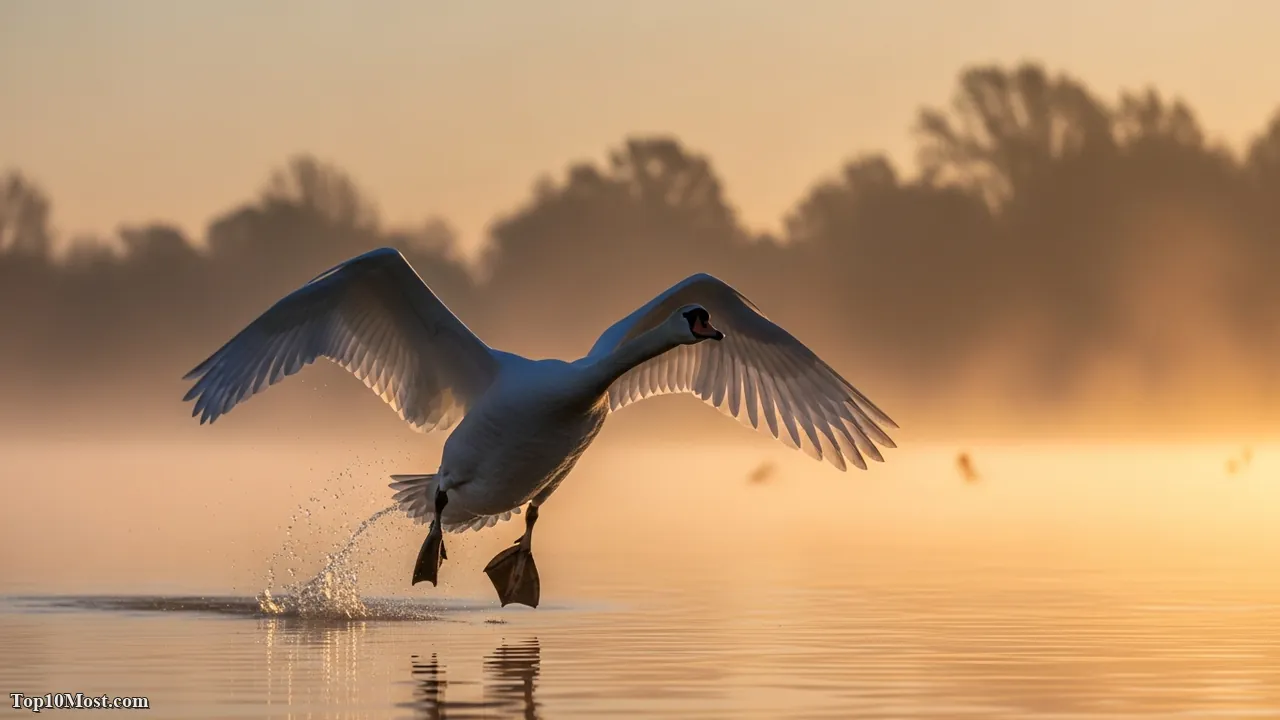
The grace of the Mute Swan lies in its synchronization and stability. Unlike smaller birds that dart and weave, swans fly with a deliberate, steady cadence. Their large wingspan, often exceeding 2.4 meters, beats with a slow, hypnotic rhythm that propels them forward with surprising speed. Watching a pair of Mute Swans flying in tandem against a winter sky is to witness a perfect union of strength and elegance, where the sheer effort of flight is masked by the beauty of the formation.
Reflecting on the Mute Swan, one cannot help but appreciate the contrast between their substantial physical mass and their aerial serenity. They remind us that grace is not always about being lightweight; it is about carrying oneself with dignity and poise regardless of size. In the air, they shed their terrestrial clumsiness entirely, becoming streamlined arrows of white light, proving that even the heaviest creatures can claim the sky with elegance.
Key Highlights
- Vocal Wings: Their wingbeats create a unique, audible throbbing or humming sound audible from a distance.
- Formation Flying: Mates often fly in perfect synchronization, reinforcing their bond.
- Heavyweight Flyer: One of the heaviest flying birds in the world, requiring a “runway” of water to take off.
Top 9. Great Egret
The Great Egret brings a different “texture” of grace to the list—one of slowness and deliberation. Known for its brilliant white plumage and S-curved neck, this bird does not rush. In flight, it tucks its neck into a tight curve, resting its head near its shoulders, which shifts its center of gravity and allows for a smooth, unhurried glide. Its large, rounded wings beat with a deep, slow cadence (roughly two beats per second) that feels almost meditative to watch.
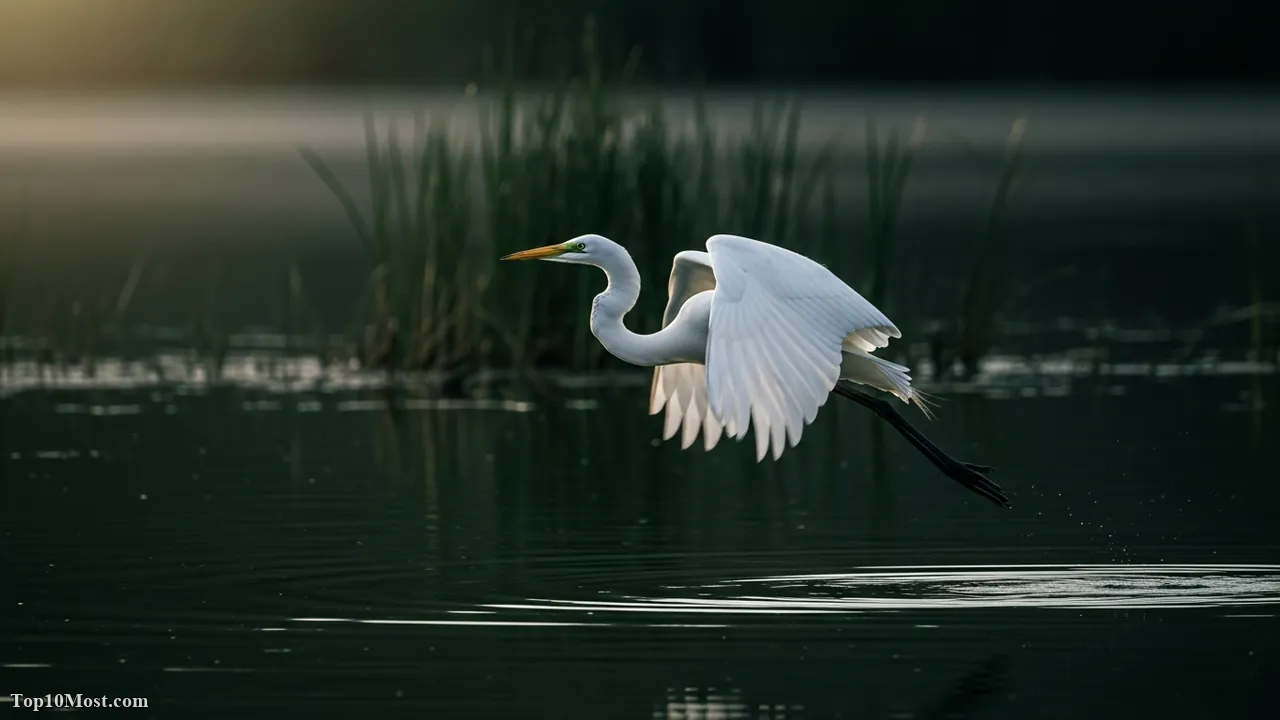
This bird’s elegance is defined by its “buoyancy.” It seems to float through the air rather than cut through it. The Great Egret’s flight is silent and ghostly, often seen drifting low over reeds and marshes at dawn or dusk. The stark whiteness of its feathers against the dark greens and browns of its wetland habitat creates a visual purity that enhances the perception of grace. It is a bird that refuses to be hurried, moving with a regal indifference to the chaos of the world below.
There is something deeply calming about watching a Great Egret in flight. It embodies the concept of “unlabored motion.” While other birds might frantically flap to gain altitude, the Egret rises on broad wings with a casual, almost lazy demeanor. It teaches us that true grace is often found in the absence of frantic energy, in the confidence of slow, purposeful movement.
Key Highlights
- Retracted Neck: Flies with its neck coiled in an “S” shape, unlike cranes or storks which fly with necks outstretched.
- Symbol of Conservation: Its elegant plumes (aigrettes) were once so prized for hats that the species sparked the creation of the Audubon Society.
- Slow Cadence: Utilizes a notably slow wingbeat, creating a sense of suspended motion.
Top 8. Arctic Tern
If the Egret is the grace of slowness, the Arctic Tern is the grace of endurance and streamlining. This medium-sized bird holds the world record for the longest migration of any animal, traveling from the Arctic to the Antarctic and back every year. To achieve this, its body has evolved into the ultimate aerodynamic form. With long, pointed wings and a deeply forked tail, the Arctic Tern cuts through the air with minimal resistance, often described as “rowing” through the sky with light, buoyant strokes.
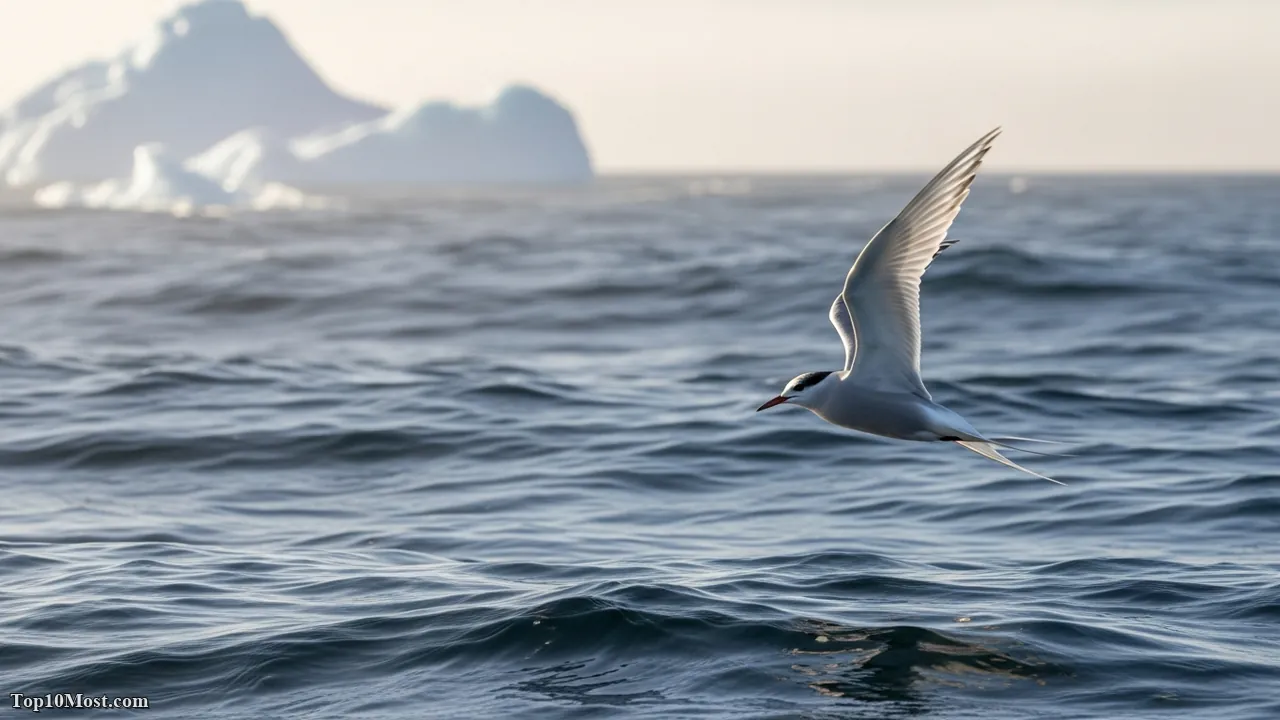
The grace here is functional; it is the elegance of efficiency. The Arctic Tern does not waste a single joule of energy. Its flight is buoyant and energetic, capable of hovering mid-air before dipping down to snatch a fish, then instantly resuming its migration path. It navigates some of the harshest weather conditions on the planet—gale-force winds and open oceans—yet it maintains a flight style that looks deceptively fragile and delicate.
When you see an Arctic Tern, you are looking at a creature that sees more sunlight than any other animal on Earth. Its grace is the grace of a marathon runner who makes the 20th mile look as easy as the first. It is a reminder that resilience and elegance are not mutually exclusive; the ability to endure tens of thousands of miles of travel while maintaining a perfect, sleek silhouette is a feat of biological engineering that borders on the miraculous.
Key Highlights
- Migration Champion: Travels roughly 70,000 to 90,000 km annually, seeing two summers per year.
- Hovering Ability: Capable of distinctive “hover-dips” to catch prey from the water’s surface without landing.
- Design: Features a high aspect ratio wing design for maximum lift and minimal drag over long distances.
Top 7. Red-crowned Crane
The Red-crowned Crane, or “Tancho,” is a cultural icon in East Asia, revered as a symbol of longevity and fidelity. Its inclusion on this list is due to its ritualistic elegance. Unlike the Egret, the Crane flies with its neck fully outstretched, creating a long, spear-like profile. However, its true claim to grace lies in its courtship “dances” which often transition into flight. These birds leap, bow, and toss vegetation with a balletic coordination that is unrivaled in the animal kingdom.

In the air, the Red-crowned Crane is a vision of black and white contrast. Its flight is powerful and direct, utilizing slow, rhythmic downstrokes and quick upstrokes. The visual impact of a flock of these cranes taking flight against a snowy Hokkaido landscape is one of the most celebrated images in nature photography. They move with a sense of nobility, their broad wings manipulating the air with a distinct “whoosh” that speaks to their size and power.
To witness the Red-crowned Crane is to witness a living piece of art. Their movements seem choreographed, almost as if they are performing for an audience rather than simply surviving. This is “performative grace”—motion that serves a social and biological purpose but is executed with such aesthetic perfection that it transcends simple behavior and becomes a dance of life.
Key Highlights
- Sacred Symbol: Known as the “Fairy Crane” in Taoism and a symbol of luck and immortality in Japanese culture.
- Outstretched Profile: Flies with neck and legs fully extended, creating a massive, straight-line silhouette.
- Dance-Flight Transition: Famous for seamless transitions from ground-based courtship dancing to aerial flight.
Top 6. Barn Owl
The Barn Owl introduces the element of “stealth” to our ranking. Known as the ghost of the countryside, its flight is defined by absolute silence. Evolution has gifted the Barn Owl with serrated leading edges on its primary feathers that break up turbulence, and a velvety coating on its wings that absorbs the sound of air rushing over them. The result is a flight that is acoustically invisible, allowing the owl to drift over fields like a phantom.
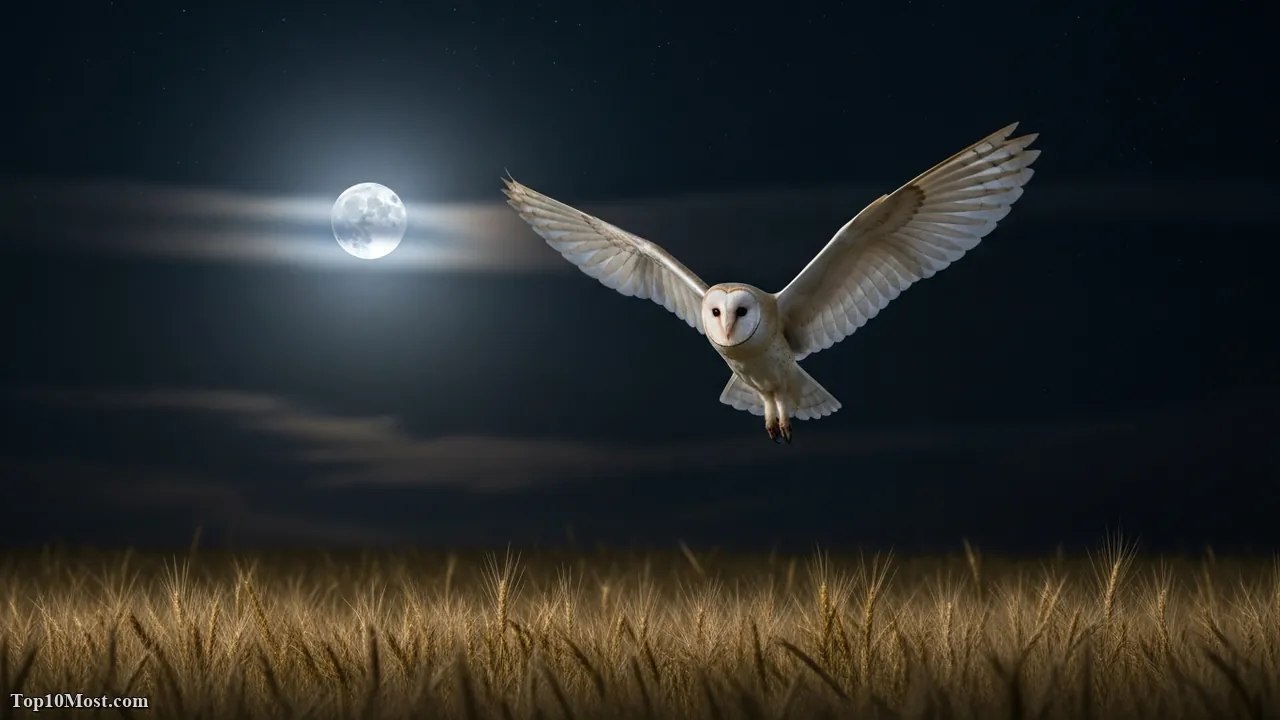
Visually, the Barn Owl is buoyant and waif-like. It has a low wing loading (large wings relative to its weight), which allows it to fly incredibly slowly without stalling. It can hover, bank, and dive with a softness that makes it appear weightless. The “grace” of a Barn Owl is eerie and supernatural; it is the grace of a creature that moves without interacting with the physics of sound, slipping through the night air without leaving a trace.
There is a profound beauty in this silence. While other birds announce their presence with the rush of wind, the Barn Owl is a study in subtraction. It removes the noise, the friction, and the effort, leaving only the pure image of flight. Watching a Barn Owl hunt in the moonlight is a haunting reminder that the most effective movements are often the ones that attract the least attention.
Key Highlights
- Silent Tech: Comb-like serrations on wing feathers disrupt air turbulence, eliminating the “swoosh” sound of flight.
- Low Speed: Can fly slower than almost any other predatory bird, allowing for precise scanning of the ground.
- Spectral Appearance: Their white underbellies and heart-shaped faces make them appear as glowing “ghosts” in low light.
Top 5. White Tern
Floating in the middle of our list is the ethereal White Tern, often called the “Fairy Tern” or “Angel Tern.” This small seabird is pure white with large, dark eyes and a black beak, creating a stark and beautiful contrast. Its flight style is uniquely fluttery and erratic, yet undeniably graceful. It does not soar like an albatross or dive like a falcon; instead, it seemingly dances in the air, changing direction with a flick of its wings that looks more like a butterfly than a bird.
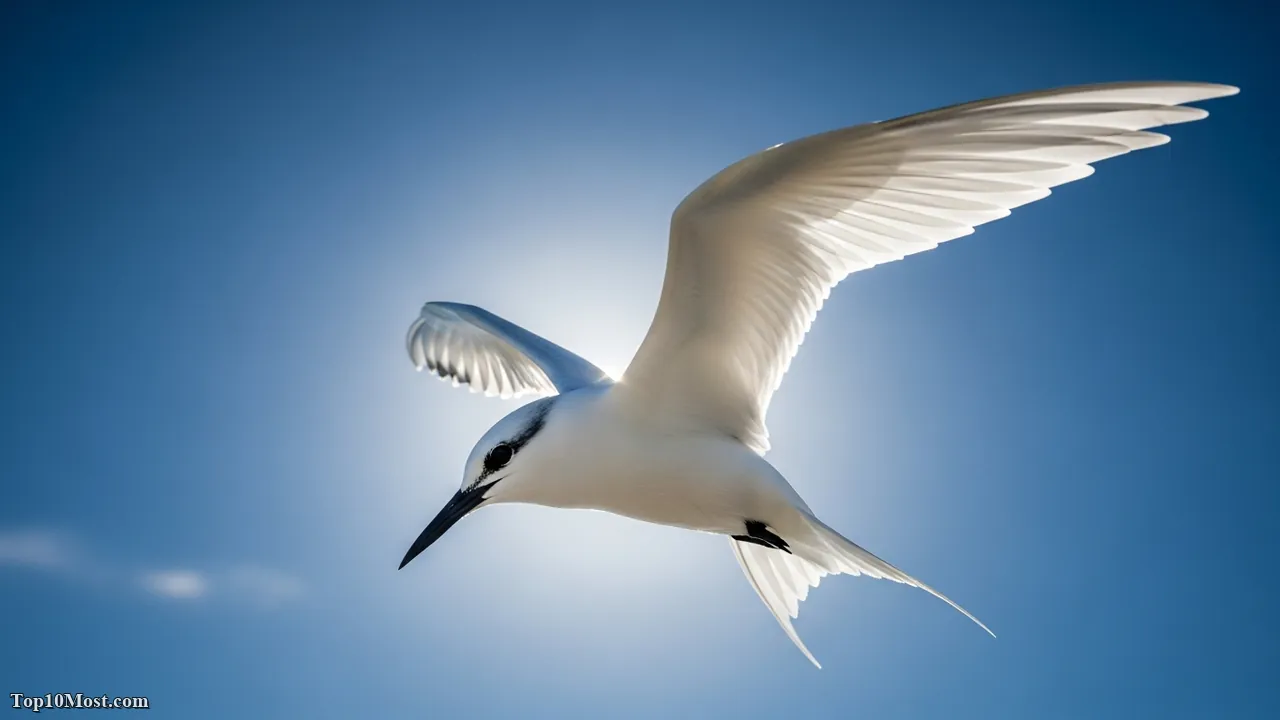
The White Tern’s grace is delicate and whimsical. Against the backdrop of the deep blue tropical Pacific, its translucent wings catch the sun, making the bird appear to glow. It is famous for its curiosity, often hovering just inches above the heads of sailors or visitors, investigating them with a gentle, fearless flutter. This lack of fear, combined with its fragility, gives it an aura of innocence and purity.
This bird proves that grace doesn’t always have to be powerful or aerodynamic in the traditional sense. Sometimes, grace is simply the ability to inhabit the air with lightness. The White Tern doesn’t fight the wind; it plays with it. It is a reminder of the softer side of nature, a creature that seems to have been designed purely for the joy of flight.
Key Highlights
- Translucent Wings: In bright sunlight, their pure white wings can appear almost transparent from below.
- Curious Hovering: Known for hovering motionlessly above humans, displaying their “angelic” form.
- Nestless Wonder: They balance their single egg on a bare branch without a nest, requiring gentle movements even when landing.
Top 4. Magnificent Frigatebird
The Magnificent Frigatebird is the pirate of the tropical skies, and its flight is the definition of “suspension.” With the largest wingspan-to-body-weight ratio of any bird, it is essentially a living kite. It can stay aloft for weeks, or even months, without ever touching land or water. It rides thermal currents with zero effort, often appearing completely motionless in the sky, a dark, angular silhouette cut against the clouds.
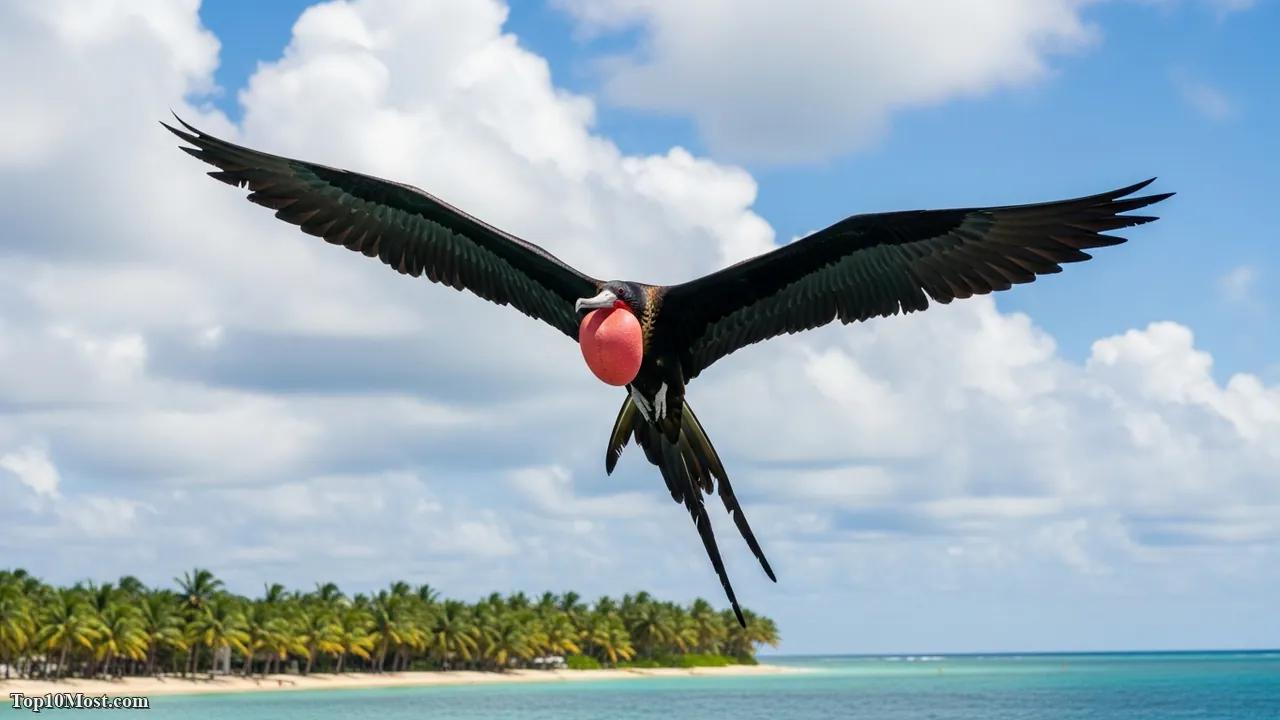
This bird’s grace is found in its mastery of static soaring. It rarely flaps. Flapping burns energy, and the Frigatebird is a master of conservation. It steers with a long, deeply forked scissor-tail that opens and closes to make minute adjustments. When it does move, it is with sudden, terrifying agility—swooping down to steal food from other birds or snatching flying fish from the air without wetting a feather (as their feathers are not waterproof).
The Magnificent Frigatebird represents “dominant grace.” It owns the sky not through constant motion, but through presence. It hangs in the air as if it belongs there more than it belongs on earth. It is a creature of the atmosphere, untethered from the ground, displaying a menacing but undeniably majestic elegance that commands respect from every other creature in its airspace.
Key Highlights
- Kleptoparasitism: Known for elegant but aggressive aerial chases to steal food from other birds (Boobies, Terns).
- Non-Stop Flight: Can stay airborne for up to two months by sleeping in 10-second bursts while soaring.
- Geometric Silhouette: Distinctive “W” shaped wings and deeply forked tail create a sharp, instantly recognizable profile.
Top 3. Wandering Albatross
Entering the top three, we encounter the Wandering Albatross, the undisputed master of “dynamic soaring.” With the largest wingspan of any living bird (reaching up to 3.5 meters), it is an engineering marvel. The Albatross locks its wings into place using a special tendon, allowing it to glide without using muscle energy. It swoops down into the wave troughs and arcs up into the wind, harvesting energy from the gradient of wind speeds above the ocean.
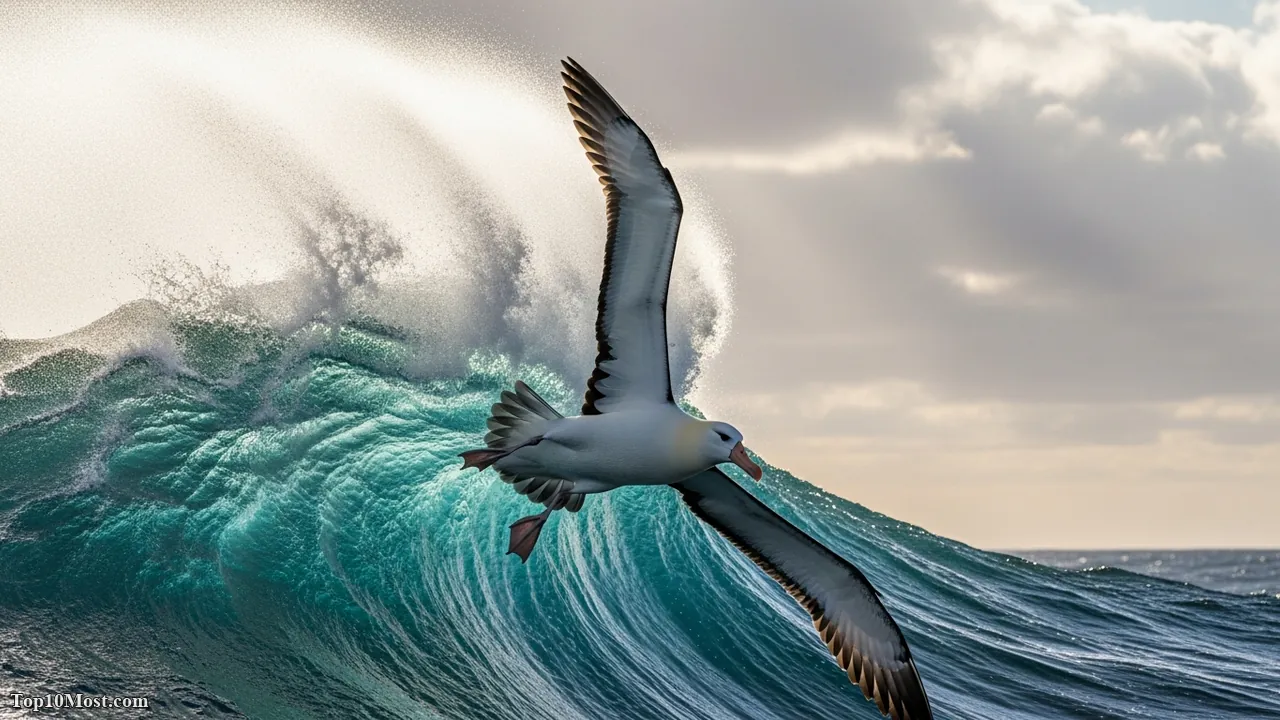
The grace of the Albatross is mathematical perfection. It can fly thousands of kilometers while consuming less energy than it would sitting on a nest. It is a “glider” in the truest sense, treating the turbulent Southern Ocean winds not as an obstacle, but as a fuel source. Watching an Albatross is like watching a roller coaster that never stops; it traces immense, invisible loops in the sky with a fluidity that seems to defy gravity.
This is a solemn, lonely grace. These birds spend most of their lives alone over the vast, empty ocean. Their flight is a symbol of absolute freedom and self-sufficiency. They do not struggle. They do not flap frantically. They simply exist in harmony with the wildest forces of nature, turning the chaos of a gale into a serene, endless glide.
Key Highlights
- Shoulder Lock: A unique tendon allows them to lock their wings in the open position, gliding without muscle fatigue.
- Dynamic Soaring: A flight technique that extracts energy from wind shear, allowing flight at “no mechanical cost.”
- Oceanic Range: Individuals can circumnavigate the Southern Ocean three times in a single year.
Top 2. Red-billed Tropicbird
The runner-up is the Red-billed Tropicbird, a creature that combines aerodynamic skill with sheer aesthetic extravagance. Known to sailors as the “Boatswain Bird,” it is famous for the two incredibly long, white central tail streamers that trail behind it like ribbons. These streamers can be as long as the bird’s body, flowing fluidly in the wind and accentuating every turn and bank the bird makes.
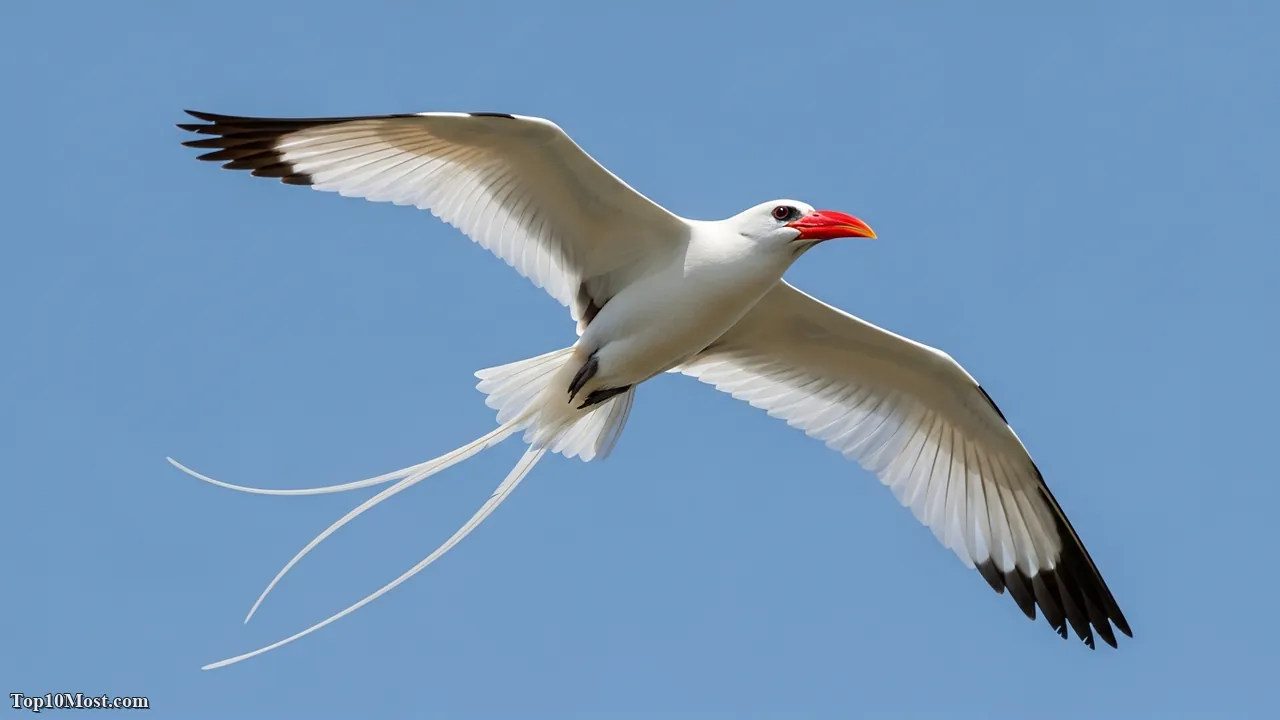
The grace of the Tropicbird is best seen during its courtship display. Pairs will fly in synchronized circles, often hundreds of feet in the air, with their long tails undulated in unison. They perform a maneuver where they fly backward or stall mid-air, drifting down together while their streamers draw calligraphy in the sky. The visual effect of the white satin plumage, the red beak, and the trailing ribbons against a blue sky is breathtaking.
While the Albatross is a marvel of efficiency, the Tropicbird is a marvel of beauty. The streamers serve no aerodynamic purpose; they are there purely for attraction, a handicap that the bird manages with effortless skill. This creates a visual spectacle that feels designed purely for the observer’s delight, making it one of the most photogenic and fluid movers in the animal kingdom.
Key Highlights
- Streamer Tails: Possesses two central tail feathers that can exceed the length of its body, trailing like ribbons.
- Aerial Courtship: Performs complex, synchronized flight displays where pairs fly in tandem, touching tails.
- Pelagic Beauty: Spends most of its life at sea, only coming to land to breed on remote cliffs.
Top 1. Swallow-tailed Kite
At the absolute pinnacle of our list is the Swallow-tailed Kite, a bird that defines the very word “grace.” Found primarily in the wetlands of the southeastern Americas, this raptor is the supreme aerialist of the bird world. With a stark black-and-white plumage and a deeply forked tail that accounts for more than half its body length, it does not just fly—it paints the air. It rarely flaps its wings, instead using its tail as a rudder to pivot, roll, and slide through the sky with zero perceptible effort.
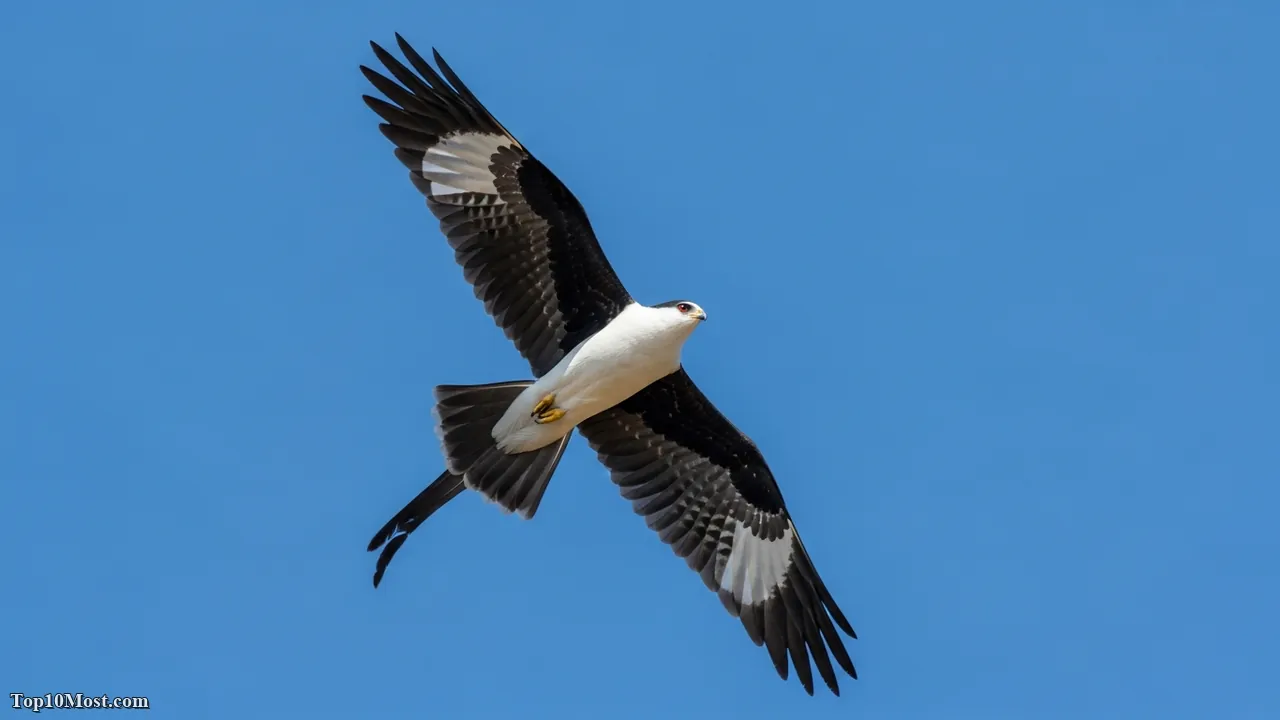
The Swallow-tailed Kite captures prey (often dragonflies or lizards) in flight, swooping down to snatch a meal off a leaf or out of the air without slowing down. It eats on the wing, soaring and circling while consuming its catch. Its maneuvers are so fluid they look like liquid; it can turn 90 degrees in a split second without a single wingbeat, simply by tilting its tail. The contrast of its crisp markings against the blue sky, combined with its silent, rolling flight, creates a mesmerizing display that birdwatchers consider unrivaled.
The Swallow-tailed Kite is number one because it combines the best elements of every other bird on this list: the maneuverability of the tern, the soaring capability of the frigatebird, and the aesthetic beauty of the tropicbird. It is a creature seemingly released from the bonds of gravity, turning the biological necessity of hunting into a ballet. It is, quite simply, the most graceful thing with feathers.
Key Highlights
- Tail Rudder: The deeply forked tail rotates and twists, allowing for impossible turns without wing flapping.
- Eating on the Wing: One of the few birds that regularly captures and consumes prey while flying, never needing to land to eat.
- Aerodynamic Perfection: Described by ornithologists as the most maneuverable and elegant of all birds of prey.
Conclusion
True grace is a rare intersection where form meets function so perfectly that the effort disappears. From the thunderous, rhythmic power of the Mute Swan to the silent, ghostly glide of the Barn Owl, nature has engineered flight in a myriad of ways. However, the Swallow-tailed Kite stands alone at the summit. It is not just a bird that flies; it is a creature that seems to be made of the air itself, manipulating the wind with a lazy, acrobatic ease that leaves human observers breathless. In a world obsessed with speed and power, these birds remind us of the enduring power of elegance.