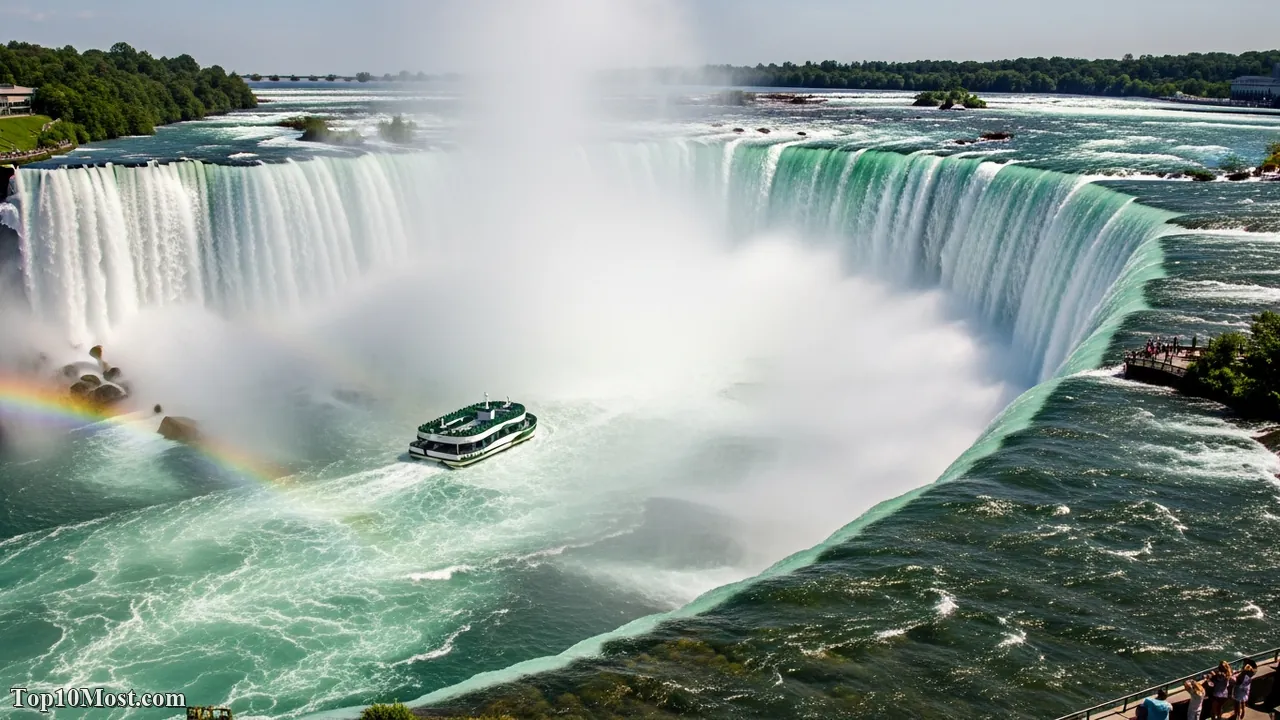
Culture is the shared heartbeat of humanity, yet it expresses itself in wildly different ways depending on where you stand on the map. At Top 10 Most, we believe that to understand a people, you must look at how they celebrate, mourn, and play. The traditions listed here are not just quirky anecdotes; they are profound expressions of history, belief, and community identity that have survived centuries of change.
The data in this article is compiled and analyzed based on information updated as of late 2025. While globalization often homogenizes our daily lives, these specific events stand as defiant, colorful reminders of our differences. From the orange-hued streets of Valencia to the lantern-lit skies of Northern Thailand, we have selected these traditions based on their cultural distinctiveness, historical longevity, and their sheer ability to awe an outside observer.
In this ranking, we look beyond the surface level of “strange” to find the “significant.” We have verified the dates, origins, and modern-day status of these events to ensure accuracy for the current time. Whether it involves leaping over infants to cleanse their souls or holding a banquet for thousands of macaques, each entry on this list represents a unique human solution to the universal questions of luck, faith, and joy.
Table of the Top 10 Most Unique Cultural Traditions
| Rank | Tradition | Location | Key Date / Timing | Primary Significance |
|---|---|---|---|---|
| 1 | El Colacho (Baby Jumping) | Castrillo de Murcia, Spain | June (Corpus Christi) | Cleansing original sin |
| 2 | Day of the Dead (Día de los Muertos) | Mexico (Nationwide) | November 1–2 | Reuniting with ancestors |
| 3 | Yi Peng Lantern Festival | Chiang Mai, Thailand | November (Full Moon) | Releasing bad luck/merit |
| 4 | Cooper’s Hill Cheese Rolling | Gloucestershire, UK | Late May (Spring Bank Holiday) | Celebrating spring/tradition |
| 5 | La Tomatina | Buñol, Spain | Last Wednesday of August | Community joy & letting go |
| 6 | Krampusnacht | Austria / Alpine Europe | December 5 | Balancing good (St. Nick) & bad |
| 7 | Holi | India / Nepal | March (Full Moon) | Triumph of good over evil |
| 8 | Monkey Buffet Festival | Lopburi, Thailand | Last Sunday of November | Honoring macaque “descendants” |
| 9 | Wife Carrying Championship | Sonkajärvi, Finland | July | Sport, humor & local history |
| 10 | Boryeong Mud Festival | Boryeong, South Korea | July | Health, cosmetics & tourism |
Top 10. Boryeong Mud Festival (South Korea)
The Boryeong Mud Festival stands as a fascinating case study of modern marketing evolving into genuine cultural heritage. Originally conceived in 1998 purely to promote the mineral-rich cosmetics produced from the local mud flats, this event has exploded into an international phenomenon. Taking place on Daecheon Beach, it transforms a quiet coastal area into a massive, gray playground where millions of visitors—both locals and international tourists—gleefully forego vanity to cake themselves in wet clay.
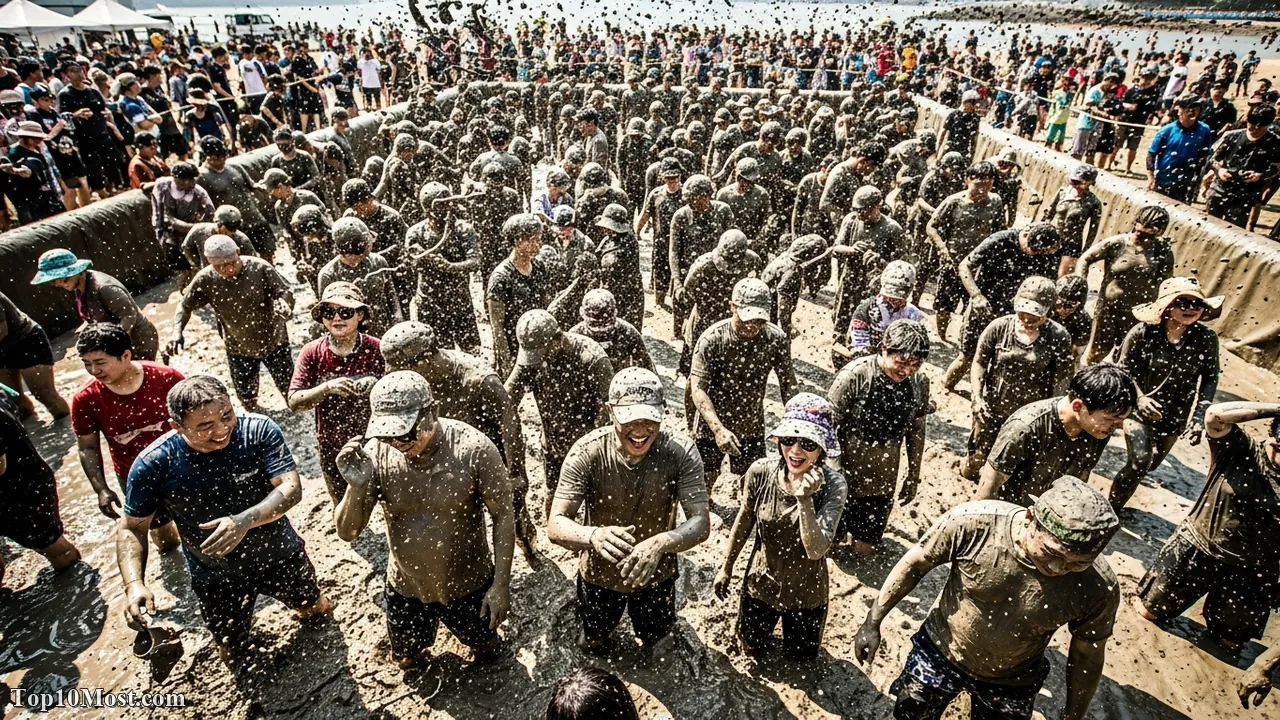
We rank this in the top 10 because it represents the modern evolution of tradition. While many festivals on this list are centuries old, Boryeong proves that culture is dynamic. It combines the ancient human love for “play” with health-conscious rituals. The mud is rich in germanium and bentonite, offering skin benefits, but the true draw is the “Mud Prison,” mud slides, and mud wrestling pits that break down social barriers. In a society often governed by strict hierarchy and etiquette, the mud serves as a great equalizer; everyone looks the same when covered in gray earth.
Reflecting on this, there is something incredibly liberating about the messiness of Boryeong. In an era of curated social media feeds and pristine appearances, this festival invites you to get physically dirty in a communal setting. It is a reminder that at our core, humans are tactile creatures who find joy in the simplest, earthiest elements of life.
Key Highlights
- Origin: Started in 1998 to market cosmetics; now attracts millions annually.
- Health Benefit: The mud is scientifically verified to be rich in minerals beneficial for the skin.
- The Experience: Features a “Mud Prison,” giant slides, and K-Pop concerts in the evening.
Top 9. Wife Carrying Championship (Finland)
Deep in the forests of Sonkajärvi, Finland, lies one of the world’s most physically demanding and humorously bizarre sporting traditions: Eukonkanto, or Wife Carrying. The premise is simple yet grueling: male competitors race through a 253.5-meter obstacle course—featuring sand, grass, and a deep water pool—while carrying a female teammate. The “wife” does not actually need to be the carrier’s spouse, but she must be over 17 years old and weigh at least 49 kilograms.
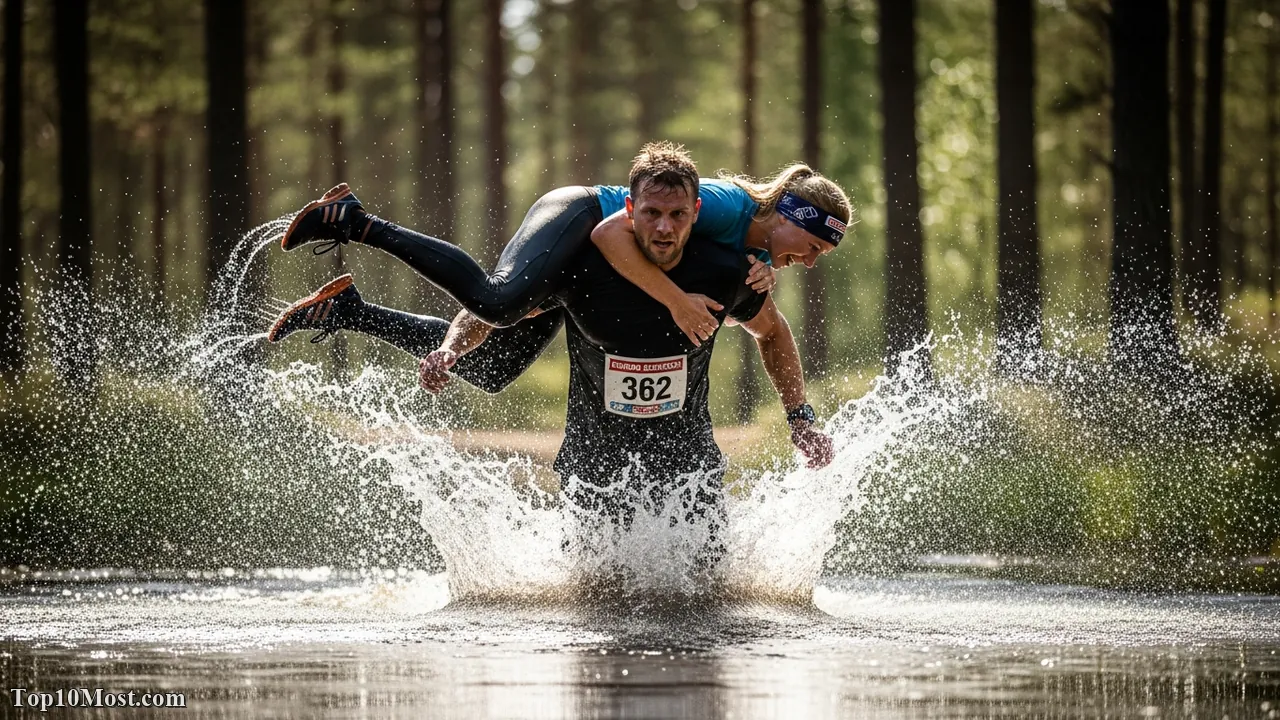
We include this tradition for its unique blend of athleticism and folklore. The legend traces back to a 19th-century brigand named Ronkainen the Robber, whose gang members had to prove their worth by carrying heavy sacks (or, allegedly, stolen women) on their backs. Today, the event is less about pillaging and more about technique; the “Estonian Carry” (where the woman hangs upside down with her legs around the man’s neck) has become the gold standard for winning. It is a serious sport played with a wink and a smile.
What makes this truly memorable is the prize: the winner receives the wife’s weight in beer. It captures the dry, self-effacing Finnish sense of humor perfectly. It is a celebration of partnership and endurance, turning a rugged historical legend into a lighthearted global competition that reminds us not to take life—or sports—too seriously.
Key Highlights
- Technique: The “Estonian Carry” is the most popular and efficient method used by champions.
- The Prize: The winning couple receives the “wife’s” body weight in beer.
- Historical Roots: Based on the legend of the 19th-century bandit Ronkainen the Robber.
Top 8. Monkey Buffet Festival (Thailand)
In the ancient city of Lopburi, north of Bangkok, the line between human civilization and nature is blurred by thousands of long-tailed macaques. On the last Sunday of November, the locals do not chase these pests away; instead, they set the table for them. The Monkey Buffet Festival involves laying out literal tons of fruits, vegetables, sticky rice, and colorful desserts in front of the Phra Prang Sam Yot temple, specifically for the monkeys to devour.
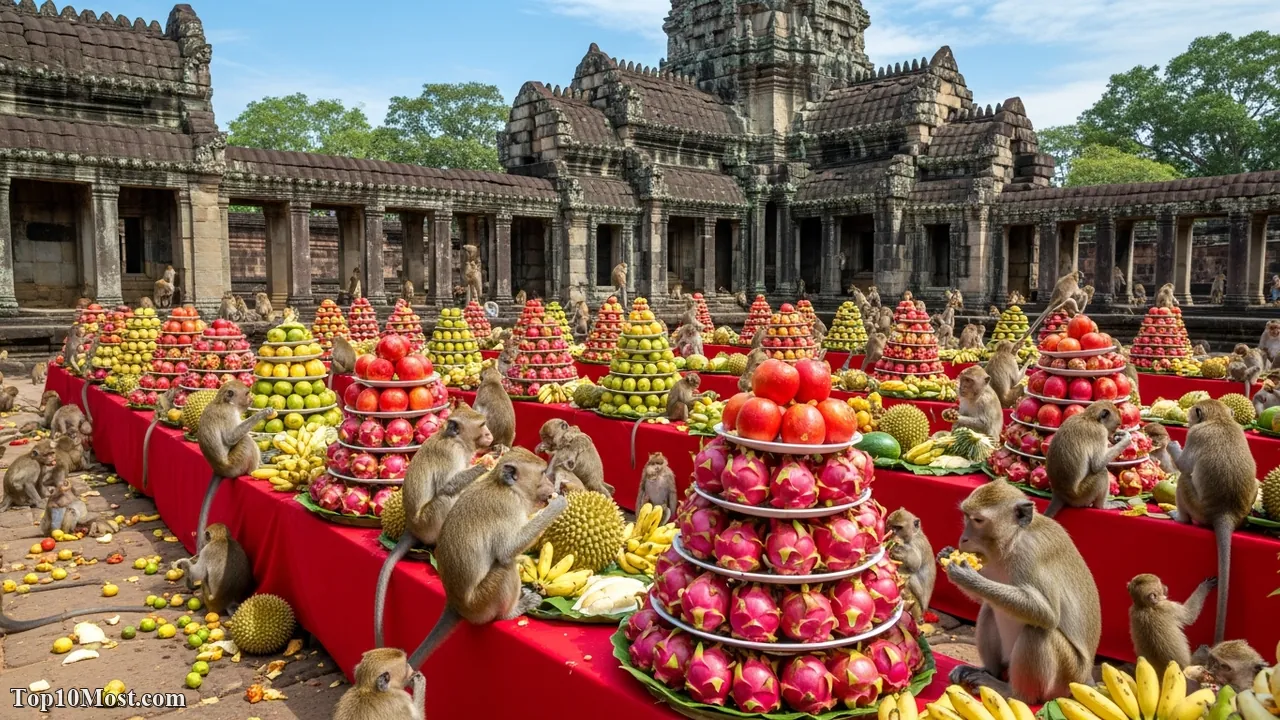
This tradition earns its spot because it is a striking example of religious devotion manifesting as ecological coexistence. The monkeys are respected as descendants of Hanuman, the monkey deity who helped Lord Rama in the Ramayana epic. Feeding them is considered an act of “merit-making” that brings good luck to the town. It is a surreal spectacle: tourists watch as hundreds of monkeys screech, jump, and gorge themselves on five-star catering, creating a chaotic, joyful mess.
There is a humbling perspective here regarding our relationship with animals. In most cities, wildlife is controlled or hidden; in Lopburi, it is the guest of honor. The festival forces us to acknowledge that we share our urban spaces with other living beings, and once a year, we step back to let them feast, acknowledging their spiritual guardianship over the land.
Key Highlights
- The Menu: Over 4,000 kilograms of fruit, vegetables, and desserts are served.
- Cultural Link: The monkeys are revered as soldiers of the Hindu god Hanuman.
- Visuals: The feast takes place among 10th-century Khmer ruins, creating a stunning backdrop.
Top 7. Holi (India & Nepal)
Few traditions have captured the global imagination like Holi, the Hindu “Festival of Colors.” Celebrated at the arrival of spring, this ancient festival signifies the triumph of good over evil, anchored in the legend of Prahlad and the burning of the demoness Holika. For one day (and the night before), social norms in India are suspended. People of all castes, ages, and backgrounds take to the streets to douse each other in colored powders (gulal) and water.
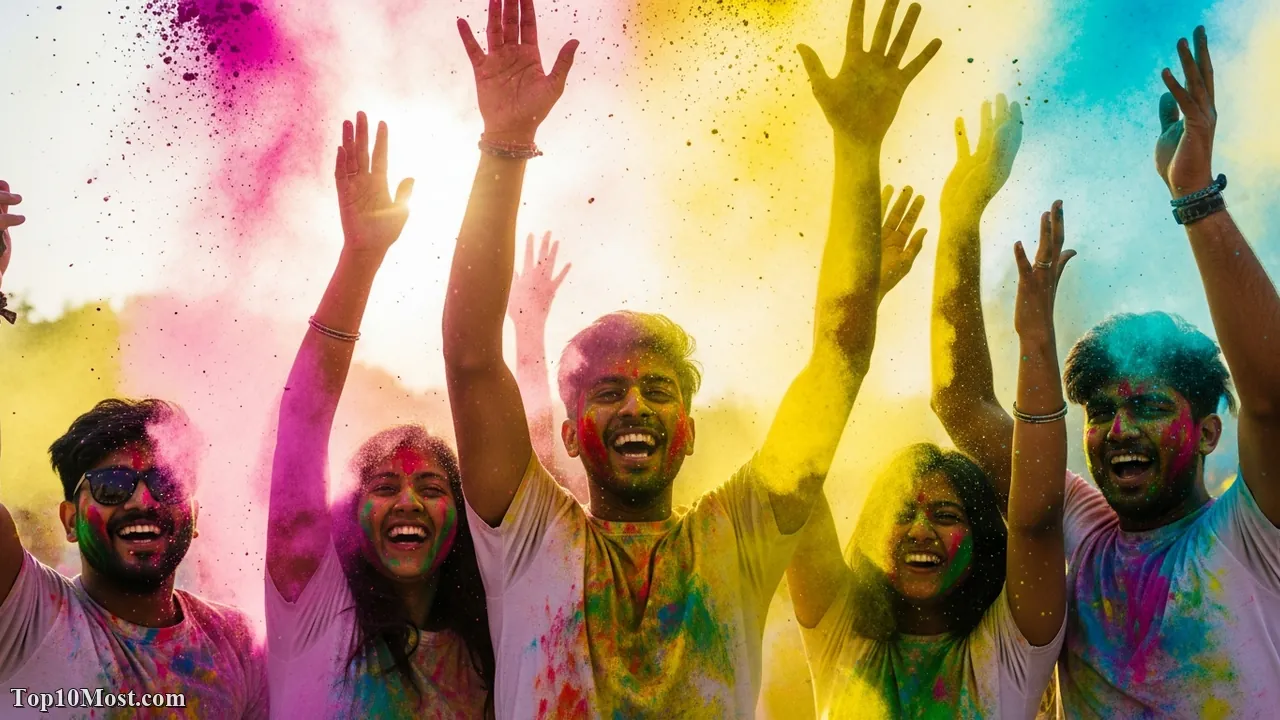
Holi is on this list because of its profound social alchemy. In a society historically stratified by caste and rigid social etiquette, Holi acts as a “pressure valve.” Under the layers of pink, green, and yellow dust, identities are temporarily erased, and enemies become friends. The vibrancy of the visual spectacle is unmatched anywhere on Earth—clouds of pigment filling the air, turning entire cities into living impressionist paintings.
The emotional resonance of Holi lies in its pure, unadulterated exuberance. It is a permission slip to be playful, to touch and be touched by community, and to welcome the season of life (spring) with chaotic joy. It teaches us that life should not just be lived in black and white, but celebrated in every available hue.
Key Highlights
- Symbolism: Represents the victory of Lord Vishnu’s devotee Prahlad over the demoness Holika.
- Social Impact: Acts as a leveling field where caste and status distinctions are temporarily ignored.
- Substance: The colored powders, or gulal, were traditionally made from medicinal herbs like turmeric and neem.
Top 6. Krampusnacht (Austria / Alpine Europe)
While much of the world awaits the jolly, gift-giving Santa Claus, the Alpine regions of Austria, Germany, and Slovenia prepare for his terrifying counterpart: Krampus. On the night of December 5th (Krampusnacht), men dress as hairy, horned, demonic goat-beasts, storming through the streets rattling rusty chains and ringing cowbells. Unlike the benign coal in a stocking, Krampus physically swats “naughty” passersby with bundles of birch branches.
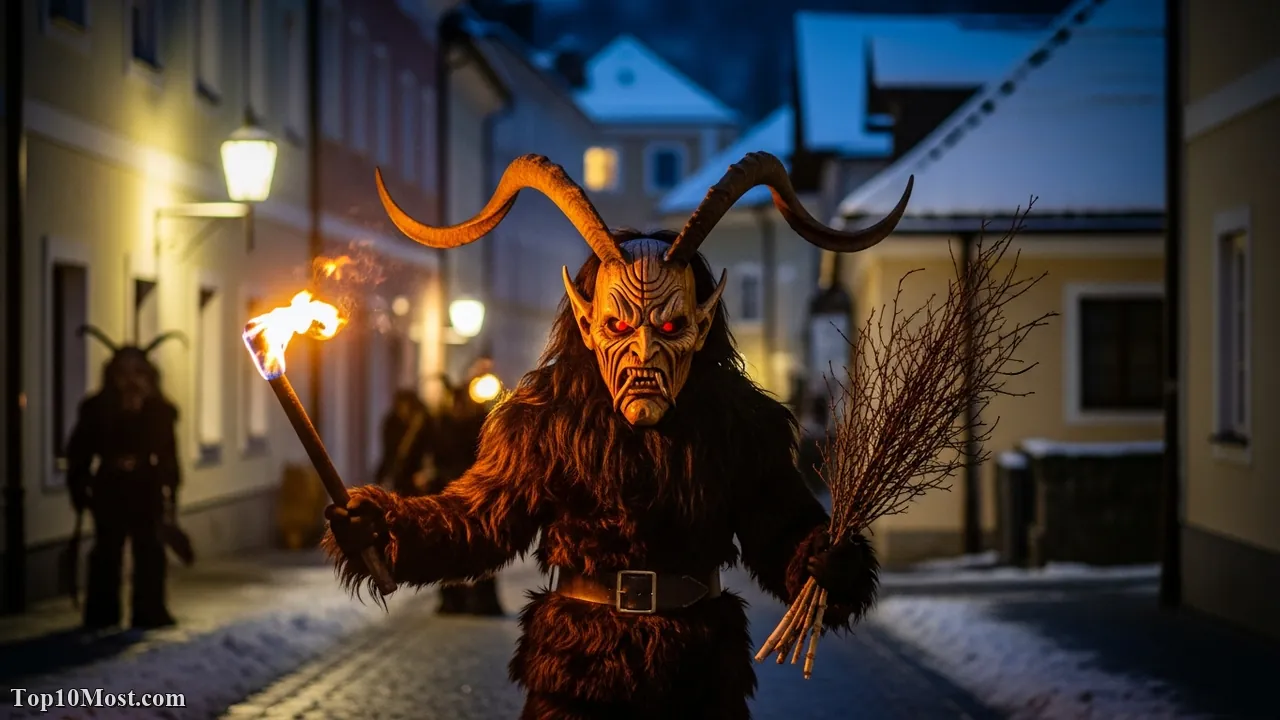
This tradition is a powerful inclusion because it preserves the “shadow side” of folklore that modern commercialism tries to sanitize. Krampus is not a villain; he is a necessary balance to Saint Nicholas. The tradition acknowledges that light cannot exist without darkness, and reward means nothing without the threat of punishment. The costumes are often hand-carved masterpieces of wood and sheepskin, representing a serious commitment to Alpine heritage.
Witnessing a Krampuslauf (Krampus run) is a visceral experience. The fear it induces—even in adults—is primal. It connects us to pre-Christian winter solstice fears, reminding us of the cold, dark, and wild nature of winter that our ancestors respected and feared. It is a thrilling, adrenaline-fueled antidote to the saccharine sweetness of modern Christmas.
Key Highlights
- The Date: Occurs the night before the Feast of St. Nicholas (December 6).
- The Costume: Participants wear elaborate wooden masks and heavy fur suits, often weighing over 20kg.
- Philosophy: Represents the duality of discipline and reward in child-rearing folklore.
Top 5. La Tomatina (Spain)
In the small Valencian town of Buñol, the world’s largest food fight turns the streets red every August. La Tomatina attracts tens of thousands of participants who hurl over 100 metric tons of overripe tomatoes at one another. Unlike many traditions on this list, La Tomatina has no ancient religious or pagan significance; it started innocuously in 1945 during a parade disturbance and simply… stuck.
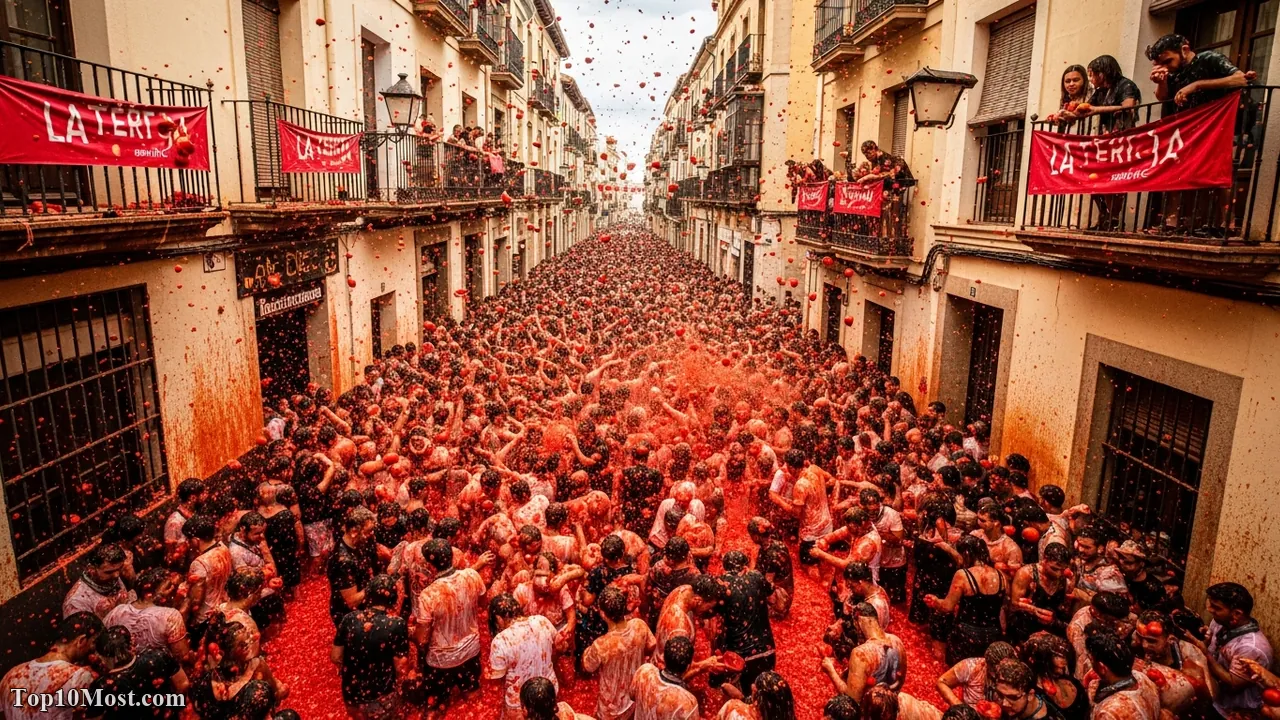
We rank La Tomatina highly because it represents the pure human need for catharsis. There is no deeper moral lesson here, no honoring of ancestors—just one hour of absolute, unbridled chaos. The city council trucks in tomatoes that are unfit for consumption, and for sixty minutes, the town becomes a slippery, acidic mosh pit of laughter and pulp. Fire trucks then hose down the streets (which end up cleaner than before due to the tomato acid).
The beauty of La Tomatina is its absurdity. In a serious world filled with rules and regulations, 20,000 people gathering to throw vegetables at strangers is a rebellious, joyful act. It reminds us that tradition doesn’t always have to be solemn; sometimes, the best way to bond with fellow humans is to engage in harmless, messy conflict.
Key Highlights
- Rules: Tomatoes must be squashed before throwing to avoid injury.
- Duration: The actual fight lasts exactly one hour, signaled by firing cannons.
- Aftermath: The citric acid in the tomatoes actually cleans the cobblestone streets of the town.
Top 4. Cooper’s Hill Cheese Rolling (UK)
Gloucestershire’s Cooper’s Hill is steep, uneven, and frankly, dangerous. Yet, every Spring Bank Holiday, dozens of racers hurl themselves down this 200-yard precipice chasing an 8-pound wheel of Double Gloucester cheese. The cheese can reach speeds of 70 mph, and the humans tumbling after it often suffer broken bones, concussions, and sprains. The first person to the bottom wins the cheese.
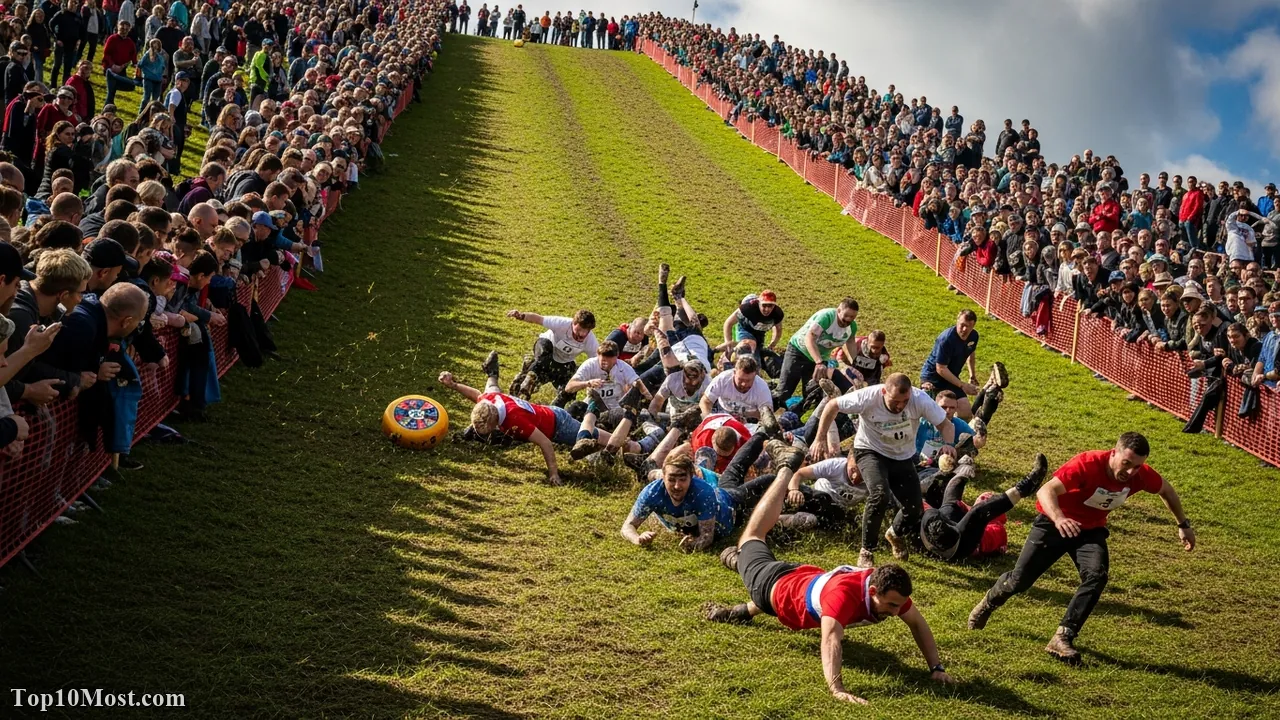
This event secures a top spot for its sheer tenacity and distinct “Britishness.” It is a tradition that defies health and safety regulations, surviving attempts by local authorities to ban it. It speaks to a quirky kind of bravery and a refusal to let modern risk-aversion kill ancient spirit. The origins are debated—some say it’s a pagan fertility rite, others say it was about maintaining grazing rights—but today, it is about glory and gravity.
Watching the Cheese Rolling is to watch human determination in its most raw, ungraceful form. There is no technique to falling down a near-vertical hill; you just surrender to the momentum. It is a hilariously violent reminder of how far people will go for a sense of community, tradition, and a round of dairy.
Key Highlights
- The Cheese: A 7-9 lb round of Double Gloucester, traditionally made by local cheesemaker Diana Smart.
- Danger: St. John Ambulance is always present; injuries are virtually guaranteed every year.
- Global Reach: Winners in recent years have come from all over the world, including the US and Japan.
Top 3. Yi Peng Lantern Festival (Thailand)
If you have ever seen an image of thousands of golden lanterns floating upward into a dark night sky, reflecting off a river below, you have seen Yi Peng. Celebrated in Northern Thailand (Lanna culture), particularly Chiang Mai, this festival coincides with Loy Krathong. While Loy Krathong involves floating baskets on water, Yi Peng involves releasing khom loi (sky lanterns) made of rice paper into the heavens.
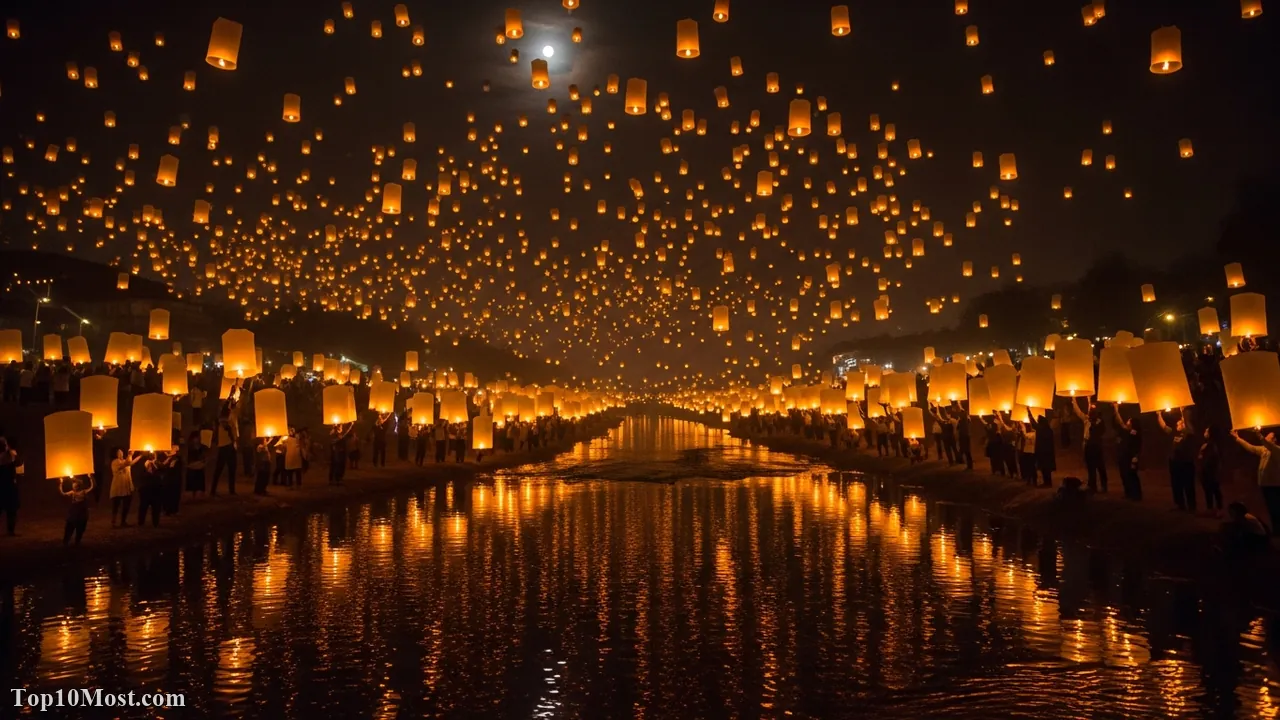
Yi Peng enters our top 3 for its unparalleled aesthetic beauty and spiritual weight. The act of releasing the lantern symbolizes letting go of all ills, misfortunes, and bad vibes from the previous year. As the lantern disappears into the darkness, it takes your worries with it. The visual magnitude of thousands of people performing this act simultaneously creates a moment of collective silence and awe that is difficult to describe.
This tradition resonates deeply because it is a physical manifestation of hope. It is a quiet, contemplative counterpart to the loud parties found elsewhere. Watching your light join thousands of others in a river of stars offers a profound sense of connection—a visual proof that individual prayers can create a collective masterpiece.
Key Highlights
- Timing: Coincides with the full moon of the 12th lunar month (usually November).
- Symbolism: An act of venerating the Buddha and releasing personal suffering (dukkha).
- Sustainability: Recent years have seen a push for biodegradable lanterns to protect the local environment.
Top 2. Day of the Dead (Mexico)
Día de los Muertos is perhaps the most misunderstood tradition by outsiders, often confused with a “Mexican Halloween.” It is, in fact, the opposite. It is not about fear; it is about love. On November 1st and 2nd, families across Mexico build colorful ofrendas (altars) laden with marigolds, photos, sugar skulls, and the favorite foods of the departed, believing that the veil between the living and the dead is thin enough for souls to visit.
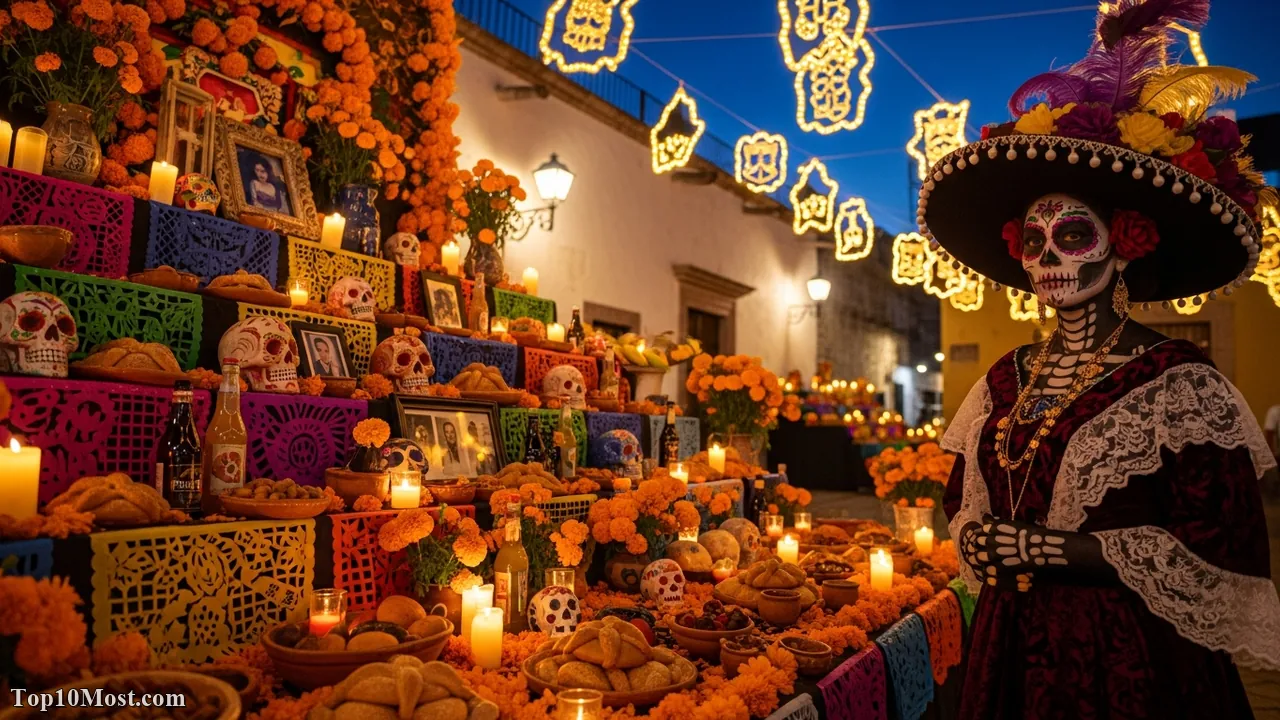
We place this at number 2 because of its healthy, vibrant relationship with mortality. Western culture often hides death, mourning in black and silence. Mexico mocks death, eats with it, and celebrates it with music and color. The tradition, recognized by UNESCO, blends indigenous Aztec rituals with Catholicism, resulting in a celebration that asserts that the dead are not truly gone as long as they are remembered.
The emotional intelligence of this tradition is staggering. It provides a dedicated time and space to grieve actively and joyfully. It teaches us that grief does not have to be a burden; it can be a party hosted in honor of those we loved. It transforms the graveyard from a place of spookiness into a place of warmth and reunion.
Key Highlights
- UNESCO Status: Recognized as an Intangible Cultural Heritage of Humanity.
- Key Symbols: Cempasúchil (marigold flowers) guide the spirits with their scent and color.
- La Catrina: The elegant skeleton figure, popularized by José Guadalupe Posada, satirizes upper-class vanity.
Top 1. El Colacho (Baby Jumping – Spain)
At the very top of our list is a tradition so unique, so visually arresting, and so perplexing to the modern eye that it stands alone: El Colacho. Since 1620, in the village of Castrillo de Murcia, men dressed as red and yellow devils (Colachos) run through the streets whipping onlookers, before culminating in the main event: leaping over mattresses laid in the street, each occupied by babies born in the previous year.
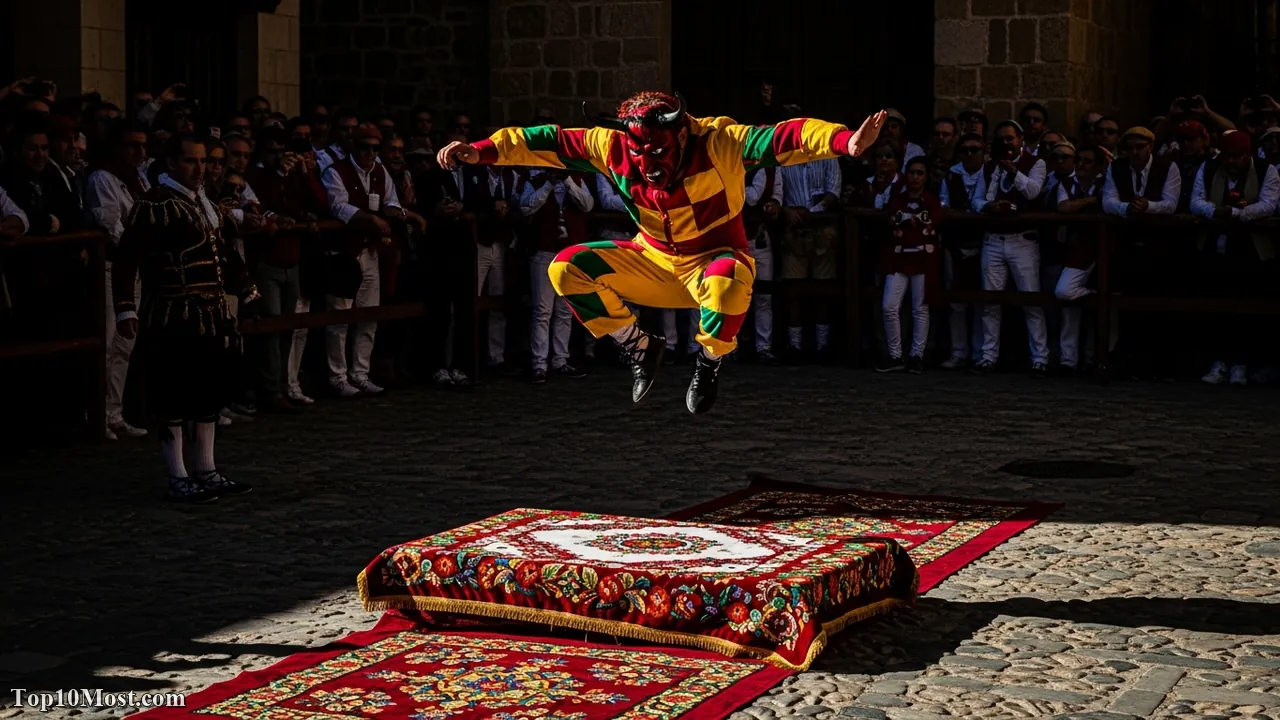
Why is this number 1? Because it perfectly encapsulates the definition of a “unique cultural tradition.” It combines high stakes (jumping over actual infants), religious doctrine (cleansing original sin), and theatrical folklore in a way that exists nowhere else. While the Catholic hierarchy has at times distanced itself from the ritual, the locals fiercely protect it. It is believed that the devil absorbs the sins of the babies as he flies over them, ensuring them a life of health and protection.
There is a breath-holding tension when the Colacho runs toward the mattress, followed by the relief and cheers of the crowd. It is a visceral, heart-stopping act of faith. In a world of safety rails and liability waivers, El Colacho is a defiant, living relic of a time when community belief was strong enough to trust a masked man to jump over your newborn child for the sake of their soul. It is the ultimate testament to the power of tradition.
Key Highlights
- History: Continuous practice since 1620, taking place during the feast of Corpus Christi.
- Safety Record: Despite the terrifying premise, there are no reported injuries to babies in the festival’s history.
- The Ritual: The jump represents the triumph of good over evil, with the babies being blessed by the sacrament immediately after.
Conclusion
These 10 traditions serve as a powerful reminder that there is no single “correct” way to be human. Whether we are scrubbing mud off our skin in South Korea, dodging tomatoes in Spain, or lighting candles for our ancestors in Mexico, we are all engaging in the same fundamental pursuit: connection.
At Top 10 Most, we see these rituals not as relics of the past, but as vital, living exercises in community. They force us to pause our digital lives and engage with the physical world in ways that are messy, dangerous, spiritual, and beautiful. As we move further into late 2025 and beyond, the preservation of these unique cultural fingerprints becomes even more essential. They are the stories we tell ourselves about who we are, where we came from, and what we value most.